
Italy Airport Fuel Crisis Escalates: Venice, Bologna, and Brindisi Face Devastating Shortages as Middle East Conflict Disrupts Strait of Hormuz Supply Chain, Forcing Flight Groundings and Cancellations Across Europe
Italian airports including Venice Marco Polo, Bologna, and Brindisi face critical jet fuel shortages due to Middle East geopolitics disrupting Strait of Hormuz supplies. Flights grounded, delays expected until April 9.

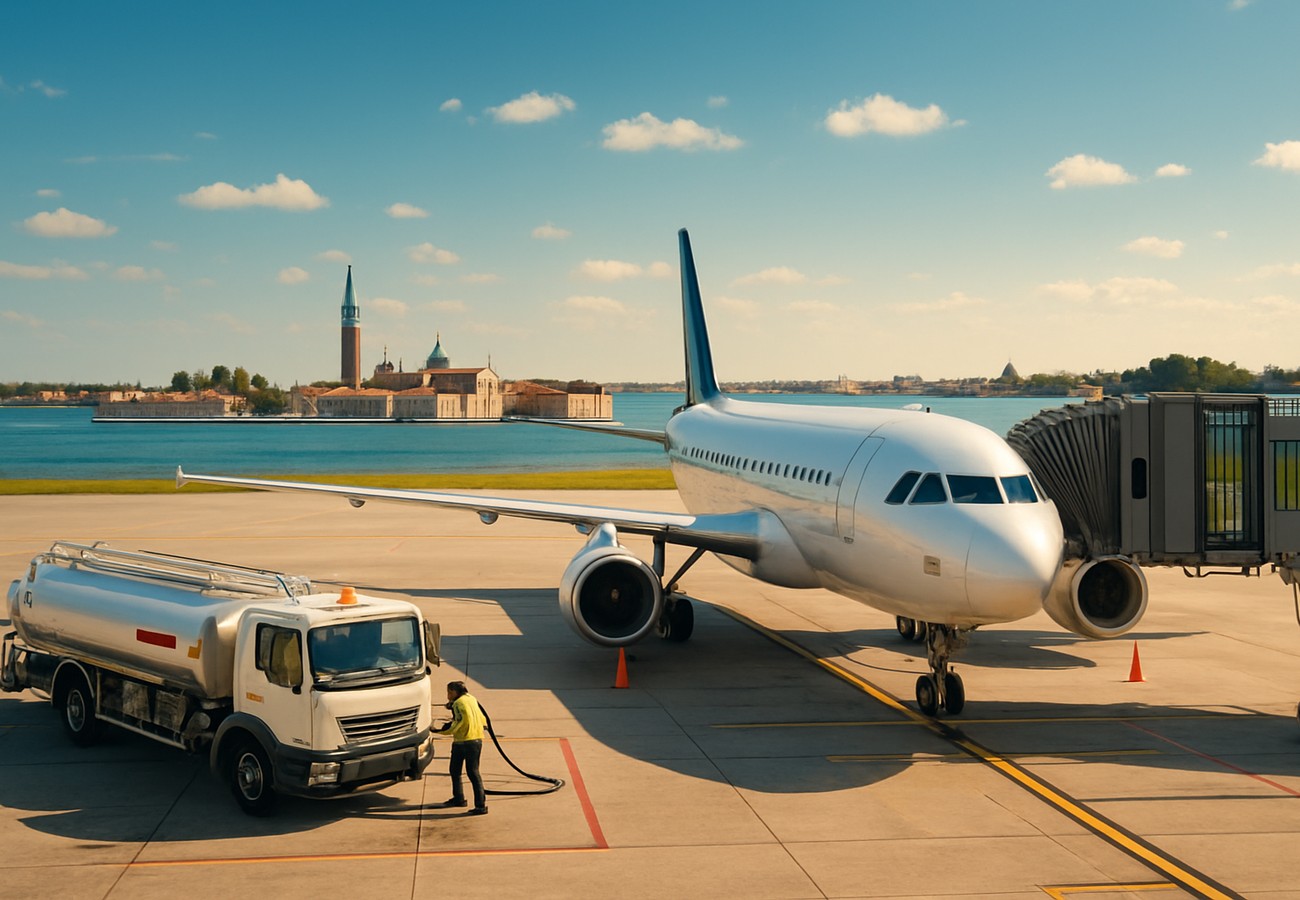
Image generated by AI
Quick Summary
- Italian airports (Venice, Bologna, Brindisi) face acute jet fuel shortages tied to Middle East conflict
- Brindisi Airport nearly depleted; only emergency, ambulance, and state flights permitted to refuel
- Fuel supply disruption stems from blocked shipping routes through Strait of Hormuz
- Short-haul flights (under 3 hours) facing cancellations until at least April 9, 2026
- European spillover: Heathrow, France, and Portugal airports also experiencing similar constraints
Italy's Airport Fuel Crisis: A Cascading Energy Emergency Threatens European Travel
ROME — A cascading fuel shortage stemming from geopolitical tensions in the Middle East has descended upon Italy's aviation infrastructure, grounding aircraft and forcing travel cancellations across one of Europe's most visited tourism destinations. As of April 23, 2026, major Italian airports—including the iconic Venice Marco Polo, Bologna's Guglielmo Marconi hub, and the southern gateway of Brindisi—are operating under severe fuel rationing protocols that prioritize emergency medical flights and government operations over commercial passenger services.
The crisis originated with deliberate disruptions to jet fuel shipments flowing through the Strait of Hormuz, a chokepoint responsible for routing approximately 21% of the world's traded petroleum. With regional conflict intensifying supply chain vulnerabilities, Italian aviation authorities have implemented emergency protocols that are reshaping flight schedules across the continent through at least mid-April.
Brindisi Airport: The Eye of the Storm
Brindisi International Airport in southern Italy has emerged as the epicenter of this fuel emergency. Operating at near-zero fuel reserves, the facility has essentially stopped accepting new commercial flight fuel. In an unprecedented move, aviation authorities have implemented a triage system distinguishing between essential and non-essential operations.
Current refueling restrictions at Brindisi include:
- ✓ Ambulance flights and medical evacuation operations (priority status)
- ✓ Government and state operations (essential functions)
- ✓ International long-haul flights exceeding 3 hours duration (strategic positioning)
- ✗ Domestic regional flights under 3 hours (deferred until supply stabilizes)
- ✗ Standard short-haul European connections (cancelled or rerouted)
Airlines operating from Brindisi are facing impossible choices: either completely restructure departure schedules or consolidate passengers onto fewer, fuel-efficient long-haul services. For regional carriers like Ryanair and Wizz Air—which depend on high-frequency, short-haul operations—this represents an existential operational constraint.
Contagion Effect: Bologna, Venice, and Beyond
The fuel shortage has metastasized beyond Brindisi to engulf Italy's central aviation network. Bologna's Guglielmo Marconi Airport, a critical European hub connecting Northern Italy to international markets, is facing identical rationing measures. Venice Marco Polo—the main gateway serving the historic Venetian Republic and northeastern Italy—is also implementing fuel quotas that threaten seasonal tourism operations during spring travel season.
Secondary airports have implemented even more severe restrictions:
| Airport | Location | Status |
|---|---|---|
| Reggio Calabria | Southern Calabria | Limited refueling capacity |
| Pescara | Central Adriatic coast | Single tanker with restricted volume |
| Milan Linate | Northern Italy hub | Operating under fuel quota system |
| Treviso | Venice region | At-risk for similar restrictions |
The convergence of shortages across multiple Italian airports signals a systemic supply chain failure rather than isolated logistical disruption. Aviation fuel distributors—particularly Air BP Italia, a subsidiary of energy giant BP—are contractually obligated to supply Italian carriers, yet inventory levels have collapsed to critical thresholds.
The Strait of Hormuz: Where Energy Flows and Empires Collide
The geopolitical catalyst for Italy's aviation emergency traces directly to the Strait of Hormuz, the narrow waterway separating Iran from Oman. This maritime passage handles approximately one-fifth of globally traded oil and—critically for European aviation—roughly one-quarter of refined jet fuel shipments destined for European refineries and distribution networks.
With Middle East tensions escalating into direct military confrontation, shipping insurance premiums have spiked, vessel routing has become unpredictable, and refineries have implemented precautionary supply reserves. The cascading effect: European jet fuel inventories have depleted faster than replenishment supplies can arrive through alternative maritime routes.
Italy, dependent on Mediterranean-based fuel imports and lacking substantial domestic refining capacity, has proven particularly vulnerable to these supply chain disruptions. Unlike larger EU nations with strategic petroleum reserves and multiple refinery networks, Italy's aviation fuel supply depends almost entirely on imported inventory managed by commercial distributors operating on just-in-time supply principles.
Government Response: Diplomatic Fuel Diplomacy
Recognizing the political and economic stakes, Italian Prime Minister Giorgia Meloni has activated personal diplomatic engagement with Gulf state energy producers. Her mission has focused on securing preferential access to additional fuel supplies and negotiating longer-term energy partnerships insulated from Strait of Hormuz route dependencies.
Meloni's intervention signals recognition that this crisis transcends routine logistical challenges—it represents a strategic vulnerability in European energy security architecture. By establishing direct government-to-government fuel agreements, Italy aims to establish an alternative supply pathway circumventing traditional commercial distribution channels.
The Italian government has also coordinated with aviation authorities to implement the priority hierarchy favoring long-haul flights (which consume fuel more efficiently per passenger) and emergency operations, effectively rationing supply until alternative sources materialize.
The European Cascade: A Continental Crisis in Formation
Italy's fuel shortage foreshadows similar constraints rippling across European aviation infrastructure. London Heathrow, Europe's busiest international airport, has already reported flight disruptions linked to upstream fuel supply tightness. Aviation authorities in France and Portugal have issued alerts preparing for potential fuel supply constraints in the coming weeks.
The European aviation industry—already grappling with post-pandemic recovery complications, labor disputes, and airspace congestion—faces a new systemic pressure: energy scarcity. Airlines that have avoided the worst impacts so far are beginning contingency planning for potential fuel rationing protocols.
This continental energy vulnerability underscores a fundamental risk in modern aviation: the dependency chain linking geopolitical stability, maritime security, energy infrastructure, and flight operations. A disruption at any link cascades across the entire system.
What This Means for Travelers: Planning in Uncertain Times
If you're booked on flights departing from Italian airports through mid-April:
- Contact your airline immediately for schedule confirmation; assume short-haul flights under 3 hours may be cancelled or consolidated
- Monitor official airport announcements at Venice (SAVE), Bologna (BLQ), and Brindisi (BDS) for daily operational updates
- Book return flights conservatively with extra buffer time—connecting flights may face extended delays
- Document all delays for EU261 compensation eligibility; fuel shortages may qualify as "extraordinary circumstances," but legal disputes are likely
- Consider alternative airports: Milan Malpensa, Rome Fiumicino, or southern European hubs may offer routing flexibility
For connection planning:
- International long-haul flights (London, New York, Middle East, Asia) maintain priority and are less likely to cancel
- Domestic and intra-European short-haul flights face the highest disruption probability
- Business travelers should consider rerouting via northern European hubs (Munich, Frankfurt, Vienna) if Italian departure points become unreliable
Timeline and Expected Resolution
Aviation authorities project that fuel supply conditions may stabilize by approximately April 9, 2026—roughly two weeks from the crisis onset. This projection depends on:
- Successful fuel shipments navigating the Strait of Hormuz and reaching Mediterranean ports
- Prime Minister Meloni's Gulf state negotiations delivering supplemental fuel imports
- De-escalation of Middle East regional tensions reducing maritime security concerns
- Refineries in Southern Europe ramping production of aviation fuel
However, these variables remain uncertain. Geopolitical situations are volatile, diplomatic negotiations frequently extend beyond initial timelines, and energy markets react unpredictably to supply shocks.
Most likely scenario: Partial improvements by April 9 with complete normalization delayed until late April or early May. During this transition period, expect elevated flight cancellations, higher fares on available flights, and increased passenger frustration across Italian aviation.
Conclusion: Italian Aviation at an Energy Crossroads
Italy's airport fuel crisis represents more than a temporary operational disruption—it exposes structural vulnerabilities in how modern European aviation depends on global energy supply chains and geopolitical stability. The shortages at Venice, Bologna, and Brindisi, while localized in geography, carry broader implications for continental travel reliability.
For travelers, this moment demands vigilance and flexibility. For policymakers, it signals urgent need to develop energy supply resilience and reduce dependency on single maritime chokepoints. For the aviation industry, it confirms that energy security and flight operations are inextricably linked in an era of geopolitical volatility.
Prime Minister Meloni's diplomatic engagement with Gulf energy producers offers a near-term pathway forward, but the underlying systemic vulnerabilities will require structural solutions extending far beyond April 2026.
Frequently Asked Questions
Will my flight be cancelled if I'm traveling from Italian airports in the next two weeks? Short-haul flights (under 3 hours) face the highest cancellation risk. Long-haul international flights are prioritized and more likely to operate. Contact your airline for confirmation rather than assuming cancellation.
What is EU261 compensation if my flight is cancelled due to fuel shortages? EU261 entitles passengers to €250-€600 compensation depending on flight distance. However, airlines may argue fuel shortages qualify as "extraordinary circumstances" exempt from compensation. Legal disputes are likely; document everything.
Are alternative Mediterranean airports operating normally? Yes, airports including Rome Fiumicino, Milan Malpensa, Naples Capodichino, and southern Spanish/French airports maintain normal operations. Consider rerouting via these hubs if Italian connections become unreliable.
When will the fuel shortage end? Aviation authorities project stabilization by April 9, 2026, but this depends on geopolitical de-escalation and successful fuel shipments. Complete normalization may extend into late April or early May.
How is this affecting ticket prices? Available flights are commanding premium fares due to reduced flight frequency and increased demand. Some routes are experiencing 40-60% price increases for next-available flights.
Which airlines are most impacted? Budget carriers like Ryanair and Wizz Air face the highest operational constraints due to their short-haul network dependency. Full-service airlines with long-haul capacity are coping better with the rationing hierarchy.
Disclaimer
This article is for informational and educational purposes only. It does not constitute legal, financial, or professional advice. While we strive to provide accurate and up-to-date information, travel policies, regulations, and conditions change rapidly. Always verify information with official sources before making travel decisions. Nomad Lawyer makes no representations about the accuracy, reliability, completeness, or suitability of the information provided. Readers should consult qualified professionals for advice specific to their circumstances. The views expressed in this article are those of the author and do not necessarily reflect the views of Nomad Lawyer.
Kunal K Choudhary
Co-Founder & Contributor
A passionate traveller and tech enthusiast. Kunal contributes to the vision and growth of Nomad Lawyer, bringing fresh perspectives and driving the community forward.
Learn more about our team →