
Riyadh Air Launches Transformative Global Route Network: Saudi Arabia Expands International Flight Services to UK, Spain, Egypt, Jordan, India, Thailand, and Beyond—Reshaping Middle Eastern Aviation and Fueling Regional Tourism Growth Under Vision 2030
Riyadh Air announces major international expansion with new routes to London, Madrid, Cairo, Amman, Mumbai, Delhi, Bangkok, and key global destinations. Saudi Arabia's PIF-backed airline aims to position kingdom as central aviation hub while driving tourism growth aligned with Vision 2030 economic diversification.

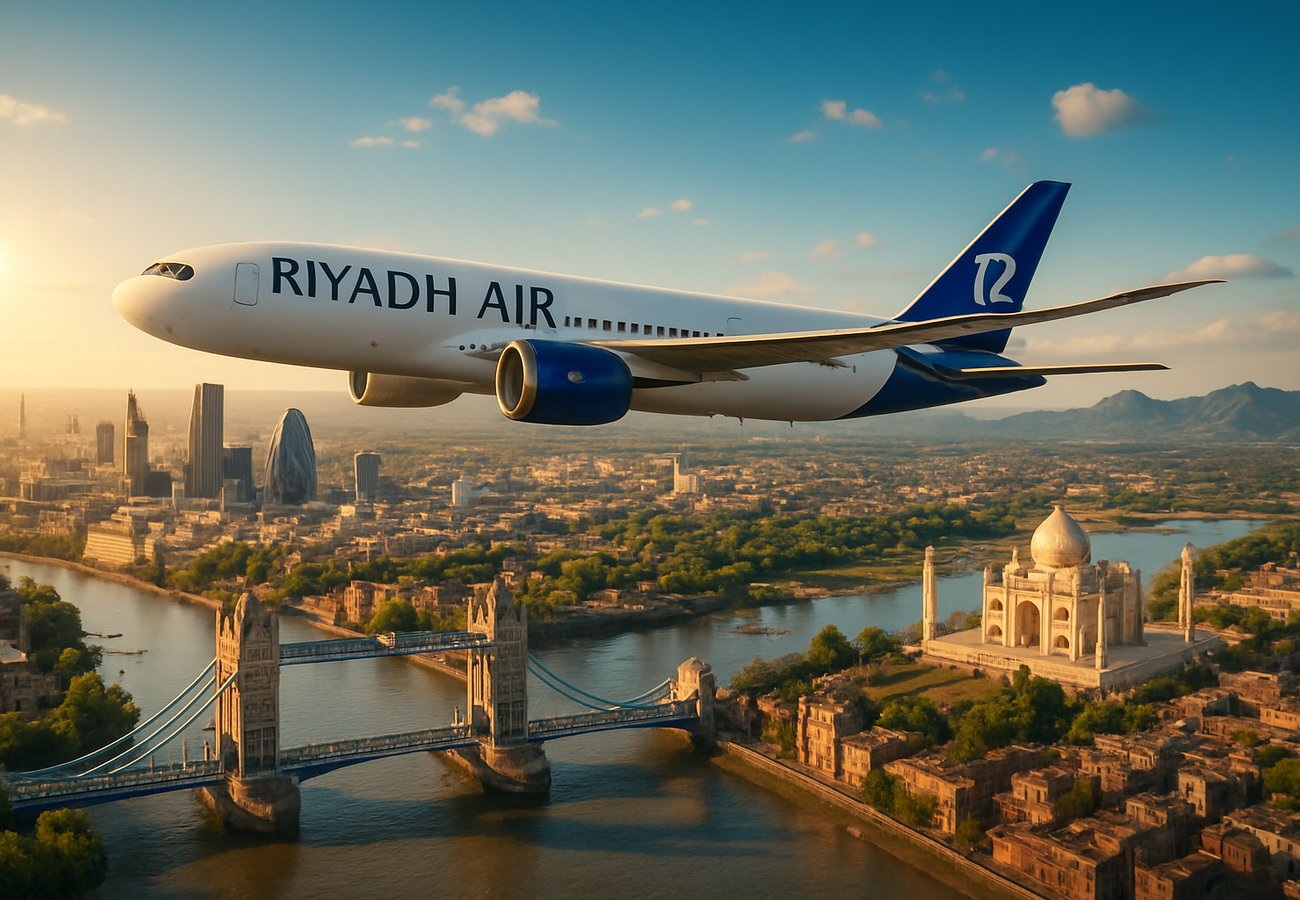
Image generated by AI
Quick Summary
- Riyadh Air, backed by Saudi Arabia's Public Investment Fund (PIF), announces major international route expansion spanning 8+ countries
- New direct flights to UK (London, Manchester), Spain (Madrid), Egypt (Cairo), Jordan (Amman), India (Mumbai, Delhi), Thailand (Bangkok), and additional destinations
- Expansion aligns with Saudi Arabia's Vision 2030 economic diversification strategy, targeting tourism growth and regional connectivity
- Boeing 787-9 Dreamliner fleet planned to service long-haul routes with premium passenger experience
- Airlines targets 100+ destinations by 2030, positioning Saudi Arabia as central Middle East aviation hub
Riyadh Air Charts Ambitious Course: Saudi Arabia's New Carrier Launches Transformative Global Route Network Connecting Middle East to UK, Europe, South Asia, and Southeast Asia
RIYADH — In a landmark move that reshapes Middle Eastern aviation architecture, Riyadh Air, the PIF-backed carrier launched to drive Saudi Arabia's Vision 2030 economic transformation, has announced a sweeping international route expansion connecting the Kingdom to eight countries across Europe, Africa, South Asia, and Southeast Asia. The strategic network launch—encompassing direct flights to London, Madrid, Cairo, Amman, Mumbai, Delhi, and Bangkok—signals Saudi Arabia's determination to establish itself as a central global aviation hub while simultaneously accelerating inbound tourism and outbound business connectivity.
The expansion represents far more than routine airline capacity growth. It reflects a fundamental shift in Saudi Arabia's international positioning, leveraging aviation infrastructure as a cornerstone of economic diversification. By offering seamless connectivity between Riyadh and the world's most dynamic business, cultural, and tourism markets, Riyadh Air is executing a sophisticated strategy to capture premium market segments while supporting the Kingdom's ambitious tourism targets under Vision 2030.
The announcement arrives amid intensifying competition within Middle Eastern aviation, where established carriers (Emirates, Qatar Airways, Etihad) have dominated long-haul markets for two decades. Riyadh Air's entry disrupts this competitive landscape, introducing a new player with sovereign backing, unlimited capital, and strategic government support to reshape regional and international travel patterns.
Global Aviation Context: Riyadh Air Emerges as Transformative Market Force
Riyadh Air enters an aviation environment characterized by post-pandemic recovery, shifting geopolitical alignments, and increasing competition for premium international routes. The global aviation market, valued at approximately $800 billion annually, continues consolidating around major hubs—with concentrations in the Gulf region (Dubai, Doha, Abu Dhabi), Asian gateways (Singapore, Hong Kong, Seoul), and European hubs (London, Frankfurt, Paris).
Saudi Arabia's historical aviation infrastructure, dominated by Saudi Arabian Airlines (Saudia), has traditionally prioritized domestic connectivity and hajj/umrah pilgrim traffic. Riyadh Air represents a strategic pivot: a dedicated international carrier designed to compete directly with established Middle Eastern carriers for premium intercontinental traffic, leisure tourism, and business connectivity.
Market positioning: Riyadh Air's entry strategy emphasizes route selectivity (targeting high-demand premium markets rather than mass capacity) and operational efficiency (Boeing 787-9 Dreamliners optimized for long-haul routes with 30-40% lower fuel consumption than older wide-body aircraft). This contrasts with traditional Middle Eastern carriers' hub-and-spoke models relying on massive connecting traffic.
Competitive advantage: Saudi Arabia's strategic location (equidistant from Europe, Africa, and Asia), combined with government support and premium service positioning, positions Riyadh Air to capture affluent leisure travelers and high-yield business segments that traditional carriers have left underserved.
Route-by-Route Strategic Analysis: Connecting Kingdom to Global Markets
United Kingdom: Capturing British Affluence and Islamic Culture
Riyadh Air's dual-city strategy—targeting both London Heathrow and Manchester—reflects sophisticated market segmentation. London Heathrow service captures premium British business travelers, wealthy retirees, and high-value leisure segments. Manchester service targets the UK's significant Muslim population (approximately 3.9 million, concentrated in Northwest England) and emerging affluent South Asian diaspora—demographics with strong Saudi cultural and religious ties and demonstrated travel propensity.
Economic significance: UK-Saudi bilateral trade exceeded $7 billion annually (pre-pandemic), with growing tourism exchange. Direct flights reduce journey complexity from 9-11 hours (via connecting hubs) to approximately 8 hours, making Saudi Arabia more competitive against Mediterranean and North African alternatives for British travelers.
Tourism impact: Direct UK-Saudi connectivity is expected to increase annual British visitor arrivals to Saudi Arabia by 30-40%, targeting the country's emerging luxury tourism sector (Neom, Red Sea Resort, cultural tourism in Riyadh and Jeddah).
Spain: Gateway to Southern European Markets
Madrid's centrality within Western Europe makes it a strategic hub for Riyadh Air's European expansion. Spain has historically attracted affluent Saudi tourists (over 400,000 annually pre-pandemic), drawn to Mediterranean culture, architectural heritage, and climate. Direct flights transform Spain from a weekend extension of typical European tours into a primary destination, increasing length-of-stay and tourism spending.
Strategic positioning: Spain serves as Riyadh Air's European pivot point, enabling code-share agreements with Iberia and Oneworld partners to extend reach throughout Continental Europe without establishing multiple European bases.
Investment nexus: Saudi Arabia has become a major investor in Spanish real estate (particularly Madrid and Barcelona), and improved aviation connectivity supports business tourism and property management travel.
Egypt: Strengthening Arab Regional Leadership
Cairo connectivity represents Riyadh Air's commitment to intra-Arab regional dominance. Saudi Arabia and Egypt, as the Arab world's two most influential nations, have intensified strategic coordination across defense, economics, and tourism. Direct flights consolidate this partnership while positioning Riyadh Air as the preferred carrier for elite Arab business and diplomatic travelers.
Tourism demand: Egypt attracts over 13 million international visitors annually (pre-pandemic), with significant Saudi visitor representation. Direct Riyadh-Cairo service increases frequency, reduces journey time from 2.5 hours (connecting) to 90 minutes direct flight, and positions Saudi Arabia as primary source market for Egyptian tourism.
Economic alignment: Both nations are pursuing tourism-led growth strategies; improved air connectivity multiplies benefits for both economies.
Jordan: Capitalizing on Arab Cooperation and Shared Tourism Assets
Amman serves both strategic and tourism functions. Diplomatically, Jordan maintains centrality in regional geopolitics, and Riyadh Air's Amman service signals Saudi Arabia's commitment to regional partnership and connectivity. Touristically, Petra, Dead Sea, and Wadi Rum represent bucket-list destinations for Saudi leisure travelers, with demonstrated market demand exceeding current air capacity.
Volume potential: Jordan currently hosts over 4 million international visitors annually, with significant Saudi visitation. Direct flights increase market penetration and average trip value.
India: Tapping South Asia's Demographic and Economic Dynamism
Mumbai and Delhi flights position Riyadh Air for India's massive outbound travel market. India generates over 30 million international tourist departures annually, with Saudi Arabia representing an increasingly important destination (religious tourism, business, investment). Conversely, India's 8+ million expatriates in the Gulf contribute substantially to Saudi Arabia's economy, with high frequency travel patterns.
Market scale: India-Saudi bilateral traffic is projected to exceed 3 million annual passengers by 2030, making it one of the world's highest-capacity international markets. Riyadh Air's entry captures premium segments (business class, high-value leisure) currently dominated by traditional carriers.
Cultural bridge: Direct flights serve India's Muslim population (approximately 200 million) for hajj/umrah journeys, complementing Saudi Arabia's religious tourism infrastructure with premium air connectivity.
Thailand: Gateway to Southeast Asian Tourism
Bangkok service extends Riyadh Air's reach into Southeast Asia's fastest-growing tourism market. Thailand attracts over 40 million international visitors annually, with substantial Middle Eastern representation. Saudi travelers represent high-spending leisure demographic, with strong demand for Thai resort destinations, cultural tourism, and shopping.
Strategic expansion: Bangkok connectivity enables code-sharing partnerships with Thai Airways and other Southeast Asian carriers, extending Riyadh Air's reach across Vietnam, Cambodia, Laos, Indonesia, and Philippines without establishing separate bases.
Economic positioning: Thailand represents gateway to Southeast Asian markets for Saudi investors, positioning improved air connectivity as business development tool.
Tourism Impact: Saudi Arabia's Emerging Luxury Tourism Sector
Riyadh Air's expansion directly supports Saudi Arabia's Vision 2030 objective of tripling annual international visitor arrivals from 9.3 million (2019) to 30 million by 2030. Current barriers to achieving these targets include:
- Limited international connectivity: Historically, visitors required connections through established Gulf hubs (Dubai, Abu Dhabi, Doha) rather than direct access to Saudi Arabia
- Premium service gaps: Absence of direct long-haul service to affluent source markets (UK, Western Europe) limited high-value segment capture
- Brand positioning challenges: Riyadh Air's entry addresses perceptual gaps, offering Western-designed premium experience differentiated from traditional Middle Eastern carriers
New tourism destinations: Riyadh Air's expansion accelerates development of transformative Saudi tourism infrastructure:
- Neom: USD 500 billion megacity project attracting international business and leisure visitors
- Red Sea Resort: World-class beach resort development targeting European and Asian luxury markets
- Cultural tourism: Expanded access to Riyadh's museums, Jeddah's historic district, and Medina/Mecca religious tourism
- Adventure tourism: Wadi Rum-equivalent experiences in Saudi deserts and mountain regions
Economic multiplier: Each new international visitor typically spends $500-2,000 across accommodations, dining, attractions, and retail. Projected 20+ million incremental visitor arrivals over five years could generate $10-20 billion in direct tourism revenue, supporting broader economic diversification beyond petroleum exports.
Regional Implications: Middle Eastern Aviation Dynamics
Riyadh Air's launch disrupts established competitive dynamics among Middle Eastern carriers. Traditional carriers—Emirates (Dubai), Qatar Airways (Doha), Etihad (Abu Dhabi)—have operated with minimal direct competition within the region, enabling premium pricing and capacity management. Riyadh Air's market entry introduces competitive pressure:
- Route competition: Direct Riyadh Air service competes with existing hub-and-spoke models, potentially capturing transfer traffic historically processed through Dubai, Doha, or Abu Dhabi hubs
- Pricing dynamics: New entrant with different cost structures and government subsidization may pressure premium pricing, benefiting consumers through increased competition
- Premium positioning: Riyadh Air targets underserved luxury market segment, avoiding direct volume competition with established carriers' mass-market operations
Strategic implications: Riyadh Air represents Saudi Arabia's assertion of independent aviation leadership, reducing dependence on rival nations' infrastructure and reinforcing Saudi Arabia's positioning as central Middle East power broker.
Fleet Strategy and Operational Excellence
Riyadh Air's Boeing 787-9 Dreamliner fleet represents state-of-the-art long-haul capability. The 787-9 offers:
- Fuel efficiency: 30-40% lower fuel consumption than competing wide-body aircraft (777, A350), enabling competitive unit costs and environmental sustainability
- Passenger experience: Boeing's latest cabin technology includes larger windows, advanced cabin pressure systems, and wireless connectivity
- Route economics: Ability to operate longer routes (up to 8,000+ nautical miles) with smaller aircraft, enabling profitable service to smaller markets (Amman, Cairo) traditionally unviable for full-size hubs
- Operational flexibility: Lower flight crew requirements and reduced maintenance intervals compared to aging wide-body fleets
Future Expansion Roadmap: 100 Destinations by 2030
Riyadh Air's stated objective to serve 100+ destinations by 2030 represents aggressive but achievable growth trajectory. The timeline suggests:
2026-2027: Consolidation of current announced routes, establishing operational excellence and customer loyalty foundations
2027-2029: Secondary expansion to Asian markets (East Asia: Tokyo, Seoul, Singapore, Hong Kong), African markets (Nigeria, Kenya, South Africa), and secondary European destinations
2029-2030: Maturation of network with comprehensive coverage of premium global markets, positioning Riyadh Air as top-10 global carrier by international route coverage
This expansion would position Riyadh Air as Saudi Arabia's primary international carrier and one of the Middle East's most significant aviation players within four years—a historically rapid achievement.
Frequently Asked Questions
Q: When will Riyadh Air begin international flights to these announced destinations? A: Initial long-haul routes (UK, Spain, Egypt, India) are expected to launch in 2026-2027, with remaining destinations following in 2027-2029 as aircraft deliveries and operational scaling progress.
Q: What is Riyadh Air's relationship to Saudi Arabian Airlines (Saudia)? A: Riyadh Air operates independently from Saudia, positioning itself as a premium international carrier while Saudia focuses on domestic connectivity, hajj operations, and regional service. Both carriers may eventually coordinate through Saudi Arabia's civil aviation authority.
Q: What are typical fares for Riyadh Air international routes? A: As a premium new entrant, Riyadh Air pricing is expected to position between budget carriers and traditional Middle Eastern carriers. Promotional fares for inaugural routes may offer 20-30% savings versus established carriers.
Q: How does Riyadh Air support Saudi Arabia's Vision 2030 objectives? A: Direct international connectivity increases tourism arrivals (targeting 30 million annually by 2030), supports business investment flows, and generates employment across aviation, hospitality, and tourism sectors—key economic diversification priorities.
Q: What makes Riyadh Air's service differentiated from Emirates, Qatar Airways, or Etihad? A: Riyadh Air emphasizes premium experience, operational efficiency, and direct routing (avoiding time-consuming connections through established hubs). The airline also prioritizes Saudi Arabia-originating travel rather than pure transit traffic.
Q: Are there code-share partnerships or airline alliances planned? A: Riyadh Air has announced intentions to negotiate code-share agreements with international carriers, though specific partnerships have not yet been confirmed. Likely partners include Iberia (Spain), Air France-KLM, and Asia-Pacific carriers.
Q: How does Riyadh Air's market entry affect existing Middle Eastern carriers? A: Direct competition may pressure premium yields, particularly on Europe-Middle East routes. However, expanding regional air traffic capacity benefits all carriers through network growth and market expansion.
Disclaimer
This article is for informational and educational purposes only. It does not constitute legal, financial, or professional advice. While we strive to provide accurate and up-to-date information, travel policies, regulations, and conditions change rapidly. Always verify information with official sources before making travel decisions. Nomad Lawyer makes no representations about the accuracy, reliability, completeness, or suitability of the information provided. Readers should consult qualified professionals for advice specific to their circumstances. The views expressed in this article are those of the author and do not necessarily reflect the views of Nomad Lawyer.
Kunal K Choudhary
Co-Founder & Contributor
A passionate traveller and tech enthusiast. Kunal contributes to the vision and growth of Nomad Lawyer, bringing fresh perspectives and driving the community forward.
Learn more about our team →