
US Air Force Doubles Down on Boeing F-15EX Fighter Jets, Signaling Shift Away From 5th-Generation-Only Strategy
Breaking airline news and aviation industry updates for 2026.

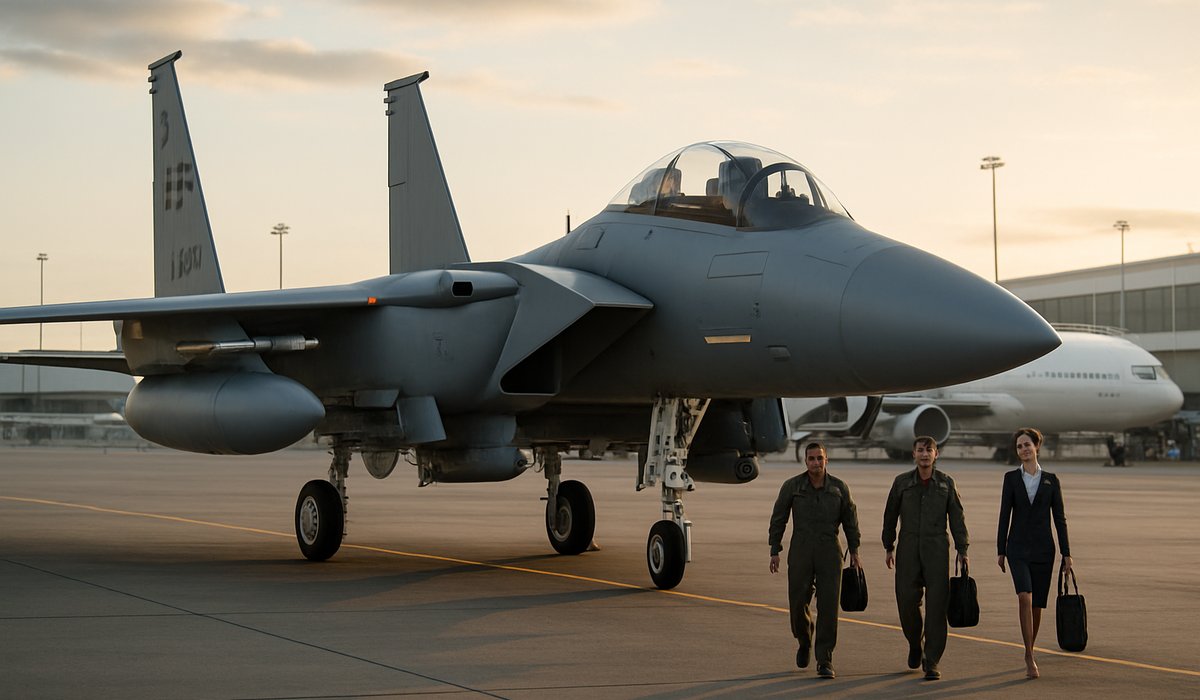
Image generated by AI
US Air Force Doubles Down on Boeing F-15EX Fighter Jets, Signaling Shift Away From 5th-Generation-Only Strategy
Pentagon's $3 billion expansion reveals fundamental rethinking of aerial combat doctrine and defense procurement priorities
Historic Procurement Decision Reshapes Air Force Fleet Strategy
The United States Air Force has announced a dramatic expansion of its Boeing F-15EX Eagle II acquisition program, doubling the planned fleet size from 129 to 267 aircraft in its FY2027 budget submission. The move, accompanied by a $3 billion allocation for 24 additional jets, represents one of the most consequential shifts in American fighter procurement strategy in recent memory and signals a fundamental reassessment of future air combat requirements.
The decision comes as the Pentagon simultaneously maintains substantial investment in Lockheed Martin's F-35A stealth fighter, indicating that military planners now envision a complementary force structure rather than a wholesale transition to fifth-generation aircraft. Defense analysts suggest the dual-track approach reflects mounting concerns about operational constraints inherent to single-platform strategies.
Balancing Stealth Penetration With High-Capacity Operations
Pentagon officials have framed the F-15EX expansion as addressing a critical capability gap in sustained aerial operations. Unlike the F-35A, designed primarily for penetrating heavily defended airspace through stealth technology, the F-15EX excels as a long-range, high-payload platform capable of carrying substantially more ordnance across extended missions.
The Eagle II's expanded role encompasses three strategic priorities: continuous homeland defense operations, power projection throughout the Indo-Pacific region, and the capacity to sustain prolonged air campaigns where technological dominance alone may prove insufficient. The aircraft's range, sensor suite, and weapons-carrying capacity position it as particularly valuable for operations across vast geographic distances—a consideration that has gained urgency given current geopolitical tensions.
The Economics of Redundancy Versus Specialization
The strategic pivot also reflects practical budget constraints. Fifth-generation stealth fighters, while superior in certain tactical scenarios, carry substantially higher per-unit costs and ongoing maintenance expenses. The F-15EX offers a more economical alternative for missions not requiring penetration of the most advanced air defense systems, potentially extending overall fleet capability within realistic defense budgets.
Defense procurement experts note that relying exclusively on stealth platforms creates vulnerabilities during extended operations when aircraft must cycle through maintenance and regeneration periods. The F-15EX's higher availability rates and lower operational costs align with military requirements for sustained presence and forward-deployed capabilities.
Industry and Strategic Implications
The announcement reinforces Boeing's position in American fighter production while simultaneously validating concerns that pure stealth-focused strategies may inadequately address modern warfare's complexity. It also signals Pentagon confidence in platform diversity as a superior alternative to technological monopolization.
FAQ: Understanding the F-15EX Expansion and Modern Fighter Strategy
Why is the Air Force doubling F-15EX orders when stealth fighters like the F-35 exist? The F-15EX offers superior payload capacity, range, and operational availability for sustained missions where stealth penetration isn't required, providing cost-effective redundancy and continuous presence capabilities that fifth-generation platforms alone cannot sustain.
What is the $3 billion budget allocation specifically funding? The appropriation covers procurement of 24 additional F-15EX aircraft, production facility expansion, and associated systems integration for the expanded 267-aircraft fleet requirement.
How does the F-15EX compare operationally to the F-35A? The F-35A excels in high-threat environments requiring stealth penetration; the F-15EX maximizes payload, range, and persistent operations in contested but not impenetrable airspace, making them complementary rather than competitive platforms.
What geopolitical factors influenced this procurement decision? Indo-Pacific security concerns and homeland defense requirements drove reassessment toward platforms capable of sustained operations across vast distances without repeated maintenance cycles.
Does this strategy indicate limitations in current stealth fighter doctrine? The dual-platform approach suggests military planners now favor force structure diversity over technological specialization, acknowledging that stealth capabilities alone cannot address all operational scenarios in prolonged conflicts.
Related Travel Guides
- Airlines Economy World: 6 Carriers With 35+ Inch Seat Pitch in 2026
- NTSB Restricts Public Access to Crash Investigation Files Following AI-Generated Cockpit Audio Breach
- Airbus A350 Production Delays Spark Global Fleet Shortages Fueling Concern Over International Airport Disruptions and Passenger Travel Chaos: New Airline News and Aviation Updates
Disclaimer
This article is for informational and educational purposes only. It does not constitute legal, financial, or professional advice. While we strive to provide accurate and up-to-date information, travel policies, regulations, and conditions change rapidly. Always verify information with official sources before making travel decisions. Nomad Lawyer makes no representations about the accuracy, reliability, completeness, or suitability of the information provided. Readers should consult qualified professionals for advice specific to their circumstances. The views expressed in this article are those of the author and do not necessarily reflect the views of Nomad Lawyer.
Raushan Kumar
Founder & Lead Developer
Full-stack developer with 11+ years of experience and a passionate traveller. Raushan built Nomad Lawyer from the ground up with a vision to create the best travel and law experience on the web.
Learn more about our team →