
United Kingdom Joins Canada and More Countries Participating at SAF Global Summit 2026 Bringing Global Aviation Leaders
United Kingdom Joins Canada and More Countries Participating at SAF Global Summit 2026 Bringing Global Aviation Leaders

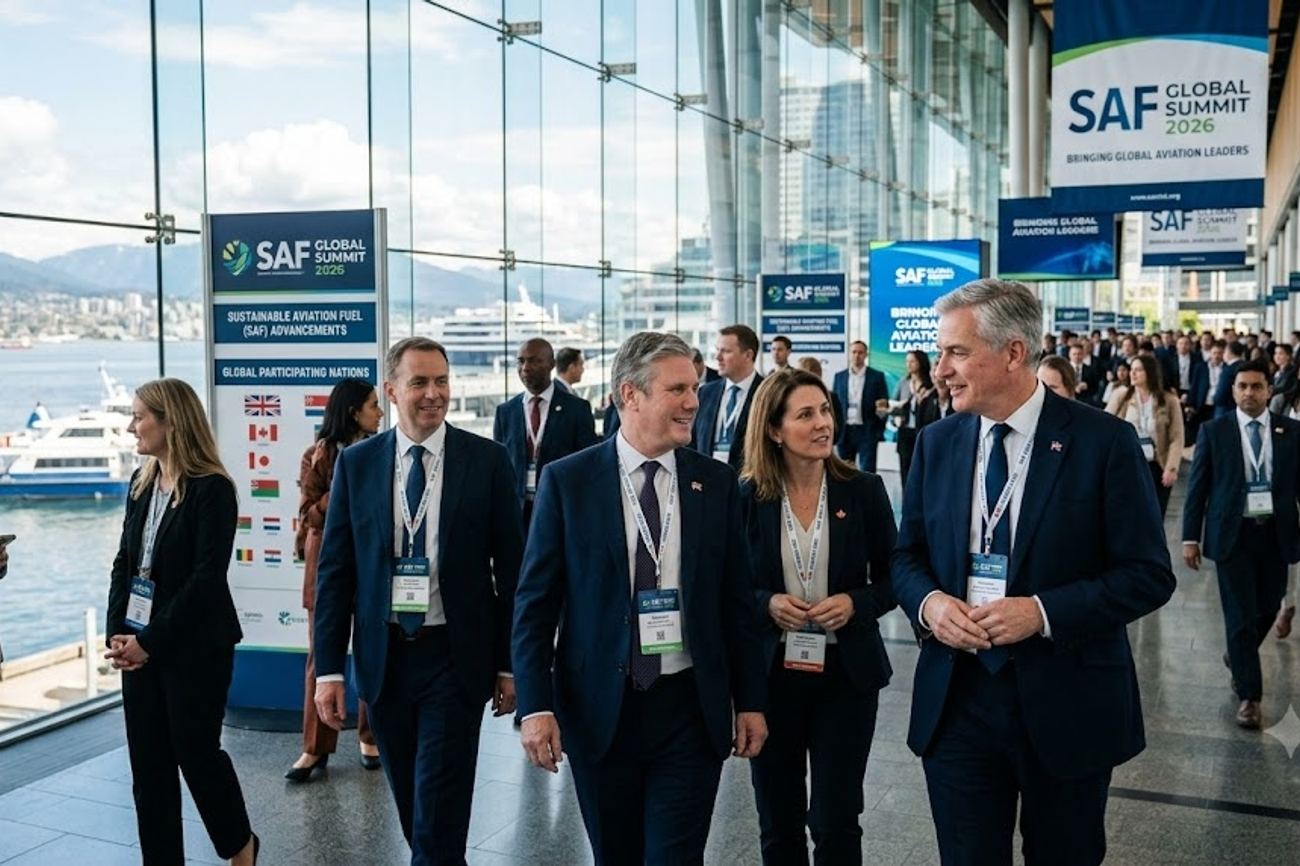
Image generated by AI
1,000+ industry delegates and 150+ speakers are converging on London for the SAF Global Summit 2026, signaling a pivot from theoretical sustainability goals to the hard logistics of fuel procurement. Scheduled for 22 and 23 September at the QEII Centre, this gathering marks a critical juncture where the United Kingdom, Canada, and a coalition of global powers will attempt to synchronize policy and investment to prevent a supply-chain collapse in the transition to sustainable aviation fuel (SAF).
The Geopolitics of Decarbonization
The aviation sector is currently trapped in a paradox: while airlines have publicized aggressive decarbonization targets, the physical infrastructure to produce and distribute non-fossil fuels remains underdeveloped. The SAF Global Summit 2026 is not merely a networking event; it is a strategic response to mounting pressure from regulators and environmental bodies to move beyond "green" press releases and into commercially viable supply chains.
The inclusion of diverse national interests—ranging from the UK Department for Transport to Saudi Arabia’s Ministry of Investment—suggests that SAF has evolved into a tool of economic competitiveness. Countries that can establish themselves as primary SAF exporters will hold significant leverage over the global aviation market, much as oil-producing nations have for the last century. The transition depends on "feedstocks"—the raw organic materials used to create the fuel—which vary by region and technology, creating a new map of resource dependency.
Market Participation and Regulatory Drivers
The summit's attendee list reveals a comprehensive cross-section of the aviation ecosystem, indicating that the shift to SAF is no longer just an "airline problem" but a systemic requirement involving energy giants, airport operators, and sovereign wealth funds.
The following table outlines the key national and corporate entities confirmed for the London proceedings:
| Country/Market | Key Participating Entities |
|---|---|
| United Kingdom | UK Civil Aviation Authority, Manchester Airports Group, Innovate UK, Fuels Industry UK, Department for Transport |
| Canada | Transport Canada |
| United States | Boeing, Amazon Global Air, World Energy |
| France | Air France-KLM |
| Germany | Lufthansa Group, Bayer |
| Saudi Arabia | Ministry of Investment |
| Italy | Eni Trade and Biofuels |
| Finland | Finnair |
| Norway | Avinor |
| Netherlands | Vopak Netherlands |
| Spain | Ministry of Transport and Sustainable Mobility |
| Portugal | Portuguese Civil Aviation Authority |
| Switzerland | Federal Office of Civil Aviation |
| Kenya | Kenya Airways |
| India | Various SAF/Alternative-fuel executives |
| Türkiye | Boeing (Regional remit) |
The primary catalysts for this gathering are aggressive regulatory frameworks. The International Air Transport Association (IATA) has long tracked the impact of such mandates, and the summit will specifically dissect the ReFuelEU Aviation regulation and the UK SAF Mandate. These are not suggestions; they are legal requirements that force airlines to blend a specific percentage of sustainable fuel into their total consumption.
Expert Analysis: The "Green Premium" and Ticket Economics
For the average traveler, the outcomes of the SAF Global Summit 2026 will eventually manifest as a line item on a boarding pass. The central tension of the summit is the "Green Premium"—the significant price gap between conventional kerosene and SAF.
The direct consequence of the UK SAF Mandate and similar EU regulations is an increase in operating costs for carriers. Because SAF is currently more expensive to produce than fossil-based jet fuel, airlines cannot absorb these costs without eroding their margins. This creates a ripple effect: to maintain profitability while meeting legal SAF quotas, airlines will likely pass these costs to the consumer. We are moving toward a pricing model where "sustainable" flights are not an optional upgrade but the baseline cost of travel.
Furthermore, the focus on "long-term offtake agreements" mentioned in the summit's agenda is a critical financial mechanism. Producers will not build multi-billion dollar refineries without a guaranteed buyer. When airlines sign these agreements, they are essentially betting on future fuel prices. If an airline locks in a high price for SAF today, and a technological breakthrough makes it cheaper in five years, that airline is stuck with an expensive contract. Conversely, if they fail to secure agreements now, they may find themselves unable to fly certain routes due to a lack of compliant fuel.
The pricing pressure created by this transition means that route profitability will be recalculated. Short-haul flights within Europe, where mandates are strictest, may see the sharpest price increases, potentially accelerating the shift toward high-speed rail for regional travel.
Key Takeaways
- Regulatory Mandates over Voluntary Goals: The industry is shifting from voluntary "net-zero" pledges to legally binding mandates (e.g., ReFuelEU, UK SAF Mandate), making SAF procurement a legal necessity.
- Infrastructure Bottlenecks: The primary hurdle is no longer technical viability—SAF works in existing aircraft—but the ability to scale production and build the physical infrastructure for distribution.
- Financial De-risking: The use of long-term offtake agreements is the primary tool being used to attract the massive capital investment required for commercial-scale SAF refineries.
- Global Competition: The participation of nations like Saudi Arabia and the US alongside European powers indicates a global race to dominate the sustainable fuel market.
- Cost Pass-Through: The higher cost of SAF compared to conventional jet fuel will likely lead to increased ticket prices as airlines struggle to balance mandates with profitability.
FAQ: SAF Global Summit 2026
Will SAF make my flight tickets more expensive? Likely yes. SAF is currently more costly to produce than traditional jet fuel. As governments mandate higher blend percentages, airlines are expected to pass these increased operational costs onto passengers through higher fares.
Can SAF be used in all current airplanes? Yes. SAF is designed as a "drop-in" fuel, meaning it can be blended with conventional aviation fuel and used in existing aircraft engines without requiring any mechanical modifications.
What is a "feedstock" in the context of SAF? Feedstocks are the raw materials used to create sustainable fuel. These include waste oils, agricultural residues, and municipal solid waste, which are processed into fuel through various chemical pathways.
Why is the 2026 summit in London significant? It brings together the regulators (governments), the users (airlines), and the producers (energy companies) to solve the supply-demand gap, moving SAF from a niche experiment to a global industrial standard.
The transition to sustainable skies is no longer a question of "if," but a high-stakes calculation of "how much."
Tags: SAF Global Summit 2026, UK SAF Mandate, ReFuelEU Aviation, Sustainable Aviation Fuel, QEII Centre London, Aviation Decarbonization
Related Travel Guides
- Hungary Unites Belgium and More Nations as IATA Cargo Experts Conference 2026 Brings 350+ Air Cargo Specialists to Budapest
- Thailand Unlocks Tremendous Economic Dominance Through Strategic ASEAN Trade and Sustainable Innovation
- United States Aligns with Portugal and More Countries in Same Line as DroneX 2026 Set to Unite 300 Exhibitors and 4,000+ Visitors
Disclaimer
This article is for informational and educational purposes only. It does not constitute legal, financial, or professional advice. While we strive to provide accurate and up-to-date information, travel policies, regulations, and conditions change rapidly. Always verify information with official sources before making travel decisions. Nomad Lawyer makes no representations about the accuracy, reliability, completeness, or suitability of the information provided. Readers should consult qualified professionals for advice specific to their circumstances. The views expressed in this article are those of the author and do not necessarily reflect the views of Nomad Lawyer.
Naina Thakur
Contributor & Travel Specialist
Travel enthusiast and legal writer covering visa regulations, responsible tourism, and cultural journeys across global destinations.
Learn more about our team →