
United Airlines Flight 455 Emergency Return at Chicago O'Hare After Takeoff Tire Failure in 2026
United Airlines Flight 455 bound for Florida performed a precautionary return to Chicago O'Hare after a tire failure during takeoff, triggering an emergency airfield response.

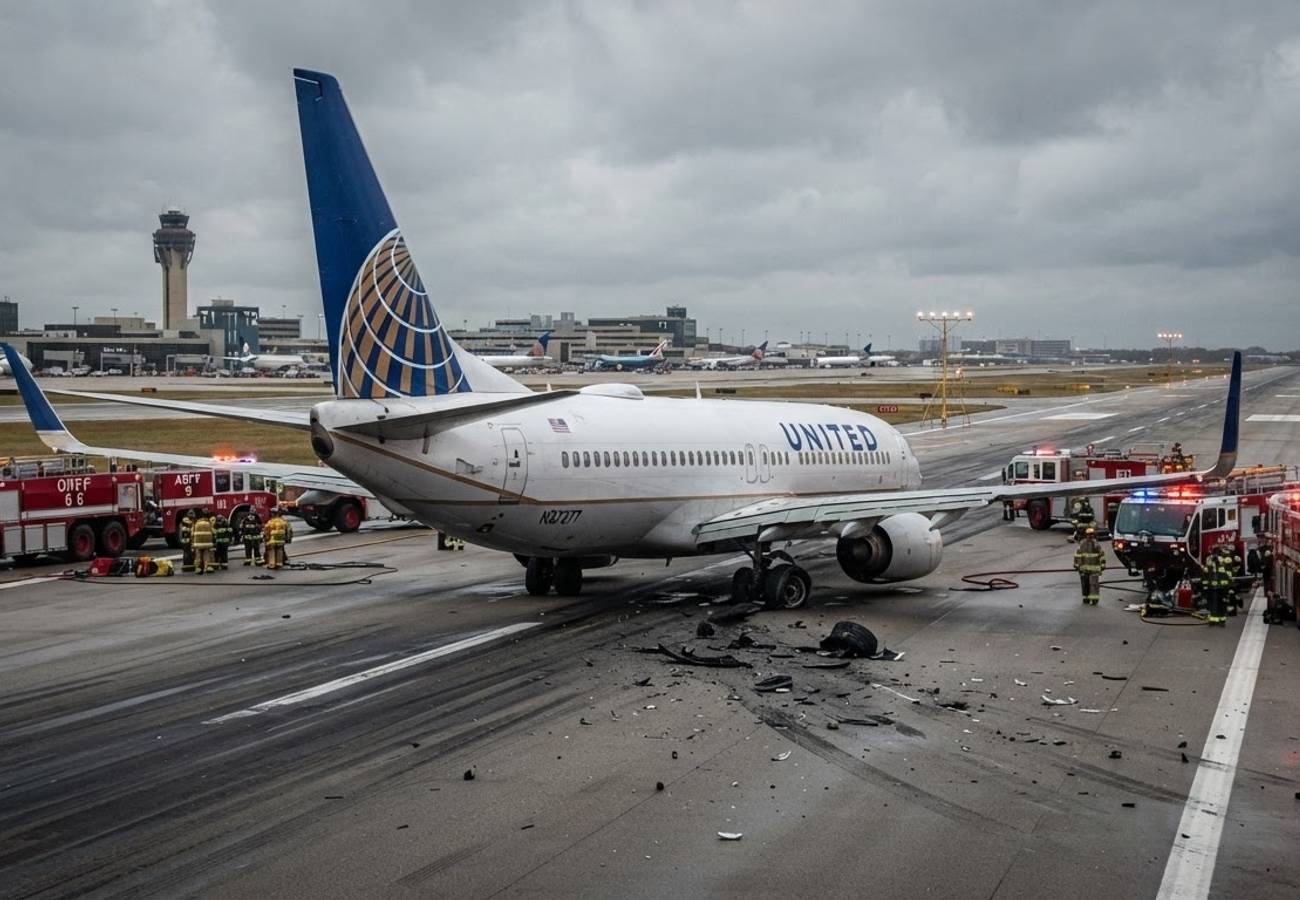
Image generated by AI
United Airlines Flight 455, bound for Florida, was forced to make an emergency return to Chicago O’Hare International Airport after a tire failed during its takeoff roll. The incident triggered a full-scale airfield emergency response, though no serious injuries have been reported.
Emergency Return of United Flight 455
United Airlines Flight 455 experienced a contained tire failure during its departure from Chicago O’Hare International Airport. According to flight-tracking data and early reports, the aircraft continued its initial climb before the flight crew identified the malfunction and requested an immediate return to the airport.
The Federal Aviation Administration (FAA) has acknowledged the event, classifying it as a tire problem during departure. Upon the aircraft's return, airport fire and rescue units were positioned along the runway to escort the jet after touchdown. This is a standard safety protocol used when there are concerns regarding landing gear integrity or the possibility of overheating brakes.
Passenger accounts and onboard video confirm a controlled environment within the cabin, with no reports of smoke or fire. The aircraft was escorted by multiple fire engines as it taxied away from the active runway toward the terminal area.
Operational Incident Specifications
The following table outlines the known parameters of the event based on available flight data and FAA summaries.
| Parameter | Detail |
|---|---|
| Flight Number | United Flight 455 |
| Departure Airport | Chicago O’Hare International Airport (ORD) |
| Destination | Florida (Specific city not disclosed) |
| Incident Type | Tire failure during takeoff roll |
| Response Level | Full airfield emergency escort |
| Outcome | Safe landing and precautionary return |
| Regulatory Status | FAA preliminary review initiated |
Traveler Logistics Guide: Navigating Hub Disruptions
From a ground-level perspective, an emergency return at a major hub like O'Hare often creates a ripple effect that extends beyond the affected aircraft. For passengers on Flight 455 and those connecting through ORD, the following logistics should be considered:
Managing Rebookings When an aircraft is removed from service for a technical inspection, the airline must shuffle the remaining fleet. Passengers should use the United mobile app for immediate rebooking rather than waiting in terminal queues. If the disruption exceeds four hours, travelers should inquire about meal vouchers or hotel accommodations, as these are standard for significant operational failures.
Understanding Emergency Responses Seeing a line of fire trucks upon landing can be unsettling for passengers. However, in aviation logistics, this is a "conservative response." Fire crews are positioned not because a fire is guaranteed, but to mitigate the risk of sparks caused by metal-on-runway contact if a tire is missing or a gear is compromised.
Digital Transit Policies For those traveling through U.S. hubs, ensure your digital travel credentials and TSA PreCheck/Global Entry status are updated. In the event of a rebooking that requires a change in departure terminal or airport, having digital documentation readily available accelerates the security re-screening process.
Infrastructure and Safety Impact Assessment
Tire failures during the takeoff phase are less frequent than those occurring during landing, as the aircraft is accelerating rather than absorbing the impact of a touchdown. However, the risk remains a critical point of analysis for the FAA and airline maintenance teams.
The primary infrastructure impact at O'Hare following such an event is the mandatory runway inspection. Airport personnel must sweep the runway for rubber debris or foreign object debris (FOD) created by the blown tire. Until the surface is cleared and verified, the specific runway may face temporary closures, leading to taxiway congestion and departure delays for other flights.
The FAA review will focus on maintenance logs to determine if the failure was caused by:
- Material Wear: Failure to meet replacement cycles.
- FOD: A foreign object on the runway puncturing the tire.
- Mechanical Stress: An issue with the braking system or gear assembly.
Aviation safety relies on these redundant systems and conservative emergency protocols to ensure a mechanical failure remains a manageable incident rather than a catastrophe.
Related Travel Guides
Disclaimer
This article is for informational and educational purposes only. It does not constitute legal, financial, or professional advice. While we strive to provide accurate and up-to-date information, travel policies, regulations, and conditions change rapidly. Always verify information with official sources before making travel decisions. Nomad Lawyer makes no representations about the accuracy, reliability, completeness, or suitability of the information provided. Readers should consult qualified professionals for advice specific to their circumstances. The views expressed in this article are those of the author and do not necessarily reflect the views of Nomad Lawyer.
Raushan Kumar
Founder & Lead Developer
Full-stack developer with 11+ years of experience and a passionate traveller. Raushan built Nomad Lawyer from the ground up with a vision to create the best travel and law experience on the web.
Learn more about our team →