
United Airlines Jet Suffers Tire Failure at Chicago O'Hare Following American Airlines Incident in 2026
A United Airlines aircraft experienced a blown tire during landing at Chicago O'Hare International Airport on August 18, 2026, mirroring a similar failure involving an American Airlines jet the same evening.

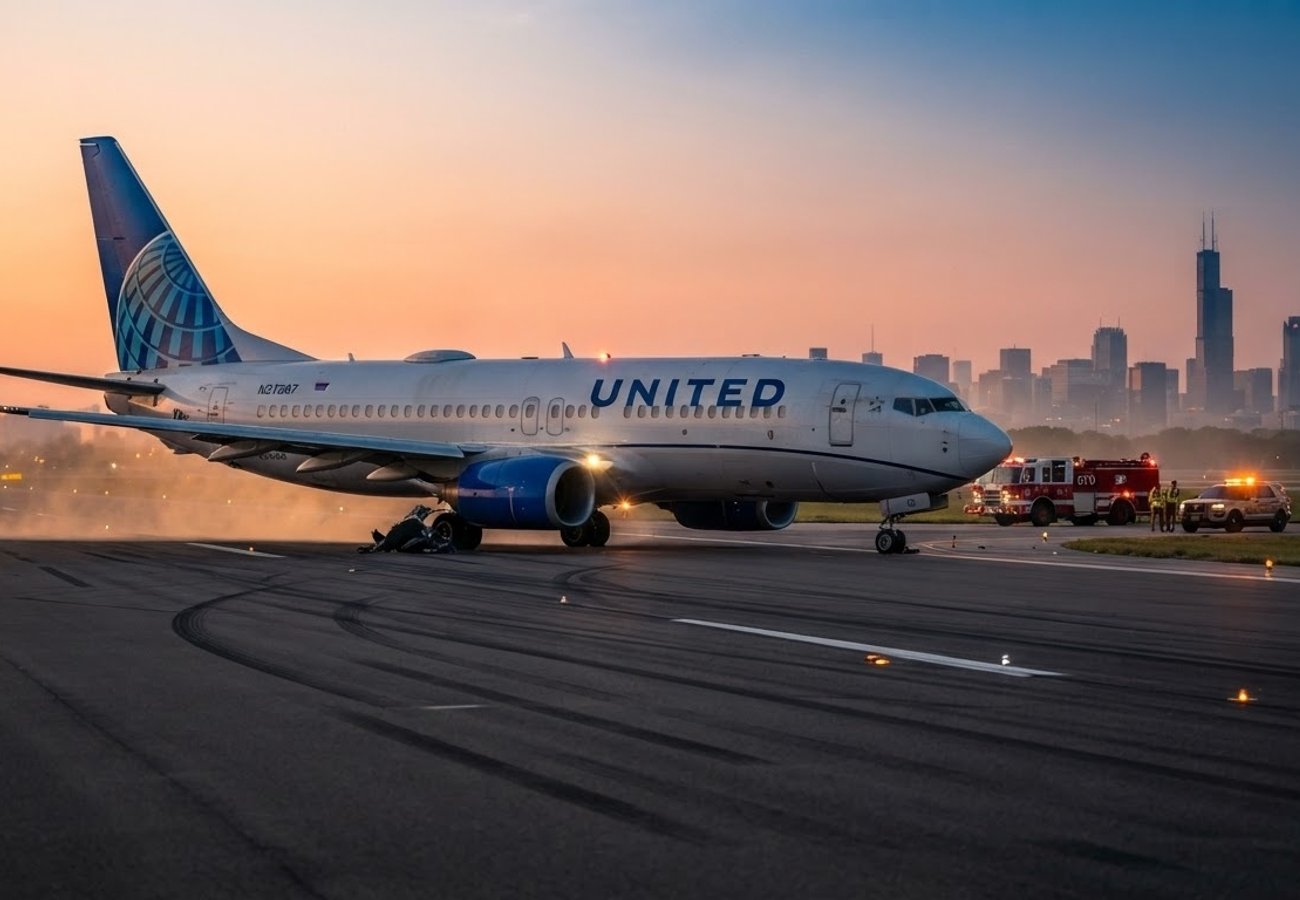
Image generated by AI
[Chicago, IL] — A United Airlines aircraft suffered a blown tire during its landing rollout at Chicago O’Hare International Airport on Tuesday evening, August 18, 2026. This event marked the second commercial jet to experience a tire failure at the hub within a very short window, following a similar incident involving an American Airlines flight earlier that night.
The dual occurrences have sparked immediate discussions regarding runway conditions at one of the world's most congested aviation gateways. While neither event resulted in injuries, the coincidence of two separate tire failures in a single evening has drawn scrutiny from aviation observers and airport personnel.
Parallel Tire Failures at Chicago O'Hare
Reports from eyewitnesses and passengers indicate that the United Airlines jet experienced the tire failure as it decelerated on the runway. According to social media accounts and flight tracking data, the aircraft maintained a controlled stop and remained on the runway until airfield response vehicles arrived to secure the scene. Passengers remained on board during the initial assessment, and there were no reports of fire or structural damage to the airframe.
Earlier that same evening, an American Airlines flight arriving at O'Hare reported a more severe failure, with both main landing-gear tires blowing out during deceleration. Like the United flight, the American Airlines aircraft came to a complete stop on the runway and required intervention from airport emergency and maintenance teams.
The proximity in timing between these two events is viewed by industry observers as highly unusual. While official technical reports from the airlines are pending, the pattern suggests that both aircraft were able to maintain directional control, preventing any runway excursions or collisions.
Operational Disruptions and Runway Management
A tire failure on a commercial jet necessitates the immediate closure of the affected runway. Airport crews must conduct a thorough inspection to remove rubber fragments and ensure no debris remains that could puncture the tires of following aircraft. At a high-volume hub like Chicago O'Hare, the temporary loss of a primary runway can create a cascading effect on flight schedules.
Flight tracking data from Tuesday evening reveals that arrival streams into the airport began to bunch, with several aircraft forced into holding patterns. Departures also experienced ground delays as air traffic controllers rerouted traffic to accommodate the runway closures.
The American Airlines incident, involving multiple blown tires, likely required a more extensive cleanup and inspection period than the United event. Consequently, travelers experienced extended taxi times and delays on the tarmac. For passengers, these operational hiccups often translate into missed connections and the need for urgent rebookings, particularly given that both United and American utilize O'Hare as a primary network hub.
Technical Analysis of the United Airlines Landing
Visual evidence shared by passengers suggests that the United aircraft remained aligned with the runway centerline throughout the incident. This indicates that the flight crew successfully managed the aircraft's trajectory despite the loss of tire pressure. Modern commercial jets are engineered with redundant wheel assemblies on each main landing gear, ensuring that a single blowout does not result in a total loss of controllability.
Flight data indicates the approach into O'Hare was routine, with no evidence of unstable descent rates or emergency maneuvers prior to touchdown. Passengers described the event as a sudden vibration or jolt during the rollout phase.
Industry reports suggest that such failures typically stem from three primary sources:
- Foreign Object Debris (FOD): Sharp materials on the runway puncturing the rubber.
- Thermal Stress: Excessive heat buildup caused by heavy braking.
- Material Fatigue: Natural wear and tear on the tire carcass.
Safety Standards for Commercial Tire Failures
While a blown tire may seem alarming to passengers, aviation safety data indicates these events are relatively common and rarely lead to accidents. Landing gear is designed to withstand extreme loads and pressures, providing a significant safety margin.
When a tire fails, pilots are trained to utilize a combination of remaining tires, spoilers, reverse thrust, and brakes on unaffected wheels to bring the aircraft to a safe stop. The primary goal is to maintain the aircraft's centerline tracking to avoid sliding off the runway.
Most tire-related events are classified as minor operational incidents. Investigations typically focus on whether the failure was an isolated maintenance issue or a result of external factors, such as runway debris or adverse weather conditions.
Investigation into O'Hare Runway Conditions
The fact that two different airlines suffered tire failures on the same evening has led to speculation regarding the state of the runways at O'Hare. Some observers have pointed toward ongoing construction projects at the airport as a potential source of foreign object debris.
Airports employ rigorous "FOD walks" and mechanical sweeping to keep runways clear of loose hardware or pavement fragments. However, in a scenario where two aircraft suffer similar damage in quick succession, investigators will likely analyze:
- Pavement Location: Whether both incidents occurred on the same runway strip.
- Construction Proximity: If recent work in a specific area left behind debris.
- Rubber Buildup: Whether excessive rubber deposits affected braking and heat distribution.
If the incidents occurred on separate runways, the events may be dismissed as a coincidence. However, if a common location is identified, it could lead to temporary closures for intensive runway scrubbing or resurfacing.
Why This Matters: The Traveler's Perspective
For the average traveler, these incidents highlight the fragility of hub-and-spoke aviation networks. A single mechanical failure on a runway doesn't just affect one flight; it creates a ripple effect that can delay hundreds of passengers across multiple airlines.
From a legal and logistical standpoint, these events underscore the importance of travel insurance and flexible booking. When a "localized" disruption occurs at a hub like O'Hare, the resulting congestion can lead to missed connections that the airline may struggle to resolve in real-time. Furthermore, the coincidence of two failures suggests that passengers should remain vigilant about potential delays during periods of heavy airport construction.
The United aircraft remains grounded for comprehensive landing gear inspections before returning to active service.
Related Travel Guides
Disclaimer
This article is for informational and educational purposes only. It does not constitute legal, financial, or professional advice. While we strive to provide accurate and up-to-date information, travel policies, regulations, and conditions change rapidly. Always verify information with official sources before making travel decisions. Nomad Lawyer makes no representations about the accuracy, reliability, completeness, or suitability of the information provided. Readers should consult qualified professionals for advice specific to their circumstances. The views expressed in this article are those of the author and do not necessarily reflect the views of Nomad Lawyer.
Preeti Gunjan
Contributor & Community Manager
A passionate traveller and community builder. Preeti helps grow the Nomad Lawyer community, fostering engagement and bringing the reader experience to life.
Learn more about our team →