
United and American Execute Pre-Holiday Capacity Cuts as Volatile Fuel Expenses Drive Up Winter Airfares
Faced with volatile jet fuel prices, United, American, and Southwest prune holiday seat capacity, triggering fare increases across peak winter travel periods.

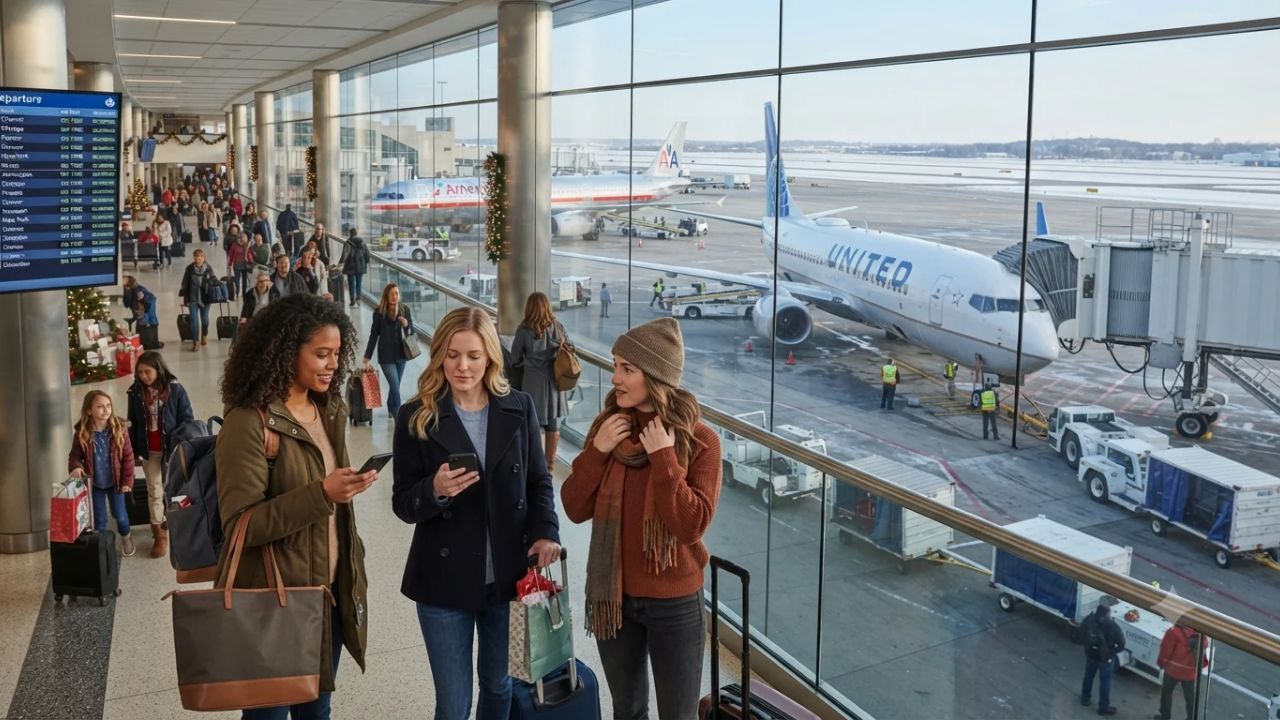
Image generated by AI
With jet fuel expenditures consistently consuming between 25% and 32% of total airline operating expenses, United Airlines, American Airlines, and Southwest Airlines have initiated targeted flight schedule reductions ahead of the peak winter travel window, preparing holiday travelers for sharp ticket price increases. The capacity realignments, tracked by the Airlines for America (A4A) consortium, mark a calculated departure from volume-driven expansion toward rigorous yield protection. Rather than flooding the market with excess seat inventory, legacy and low-cost carriers are quietly pruning low-margin regional frequencies, concentrating widebody and high-density narrowbody aircraft on core trunk corridors to maximize revenue per available seat mile (RASM).
The timing of these schedule adjustments signals an acute shift in airline network management. For decades, major carriers absorbed temporary fuel price spikes to protect passenger market share during high-visibility holiday corridors. In the current operating climate, compounded by elevated labor contracts, maintenance cost increases, and supply-chain delivery delays from airframe manufacturers, airlines are unwilling to operate marginal flights. By trimming secondary departures across peripheral spoke airports, carriers are engineering artificial seat scarcity that allows automated revenue management algorithms to push baseline holiday fares to new cyclical highs.
The Economics of Jet Fuel Volatility: Why Carriers Are Pruning Flight Banks
Aviation fuel represents the most volatile line item on an airline balance sheet. Unlike fixed debt service or terminal gate leases, jet fuel prices fluctuate daily based on global refinery capacity and crude markets. Energy performance data released by the U.S. Energy Information Administration (EIA) documents ongoing premiums in the Gulf Coast and New York Harbor jet fuel spot markets, which directly inflates the hourly burn cost of operating regional and mainline fleets.
When jet fuel prices surge, the breakeven load factor—the percentage of seats an airline must sell just to cover direct operating expenses—rises dramatically. On a secondary route connecting a mid-sized Midwestern or Southern manufacturing city to a coastal hub, a 50-seat regional jet or 76-seat turboprop quickly becomes economically unviable if fuel costs rise by 15% to 20%.
Consequently, United Airlines and American Airlines are executing surgical network reductions. Rather than canceling entire city pairs, airlines are shaving flight frequencies: converting a four-times-daily service into two or three daily rotations, or discontinuing Tuesday and Wednesday off-peak flights entirely. This structural reduction removes tens of thousands of available seat miles from the domestic aviation grid, directly tightening inventory ahead of Thanksgiving, Christmas, and New Year holiday rushes.
| Airline Operator | Primary Operational Response | Targeted Route Categories | Strategic Capacity Objective |
|---|---|---|---|
| United Airlines | Trimming marginal frequencies | Secondary regional spoke routes, off-peak midday banks | Hub concentration through Chicago, Denver, and Houston |
| American Airlines | Schedule consolidation and aircraft upgauging | Underperforming domestic point-to-point services | Protecting fortress hub connectivity via DFW and Charlotte |
| Southwest Airlines | Reassessing fleet delivery schedules | High-frequency short-haul commuter corridors | Curbing unprofitable flying, optimizing Boeing 737 utilization |
| Ultra-Low-Cost Carriers | Pruning unprofitable off-peak departures | Discretionary leisure flights without strong ancillary spend | Capital preservation, focusing on dense weekend leisure |
Network Realignment Across Major Legacy and Low-Cost Networks
The response to elevated operating expenses varies across carrier business models, but the outcome for passengers remains consistent: reduced departure choice.
United Airlines is focusing its capacity management around its primary connecting bastions: Chicago O'Hare, Denver International, Houston Intercontinental, and Newark Liberty. By retiring older, fuel-inefficient narrowbodies and relying on high-capacity Boeing 737 MAX and Airbus A321neo aircraft, United aims to lower seat-mile costs while reducing total departures. Routes that cannot support high load factors at elevated ticket prices are being postponed until spring 2027.
American Airlines is mirroring this discipline across its Sun Belt strongholds, adjusting scheduling banks at Dallas/Fort Worth and Charlotte Douglas. American has increasingly favored upgauging—replacing two smaller regional jet flights with a single larger mainline aircraft—which reduces pilot staffing pressure and airport departure fees but leaves travelers with fewer flight timing choices throughout the day.
Meanwhile, Southwest Airlines is navigating its own operational transition. Faced with delays in aircraft deliveries and rising operating overhead, the Dallas-based carrier is reviewing its forward schedules, eliminating unprofitable point-to-point connections that bypass major hubs. By recalibrating network growth downward, Southwest is removing low-fare pressure from competitive domestic corridors, allowing legacy rivals to hold ticket prices firm without fear of aggressive discounting.
Peak Holiday Demand Compression: The Mechanics of Reduced Seat Supply
The structural consequence of these airline schedule adjustments is intense demand compression during November and December. Holiday travel demand is inherently inelastic: millions of families, students, and seasonal vacationers must travel on specific calendar dates, regardless of prevailing airfare.
When airlines reduce available seat supply while customer demand remains fixed, algorithmic revenue management systems accelerate price increases. Booking engines monitor search velocity and seat inventory in real time. As standard economy fare classes sell out weeks earlier than normal, the algorithm automatically closes discount buckets, leaving only high-tier main cabin, extra-legroom seats, and premium cabins available for purchase.
Travelers booking flights for peak departure dates—such as the Wednesday preceding Thanksgiving or the Sunday following Christmas—will encounter extreme fare compression. Flights that traditionally offered standard economy tickets at $350 are routinely pricing above $600 to $800 as seat availability vanishes.
Expert Analysis: Asymmetric Burden on Budget Flyers and Premium Insulation
From an airline revenue management viewpoint, capacity pruning represents a deliberate operational triage designed to protect high-yield corporate and premium leisure bookings while passing operational cost inflation directly onto price-sensitive leisure travelers.
For travelers booking this route, the direct consequence is a severe reduction in schedule flexibility and a dramatic rise in secondary fees. With fewer daily flights operating between key city pairs, missed connections caused by winter weather will trigger multi-day delays, as remaining holiday flights operate at load factors exceeding 90%, leaving little standby seat availability for disrupted passengers.
The pricing pressure this creates means budget-conscious travelers are increasingly priced out of prime flight banks, forcing them into undesirable departure times—such as 5:00 AM departures or red-eye transits—or compelling them to substitute air travel with private ground transport. Conversely, premium cabins remain heavily insulated from these cuts. High-margin business-class and premium economy bookings generate up to 40% of an airline's total seat revenue while consuming minimal extra fuel, incentivizing legacy carriers to protect premium schedules while trimming basic economy supply. To mitigate these price surges, holiday travelers must book 45 to 60 days in advance, maintain multi-airport flexibility, and target off-peak departure days like Thanksgiving Day or Christmas Eve.
Key Takeaways
- Strategic Supply Reductions: United Airlines, American Airlines, and Southwest Airlines are trimming regional and secondary flight schedules to offset persistent jet fuel inflation.
- Extreme Peak-Season Scarcity: Removing flight frequencies before the winter holidays reduces available seat miles, accelerating airfare price hikes for Thanksgiving and Christmas.
- Rising Breakeven Load Factors: With jet fuel accounting for 25% to 32% of airline operating costs, carriers are eliminating low-margin flights that cannot sustain profitability.
- Compounded Disruption Vulnerability: Operating fewer total flights at near-100% capacity means winter weather delays will result in multi-day rebooking bottlenecks for travelers.
- Disproportionate Impact on Economy Travelers: While high-yield premium cabins remain protected, basic economy travelers face elevated base fares, fewer flight options, and higher ancillary charges.
FAQ: Airline Capacity Cuts and Holiday Travel Airfares 2026
Why are United and American cutting flights ahead of the holidays?
Airlines are trimming schedules to counter elevated jet fuel costs and operational overhead, eliminating marginal, low-profit flights to protect overall profitability.
How much higher will holiday airfares be in 2026?
With airlines reducing seat capacity while passenger demand remains high, peak holiday departure dates are seeing airfares jump 15% to 30% compared to off-peak periods.
What dates are the most expensive for holiday flights?
The Wednesday before Thanksgiving, the Sunday following Thanksgiving, and the weekend immediately following Christmas represent the highest-demand, highest-cost travel dates.
How can travelers avoid paying peak holiday airfares?
Travelers can reduce costs by booking 45 to 60 days early, departing on the actual holiday (Thanksgiving Day or Christmas morning), and considering secondary regional airports.
As airlines trade passenger volume for balance-sheet protection, holiday travelers must navigate a winter sky where seat supply is tight and every boarding pass carries a premium.
Related Travel Guides
Disclaimer
This article is for informational and educational purposes only. It does not constitute legal, financial, or professional advice. While we strive to provide accurate and up-to-date information, travel policies, regulations, and conditions change rapidly. Always verify information with official sources before making travel decisions. Nomad Lawyer makes no representations about the accuracy, reliability, completeness, or suitability of the information provided. Readers should consult qualified professionals for advice specific to their circumstances. The views expressed in this article are those of the author and do not necessarily reflect the views of Nomad Lawyer.
Raushan Kumar
Founder & Lead Developer
Full-stack developer with 11+ years of experience and a passionate traveller. Raushan built Nomad Lawyer from the ground up with a vision to create the best travel and law experience on the web.
Learn more about our team →