
Travel Chaos Devastates United Airlines as 7 Cancellations and 168 Delays Paralyze Operations Across Newark, San Francisco, and Transatlantic Routes: Latest Airline News
A severe operational breakdown paralyzes United Airlines, triggering massive flight cancellations and stranding passengers bound for San Francisco, Denver, and key destinations across Portugal.

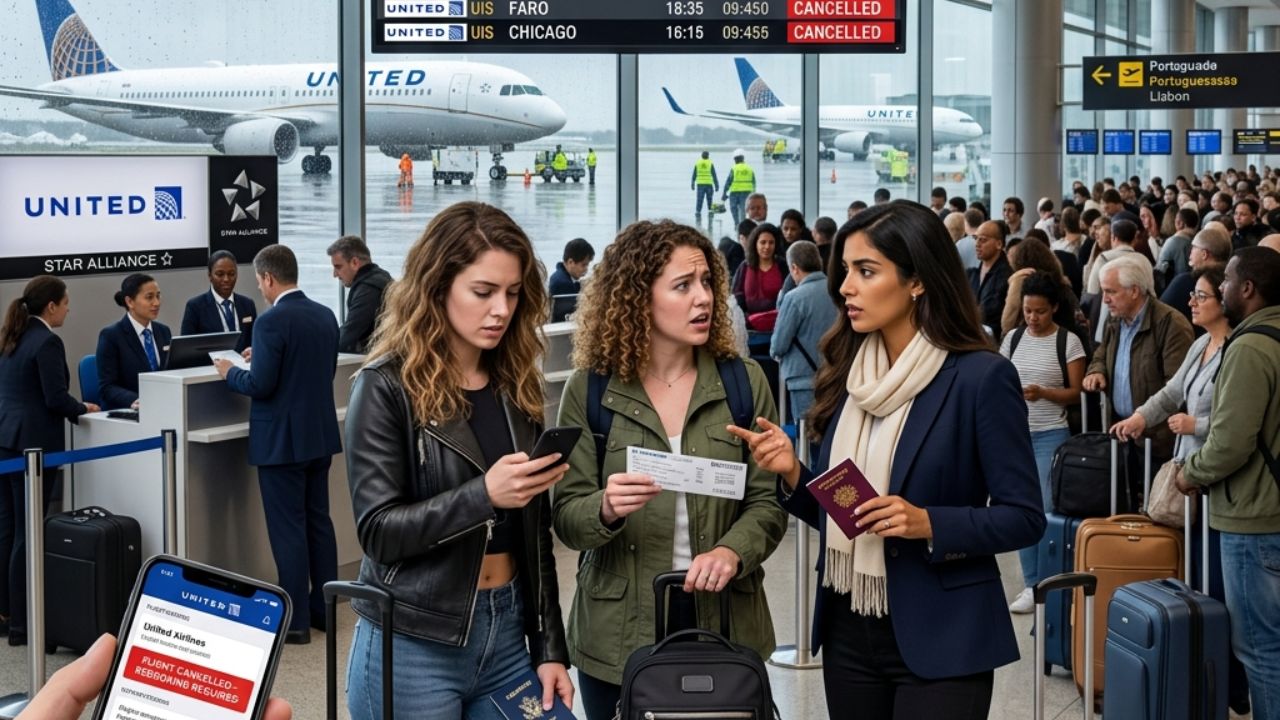
Image generated by AI
A Devastating Transcontinental Meltdown
While the broader global passenger network frequently battles unpredictable weather events and standard seasonal congestion, a highly disruptive operational breakdown is currently paralyzing the absolute core of one of the world's largest legacy carriers. Delivering highly urgent, breaking airline news, verified flight data confirms that United Airlines (UAL) has succumbed to a severe scheduling collapse this weekend. While desperate travelers attempt to navigate sudden airport disruptions, these exclusive aviation updates reveal that the carrier has abruptly executed at least 7 absolute flight cancellations alongside a staggering 168 rolling delays. By violently grounding these highly critical departures, this localized operational failure has triggered massive, uncontrollable travel chaos, leaving hundreds of passengers entirely stranded and completely severing vital domestic corridors across Newark, San Francisco, Tampa, and San Antonio, alongside highly lucrative transatlantic routes bound for Portugal and the Azores.
Expanded Overview: The Scale of the United Airlines Gridlock
The sudden execution of these targeted cancellations serves as a massive, undeniable example of how rapidly carrier-specific operational hurdles can dismantle an airline's highly optimized global schedule. Historically, United Airlines operates as a premier, highly efficient gateway connecting the United States to massive intercontinental hubs. However, the sheer impact of today's disruption has completely dismantled that reliability within a brutal 24-hour window.
This is a highly severe crisis; the grounding issues have aggressively expanded far beyond domestic borders to impact massive routes across multiple continents. Passengers traveling within the contiguous United States faced immediate, brutal cancellations to key corporate hubs, while those heading to Europe experienced devastating long-haul groundings. According to the United States Department of Transportation (DOT) and the Federal Aviation Administration (FAA), the sheer volume of irregular operations during this specific time period points directly to a massively increasing trend of service irregularities plaguing the legacy airline industry.
Section-Wise Breakdown of the Airport Disruptions
Transatlantic Routes to Portugal Severed
The absolute epicenter of the international logistical nightmare radiated outward from United's massive East Coast hub. The operational halts violently decimated highly critical transatlantic corridors bound for the Iberian Peninsula. United completely grounded Flight UAL3887 (Boeing 752), a massive transatlantic departure scheduled to connect Newark Liberty International (KEWR) directly to Faro, Portugal (FAO).
Furthermore, the highly strategic Atlantic archipelago network suffered brutal cuts. Flight UAL3017 (Boeing 38M), scheduled to bridge Santa Maria in the Azores (SMA) to Porto (OPO), was permanently removed from the departure boards. The transatlantic return leg connecting the Azores to the United States—Flight UAL217 (Boeing 38M) bound from Ponta Delgada (PDL) to Newark—was also violently grounded.
Domestic Corridors Completely Paralyzed
While the transatlantic network buckled, the domestic trunk lines suffered equal devastation. A critical cross-country business rotation connecting Newark and San Francisco International (KSFO) was entirely wiped out, with the airline executing cancellations on both the outbound leg (UAL1343) and the inbound return (UAL2248).
Shorter regional corridors were also violently severed. Passengers attempting to connect from San Antonio International (KSAT) to the massive mega-hub at Chicago O’Hare (KORD) on Flight UAL1332 (Boeing 737) were left entirely stranded. Similarly, Flight UAL3934 (Airbus A21N) connecting Tampa International (KTPA) to Denver International (KDEN) was scrubbed, leaving evening travelers completely out of options.
Verified United Airlines Disruption Metrics Table
To fully comprehend the highly severe operational parameters and massive logistical breakdown dictating this network collapse, the following table explicitly details the exact airports affected by this specific wave of cancellations:
| Airport (Code) | Flights Affected by Cancellations |
|---|---|
| Newark Liberty International (KEWR) | UAL3887, UAL1343, UAL2248 |
| San Francisco International (KSFO) | UAL1343, UAL2248 |
| Tampa International (KTPA) | UAL3934 |
| San Antonio International (KSAT) | UAL1332 |
| Chicago O’Hare International (KORD) | UAL1332 |
| Denver International (KDEN) | UAL3934 |
| Santa Maria Airport (SMA / LPAZ) | UAL3017 |
| Porto / Oporto (OPO / LPPR) | UAL3017 |
| Ponta Delgada Joao Paulo II (PDL) | UAL217 |
| Faro Airport (FAO / LPFR) | UAL3887 |
Passenger Impact: Missed Connections and Overnight Chaos
For the modern global tourist and domestic corporate commuter, the passenger impact of these massive, sudden cancellations is financially and emotionally devastating. Hundreds of travelers were directly affected by these sudden groundings, facing abrupt, terrifying changes to their itineraries, extended, multi-day layovers, and the complete destruction of outbound and return vacation plans.
Passengers scheduled for transatlantic routes out of Newark violently lost key connections to European destinations, forcing incredibly frustrating emergency rebooking on alternate European carriers. Domestic travelers on late evening departures, particularly those booked on the Tampa-Denver leg, were forced into securing highly expensive overnight hotel accommodations. U.S. Department of Transportation rules strongly require airlines to immediately provide full refunds when flights are significantly changed or permanently canceled; affected passengers are aggressively urged to request these refunds or demand penalty-free rebooking via the DOT’s Aviation Consumer Protection Division.
Industry Analysis: Maintenance, Crew Limits, and Tourism Fallout
From a macroeconomic and industry operations perspective, this incident highlights a highly terrifying reality for legacy aviation planners. While United Airlines has not publicly detailed the exact microscopic failure point for each flight, broader context from FAA flight status data suggests a highly toxic combination of aircraft maintenance issues, severe crew scheduling constraints, and residual weather impacts. When massive aircraft and specialized crews cannot be repositioned efficiently between mega-hubs like Newark and San Francisco, the entire network violently cascades into failure.
These cancellations arrive at a highly critical point in the travel calendar, directly threatening massive transatlantic tourism flows. Portugal’s highly lucrative Algarve region, heavily served via Faro, relies completely on these direct U.S. connections. By severing the Azores routes, the airline generates massive downstream economic impacts, heavily suppressing hotel bookings, ground transportation services, and ancillary tourism spending in regions that demand predictable, reliable flight schedules.
Conclusion: A Highly Volatile Recovery Phase for United
The sudden, highly publicized execution of 7 outright cancellations and 168 massive delays across the United Airlines network is exponentially more than a routine operational hiccup—it represents a massive, highly visible failure of the airline's peak season reliability. By completely severing critical connections across the United States and violently grounding routes to Portugal and the Azores, the disruption has proven how rapidly carrier friction can devolve into absolute chaos. As operations teams aggressively attempt to process the backlog of stranded passengers, travelers are urgently advised to completely avoid arriving at the airport without aggressively monitoring the airline's official app for real-time flight status and utilizing DOT regulations to secure refunds.
Key Takeaways
- Massive Network Gridlock: United Airlines suffered a highly disruptive wave of 7 massive flight cancellations and 168 severe delays.
- Transatlantic Routes Severed: Critical intercontinental flights bound for Faro, Porto, and Ponta Delgada were entirely grounded.
- Domestic Corridors Devastated: Operations connecting Newark to San Francisco, San Antonio to Chicago, and Tampa to Denver were violently cancelled.
- Severe Industry Pressures: The groundings point directly to complex aircraft maintenance issues and incredibly tight crew scheduling constraints.
- Passenger Rights: Stranded travelers are heavily urged to utilize U.S. Department of Transportation rules to secure immediate refunds and penalty-free rebooking.
Disclaimer: The specific flight cancellation metrics, impacted routes, and aircraft types presented in this report are based on verified flight tracking data regarding United Airlines operations. Official causes for this massive operational breakdown, subsequent network recovery timelines, and passenger compensation procedures are highly volatile and subject to continuous, real-time update. Affected passengers are urgently advised to monitor their specific booking status directly via their airline's official portal and review DOT Aviation Consumer Protection guidelines.
Disclaimer
This article is for informational and educational purposes only. It does not constitute legal, financial, or professional advice. While we strive to provide accurate and up-to-date information, travel policies, regulations, and conditions change rapidly. Always verify information with official sources before making travel decisions. Nomad Lawyer makes no representations about the accuracy, reliability, completeness, or suitability of the information provided. Readers should consult qualified professionals for advice specific to their circumstances. The views expressed in this article are those of the author and do not necessarily reflect the views of Nomad Lawyer.
Kunal K Choudhary
Co-Founder & Contributor
A passionate traveller and tech enthusiast. Kunal contributes to the vision and growth of Nomad Lawyer, bringing fresh perspectives and driving the community forward.
Learn more about our team →