
Thailand Implements Mandatory Digital Arrival Cards and THIM Pilot for Indian Travelers in 2026
Thailand is reshaping entry requirements for Indian visitors with the mandatory Thailand Digital Arrival Card (TDAC) and the new THIM immigration app pilot.

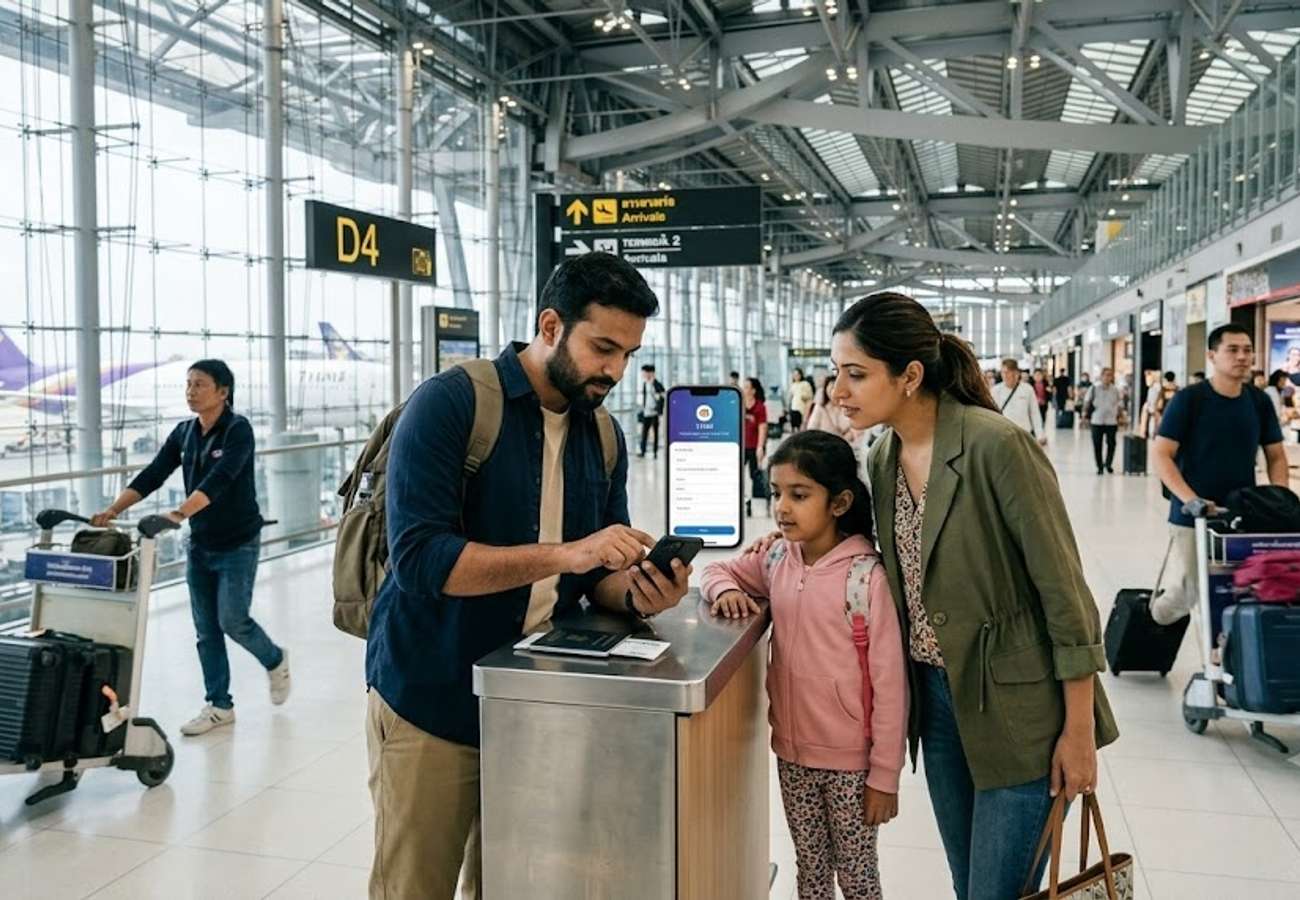
Image generated by AI
[Bangkok, July 28, 2026] — Thailand has launched a sophisticated, multi-tiered digital ecosystem for international visitors, centering on the mandatory Thailand Digital Arrival Card (TDAC), the pilot phase of the Thailand Immigration Management (THIM) application, and an expanded Tourist Police emergency network. These updates are particularly critical for travelers from India, which established itself as Thailand's fourth-largest source market in early 2026, requiring a new approach to pre-departure digital preparation for those visiting Bangkok, Phuket, and other major hubs.
The shift toward a digital-first entry process means that the traditional paper-based arrival experience is being phased out in favor of integrated mobile solutions. For the modern traveler, this transition transforms digital registration from a mere convenience into a compulsory legal requirement for entry.
Integration of the Thailand Digital Arrival Card and THIM App
The foundation of Thailand's new entry strategy is the Thailand Digital Arrival Card (TDAC). This digital declaration is now compulsory for every non-Thai national entering the country, regardless of whether they arrive via air, land, or sea. To comply, visitors must submit their passport details, personal information, journey specifics, accommodation addresses, and relevant health data online. This submission must be completed within a strict three-day window prior to arrival. It is important to note that while the TDAC replaces the physical arrival card, it does not serve as a visa.
Complementing the TDAC is the Thailand Immigration Management application, known as THIM. This platform entered a pilot phase in June 2026, with a full official rollout scheduled for August. Currently, THIM serves as an optional mobile gateway that links directly to TDAC registration. While not yet a mandatory requirement for entry, it is designed to streamline the immigration process.
The digital journey concludes with the Thailand Tourist Police application and the 1155 assistance network. This layer provides a safety net for visitors, offering SOS connectivity, GPS location sharing, and direct incident reporting. Together, these three tools create a digital chain that manages a traveler's journey from the first pre-departure form to in-country emergency response.
Thailand Digital Entry and Safety Framework
| Digital service | Present role as of 28 July 2026 | Traveller requirement | Main operational value |
|---|---|---|---|
| Thailand Digital Arrival Card | Official online arrival declaration | Mandatory for non-Thai nationals entering by air, land or sea | Records passport, journey, accommodation and relevant health information |
| THIM application | Immigration service platform in pilot access | Optional during the pilot phase | Provides TDAC-linked mobile registration and planned access to wider immigration services |
| Thailand Tourist Police application | Visitor safety and emergency support platform | Optional but increasingly useful | SOS assistance, GPS location sharing, incident reporting, translation and police communication |
| Tourist Police 1155 | National traveller assistance hotline | Available when required | Multilingual support and coordination with relevant authorities |
| Emergency services 191 and 1669 | Police and medical emergency networks | Used according to the emergency | Wider public-safety and medical response |
Technical Enhancements to Tourist Police Emergency Systems
The Thai government has significantly increased investment in the Tourist Police Bureau (TPB) to move the Tourist Police app beyond a simple emergency tool. On March 26, 2026, the TPB announced the results of an electronic procurement process for the second phase of a project aimed at upgrading how tourists submit emergency reports via the application.
Further institutional integration occurred on May 27, when a procurement notice detailed the merging of the 1155 incident-reporting service with a centralized coordination center for the 2026 budget year. This indicates that the backend infrastructure is being overhauled to ensure that requests for help are distributed and handled more efficiently by authorities.
The application's SOS feature now connects directly to provincial emergency centers 24/7, integrated with the national 191 police and 1669 medical networks. To assist non-Thai speakers, the 1155 hotline offers support in eight languages: English, Chinese, Japanese, Korean, Russian, French, German, and Hindi.
Analyzing the Impact on the Indian Travel Market
The scale of Indian tourism in Thailand makes these digital shifts highly impactful. In 2025, Thailand welcomed 2,487,319 Indian travelers, marking a growth rate of 16.82% and contributing 93.86 billion baht to the economy. The momentum continued into 2026, with 382,768 Indian visitors arriving between January 1 and February 23, cementing India's position as a top-four source market.
Total arrivals for the first quarter of 2026 reached approximately 626,000, placing India ahead of South Korea and behind only China, Malaysia, and Russia. The Thai government has set an ambitious target for 2026, aiming for over 2.55 million Indian visitors and 97.86 billion baht in revenue.
The aviation infrastructure supports this surge. In 2025, ten different airlines operated direct flights between India and Thailand, totaling 19,132 flights and providing 3,835,214 seats. This high volume of traffic primarily feeds into Bangkok, Phuket, and Krabi.
India–Thailand Tourism and Safety Indicators
| India–Thailand tourism indicator | Official figure | B2B safety implication |
|---|---|---|
| Indian arrivals in 2025 | 2,487,319 | A large volume of independent, family, group and event travellers requires scalable pre-trip communication |
| Annual arrival growth in 2025 | 16.82% | Faster growth increases pressure on multilingual information and traveller-support systems |
| Tourism revenue from India in 2025 | 93.86 billion baht | Traveller confidence has direct economic value for Thailand’s tourism supply chain |
| Indian arrivals in Q1 2026 | Approximately 626,000 | India remained among Thailand’s four largest inbound markets |
| Thailand’s 2026 India target | More than 2.55 million visitors | Digital safety preparation could affect repeat travel and destination confidence |
| India–Thailand seats in 2025 | 3,835,214 | High capacity increases the importance of consistent airline and agency instructions |
| Direct flights in 2025 | 19,132 | Safety messaging can be distributed through multiple airports, airlines and departure cities |
Addressing the Multilingual Accessibility Gap
Despite the push for digitalization, a significant language gap exists at the start of the traveler's journey. The THIM application's initial pilot supports only four languages: English, Russian, Japanese, and Chinese. While 15 additional languages are planned, Hindi is not included in the current release.
This creates a discrepancy in the user experience. While the 1155 Tourist Police hotline provides full Hindi support, the mandatory registration screens for immigration may only be available in English or other pilot languages. For a market as large as India, this means that while emergency help is accessible in Hindi, the initial legal entry process remains an English-centric experience.
Why This Matters: The Traveler's Perspective
For the traveler, these changes mean that "packing" now includes a digital checklist. The transition of the TDAC from a recommendation to a mandate means that failure to complete the digital form within the three-day window could lead to boarding denials or significant delays at immigration.
From a logistical standpoint, the disparity in language support across the three platforms (TDAC, THIM, and Tourist Police) creates a point of friction. Travelers who are not fluent in English may find the entry process daunting, even if they know that emergency help is available in Hindi once they land.
For travel agencies and tour operators, these apps are no longer optional "extras" but essential risk-management tools. Including a guide on how to navigate the TDAC and THIM apps in pre-departure briefings is now a necessity for maintaining a professional standard of care and ensuring a seamless entry for clients.
The shift to a digital-first border suggests that Thailand is prioritizing data-driven immigration over traditional paperwork to handle its growing tourism volumes.
Related Travel Guides
Disclaimer
This article is for informational and educational purposes only. It does not constitute legal, financial, or professional advice. While we strive to provide accurate and up-to-date information, travel policies, regulations, and conditions change rapidly. Always verify information with official sources before making travel decisions. Nomad Lawyer makes no representations about the accuracy, reliability, completeness, or suitability of the information provided. Readers should consult qualified professionals for advice specific to their circumstances. The views expressed in this article are those of the author and do not necessarily reflect the views of Nomad Lawyer.
Raushan Kumar
Founder & Lead Developer
Full-stack developer with 11+ years of experience and a passionate traveller. Raushan built Nomad Lawyer from the ground up with a vision to create the best travel and law experience on the web.
Learn more about our team →