
Sydney Southwest Metro Completes High-Pressure Trials for 2026 Driverless Launch
Sydney's Southwest Metro completes 130 high-pressure trial scenarios, converting a 130-year-old rail line into a GoA4 driverless network for 2026 launch.

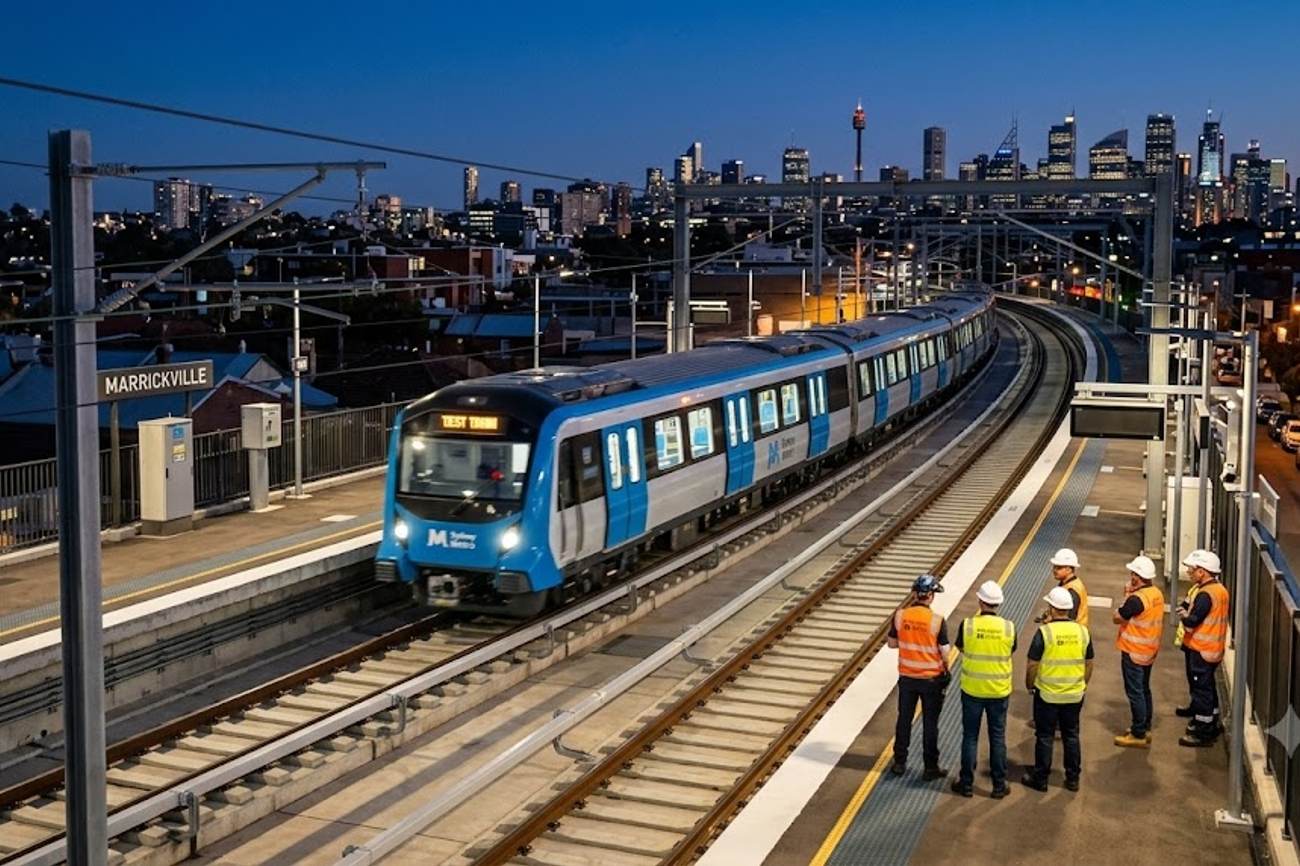
Image generated by AI
The conversion of Sydney's legacy southwest rail corridor into a fully automated metro network has reached its final certification phase following the successful execution of 130 high-stress operational scenarios.
The Core Development
Sydney Metro and operator Metro Trains Sydney (MTS) have completed a critical trial running program for the Southwest Metro. This project represents a massive "brownfield" engineering shift, retrofitting a 130-year-old suburban railway line—stretching from Marrickville to Bankstown—into a Grade of Automation 4 (GoA4) driverless system.
The trials, concluded in September 2026, focused on validating the system's ability to handle catastrophic failures and daily operational surges. This transition will directly impact over 100,000 daily commuters, replacing legacy heavy rail with high-frequency, autonomous transit.
Key Facts Breakdown
- Operational Scale: Conversion of a century-old corridor into a GoA4 driverless network.
- Testing Rigor: 130 high-pressure scenarios tested over five continuous weeks.
- Emergency Validation: A massive simulation involving 300 civilian volunteers and agencies including Fire and Rescue NSW, NSW Police Force, and Transport for NSW.
- The "Bankstown Blaze" Test: A simulated on-board fire required the autonomous system to trigger emergency ventilation and execute a full evacuation without safety breakdowns.
- Infrastructure Scope: Complete overhaul of 10 stations: Marrickville, Dulwich Hill, Hurlstone Park, Canterbury, Campsie, Belmore, Lakemba, Wiley Park, Punchbowl, and Bankstown.
Data Table: Testing and Commissioning Benchmarks
| Metric | Value | Status/Goal |
|---|---|---|
| Testing Hours Logged | 5,800+ Hours | Out of 9,000 required for sign-off |
| Distance Covered | 24,235 Kilometres | Marrickville-to-Bankstown corridor |
| Distance Target | 30,000 Kilometres | Final endurance validation goal |
| Volunteer Evacuees | 300 Persons | Bankstown emergency exercise |
| Station Upgrades | 10 Stations | Full architectural/tech overhaul |
Why This Matters
From a logistical perspective, this project is not a standard metro build; it is a global blueprint for "brownfield" automation. Most cities build new tunnels for driverless trains because retrofitting legacy lines is deemed too risky due to heritage curves and aging power infrastructure.
The real impact for travelers is the elimination of the "boarding gap." Because legacy platforms were curved, Sydney Metro implemented mechanical gap fillers. These extend from the platform to the train with millimeter precision, allowing zero-step boarding for wheelchairs and prams.
Our analysis of the technical implementation suggests that by solving the geometry of 19th-century stations through automation, Sydney has proven that legacy heavy rail can be modernized without completely demolishing existing urban footprints.
Industry Outlook
The successful completion of these trials signals a shift in how megacities will approach rail modernization. Expect other transit agencies in London, New York, and Paris to move away from purely new-build projects and toward the "Sydney Model" of retrofitting existing corridors. The next phase will focus on the final 4,200 hours of mandated testing and the calibration of anti-intrusion fencing and thermal camera arrays before the 2026 public launch.
Internal Link Suggestions:
- Guide to Sydney's Updated Transit Map 2026
- Comparative Analysis: GoA4 vs. GoA2 Automation in Global Metros
- The Future of Brownfield Infrastructure Projects in Australia
Related Travel Guides
Disclaimer
This article is for informational and educational purposes only. It does not constitute legal, financial, or professional advice. While we strive to provide accurate and up-to-date information, travel policies, regulations, and conditions change rapidly. Always verify information with official sources before making travel decisions. Nomad Lawyer makes no representations about the accuracy, reliability, completeness, or suitability of the information provided. Readers should consult qualified professionals for advice specific to their circumstances. The views expressed in this article are those of the author and do not necessarily reflect the views of Nomad Lawyer.
Naina Thakur
Contributor & Travel Specialist
Travel enthusiast and legal writer covering visa regulations, responsible tourism, and cultural journeys across global destinations.
Learn more about our team →