
Sydney Airport ATC Shortage Delays Flights on July 5 2026, Exposing Australia's Aviation Workforce Gap
Sydney Airport faced significant flight delays on 5 July 2026 as air traffic controller staffing constraints forced wider departure spacing across peak operations, exposing structural vulnerabilities in Australia's aviation network during school holiday travel demand at the nation's busiest international gateway.

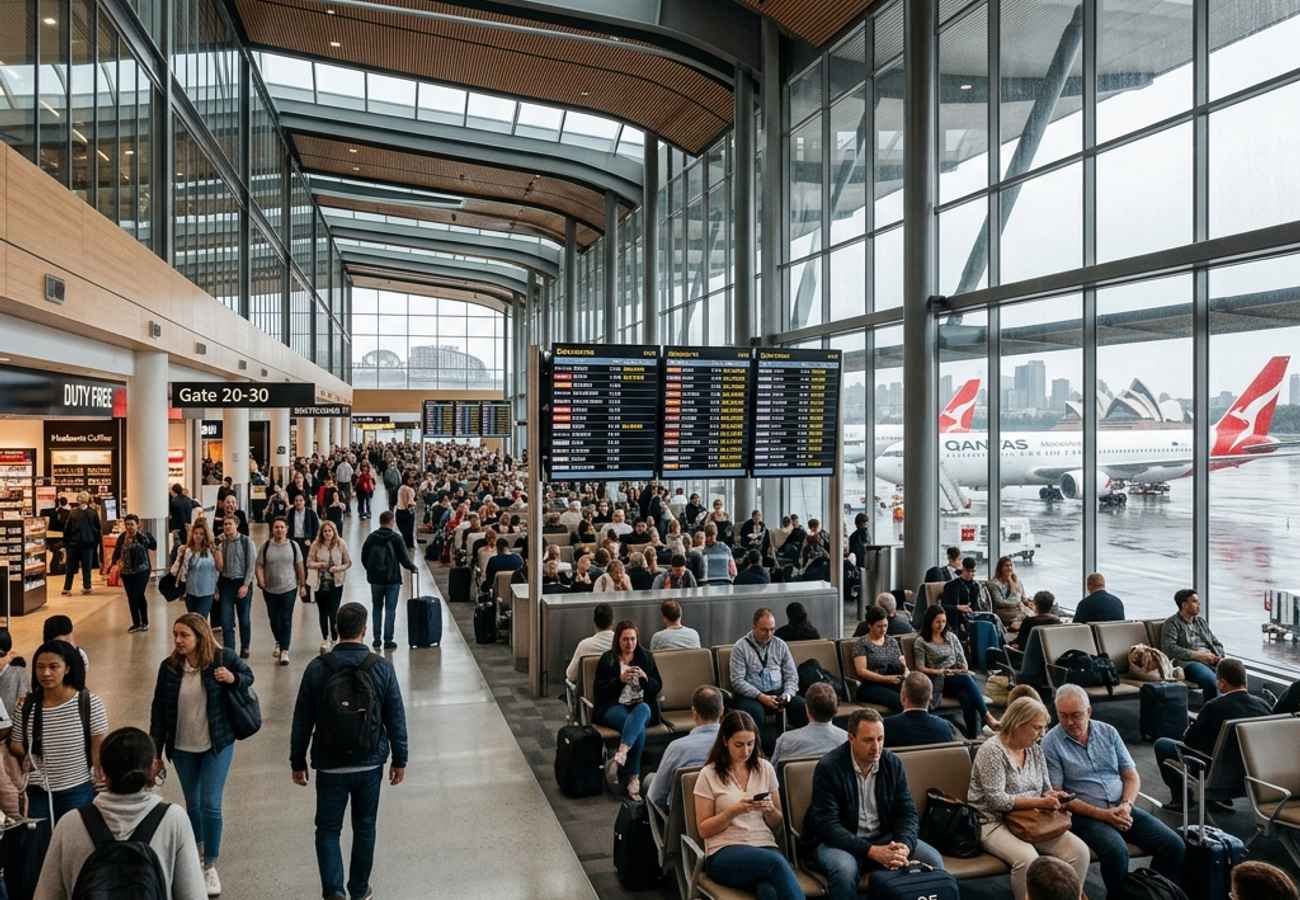
Image generated by AI
[Sydney, 5 July 2026] — Sydney Airport flight delays struck Australia's busiest international gateway on 5 July 2026, triggered by air traffic controller staffing constraints that forced wider departure spacing across peak operations. The disruption affected a hub handling more than 42.54 million passengers annually, including a record 17.17 million international travellers, and struck at the height of school holiday demand when aircraft rotations run tight and traveller tolerance for missed connections is minimal.
Australia's Travel Network Under Pressure as Sydney ATC Staffing Strains Operations
The 5 July delay event has intensified scrutiny of staffing resilience within Australia's air navigation system and its direct effect on airline punctuality, passenger confidence, and travel trade planning. Sydney Airport functions as a high-density convergence point where international arrivals, domestic trunk routes, regional New South Wales connections, cruise transfers, corporate travel, and meetings, incentives, conferences, and exhibitions itineraries all intersect.
When air traffic controllers widen departure spacing to manage staffing limitations, runway throughput drops immediately. At a gateway like Sydney, that reduction propagates rapidly. Knock-on effects can reach Melbourne, Brisbane, Perth, Canberra, Gold Coast, and regional NSW sectors within hours, as aircraft, crew, and gate sequences fall out of alignment.
The timing compounds the problem. School holiday periods mean aircraft rotations run on tighter margins, and travellers have little flexibility for missed hotel nights, cruise departures, conference openings, or connecting long-haul services. Travel agents and tour operators face immediate rebooking pressure when delays at the top of the network cascade downward.
Airservices Australia Manages 11 Per Cent of World's Airspace
Airservices Australia, the government-owned air navigation service provider, manages air traffic across 11 per cent of the world's airspace. Its published operational data outlines the scale of the national system: 161.2 million passenger movements in FY2025, 3,883 staff deployed across Australia, and 3.7 million aircraft movements in 2025.
The organisation has publicly acknowledged that consistent service quality depends on building and maintaining a sufficient operational workforce, including both air traffic controllers and aviation rescue fire fighters. Corporate planning documents identify workforce supply, deployment practices, fatigue management, systems, and procedures as core components of operational resilience.
Airservices is actively working to increase controller supply through an expanded trainee pipeline and targeted international recruitment. In 2026, the organisation confirmed a training agreement with Airways International in New Zealand, with student groups scheduled to arrive at the Christchurch training academy in April 2026. Airservices reported 91 controller endorsements in 2025 and aims to endorse another 95 in 2026.
| Workforce Resilience Factor | Officially Identified Measure | Travel-Sector Relevance |
|---|---|---|
| Controller supply | Expanded trainee pipeline | Supports medium-term network reliability |
| Recruitment | Targeted international recruitment | Addresses specialised skill shortage risk |
| Training capacity | Airways International training agreement | Builds additional controller throughput |
| 2025 controller endorsements | 91 | Shows active workforce replenishment |
| 2026 endorsement target | 95 | Indicates continued staffing focus |
Sydney Airport's 2025 Record Performance Amplifies Disruption Exposure
Sydney Airport's 2025 performance data explains why any operational disruption at this gateway carries broader economic weight. The airport handled more than 42.54 million passengers in 2025, a 2.7 per cent increase over 2024. International passengers reached 17.17 million, marking the airport's busiest year on record for international travel.
Q4 2025 figures reinforce the gateway's intensity: 11.41 million total passengers, including 4.62 million international travellers. Domestic and regional passenger numbers rose 2.1 per cent in the quarter to 6.79 million. Sydney is not merely an international entry point — it serves as a transfer engine for domestic tourism, regional dispersal, and corporate movement across Australia.
| Indicator | Latest Official Figure | Why It Matters for the Travel Trade |
|---|---|---|
| Total Sydney Airport passengers in 2025 | More than 42.54 million | Shows the scale of potential passenger exposure during disruption |
| International passengers in 2025 | 17.17 million | Confirms Sydney's role as Australia's main global gateway |
| Q4 2025 passengers | 11.41 million | Demonstrates peak-period operating intensity |
| Q4 2025 international passengers | 4.62 million | Highlights sensitivity for inbound tourism and long-haul connections |
| Q4 2025 domestic and regional passengers | 6.79 million | Shows exposure for domestic packages, regional touring, and fly-cruise itineraries |
Sydney's Movement Cap and Slot Rules Make Recovery Harder Than Expected
Sydney Airport operates under a formal demand management framework established by the Australian Government. The airport is governed by an hourly maximum of 80 aircraft movements per regulated hour, with a daily ceiling of 1,360 movements. It is classified as a Level 3 coordinated airport under IATA standards, meaning demand significantly exceeds available capacity and operators must hold allocated slots to land or depart.
This structural constraint explains why staffing-driven spacing changes produce a more complicated recovery than a simple late-running schedule. When flow rates drop during morning peaks, aircraft, crew, and gate sequences shift out of position. Recovery is then bounded by slot rules, runway capacity limits, curfew requirements, and airline rotation plans.
The Department of Infrastructure has implemented a reformed demand management framework that includes a recovery period mechanism. After significant disruption, a declared recovery period can temporarily permit up to 85 movements per hour for a maximum of two consecutive hours. This relief cannot be used during curfew hours and does not increase the total daily aircraft movement cap.
| Regulatory Feature | Official Setting | Operational Implication |
|---|---|---|
| Standard movement cap | Up to 80 movements per regulated hour | Limits runway recovery speed after delays |
| Daily movement cap | 1,360 movements per day | Prevents unlimited same-day catch-up |
| Recovery-period ceiling | Up to 85 movements per hour | Provides limited temporary relief after significant disruption |
| Recovery-period duration | Maximum two consecutive hours | Makes early operational decisions critical |
| Curfew limitation | Recovery cannot be used during curfew hours | Late-day disruption is harder to unwind |
Australian Network Performance Was Improving Before July Setback
The July disruption stands out because official May 2026 data indicated strengthening network performance. Airservices reported that the Australian aviation network recorded no Airservices-attributable air traffic flow management ground delays at the four major airports in May 2026. Airspace service variations were 18 per cent lower than May 2025. May ATFM ground delays represented just 1.4 per cent of total network delays and were driven primarily by weather.
BITRE data reinforced the positive trend. In May 2026, participating domestic airlines averaged 82.1 per cent on-time arrivals and 82.8 per cent on-time departures, with a cancellation rate of 1.5 per cent. These results exceeded long-term averages of 80.5 per cent for arrivals, 81.6 per cent for departures, and 2.2 per cent for cancellations.
That contrast carries real significance. A single staffing-led disruption at a major airport can undercut otherwise improving national indicators. It also demonstrates that monthly performance averages can mask sharp day-of-operation shocks that leave travellers stranded and travel sellers scrambling to rebook itineraries across multiple sectors.
Impact on Airlines, Travel Agents, and Corporate Travel Buyers
The 5 July event affects multiple layers of the travel ecosystem simultaneously. Airlines operating through Sydney face slot recovery constraints that limit their ability to absorb delays within the same operating day. With the 80-movement-per-hour cap and the two-hour recovery window capped at 85 movements, carriers cannot simply run extra sections to clear backlogs — particularly when curfew hours block late-day recovery.
Travel agents and tour operators managing school holiday bookings face immediate rebooking workloads. Fly-cruise passengers missing departure windows, conference attendees losing first-day registration, and escorted tour participants missing connection points all require rapid intervention. The concentration of international, domestic, and regional traffic at Sydney means a single spacing adjustment can disrupt itineraries across six or more Australian cities within hours.
Corporate travel managers and MICE planners face a different challenge. When ATC staffing constraints produce unpredictable day-of-operation delays, travel policy compliance and duty-of-care obligations become harder to meet. Travellers stranded by cascading delays may need overnight accommodation, meal vouchers, and rebooked flights — costs that fall on employers when disruptions originate from infrastructure rather than airline decisions.
Why This Matters: Australia's Aviation Bottleneck Problem
The Sydney Airport disruption reveals a structural vulnerability in Australia's aviation network that extends well beyond a single day of delays. The country's primary international gateway operates at capacity under normal conditions. When air traffic controller staffing reduces throughput even marginally, the system has almost no slack to absorb the shock.
The movement cap framework — designed to manage noise impact and environmental concerns — simultaneously limits the airport's ability to recover from disruptions. The recovery period mechanism helps, but a two-hour window at 85 movements per hour provides only marginal relief when an entire morning's flow rate has been reduced. Carriers cannot make up lost time during curfew hours, meaning late-day disruptions carry over to the following day and affect aircraft positioning across the entire network.
Airservices Australia's workforce strategy addresses the medium-term challenge. The 91 controller endorsements completed in 2025 and the 95-target for 2026 represent genuine replenishment, and the Airways International training partnership adds throughput capacity. But training pipelines take years to convert into fully rated controllers managing live traffic at a Level 3 coordinated airport where demand already exceeds available slots.
The broader lesson for the travel industry is that infrastructure-driven delays behave differently from weather events or airline-specific disruptions. They expose the intersection of regulatory caps, workforce planning, slot allocation rules, and operational recovery mechanisms. A staffing shortage at one control position can trigger spacing changes that reduce runway throughput, push aircraft out of sequence, and create a recovery backlog that the movement cap framework cannot fully absorb.
For global travel buyers, the Sydney case underscores a growing risk. As major gateway airports worldwide approach their structural capacity limits, workforce shortages in air navigation services can become the trigger point for systemic disruption. The recovery tools available — slot waivers, temporary movement increases, schedule adjustments — are only as effective as the workforce and regulatory flexibility behind them. Monthly performance statistics may show improvement, but a single day of ATC staffing pressure can erase weeks of gains and leave passengers questioning the reliability of the entire network.
Australia's busiest gateway just demonstrated that air traffic controller shortages are no longer a workforce issue — they are a travel industry resilience issue.
Related Travel Guides
Disclaimer
This article is for informational and educational purposes only. It does not constitute legal, financial, or professional advice. While we strive to provide accurate and up-to-date information, travel policies, regulations, and conditions change rapidly. Always verify information with official sources before making travel decisions. Nomad Lawyer makes no representations about the accuracy, reliability, completeness, or suitability of the information provided. Readers should consult qualified professionals for advice specific to their circumstances. The views expressed in this article are those of the author and do not necessarily reflect the views of Nomad Lawyer.
Preeti Gunjan
Contributor & Community Manager
A passionate traveller and community builder. Preeti helps grow the Nomad Lawyer community, fostering engagement and bringing the reader experience to life.
Learn more about our team →