
Singapore Airlines Schedules 2026 Ultra-Long US Flight Network
Singapore Airlines expands nonstop long-haul routes to New York JFK, Newark, Los Angeles, San Francisco, and Seattle using Airbus A350-900ULR aircraft.

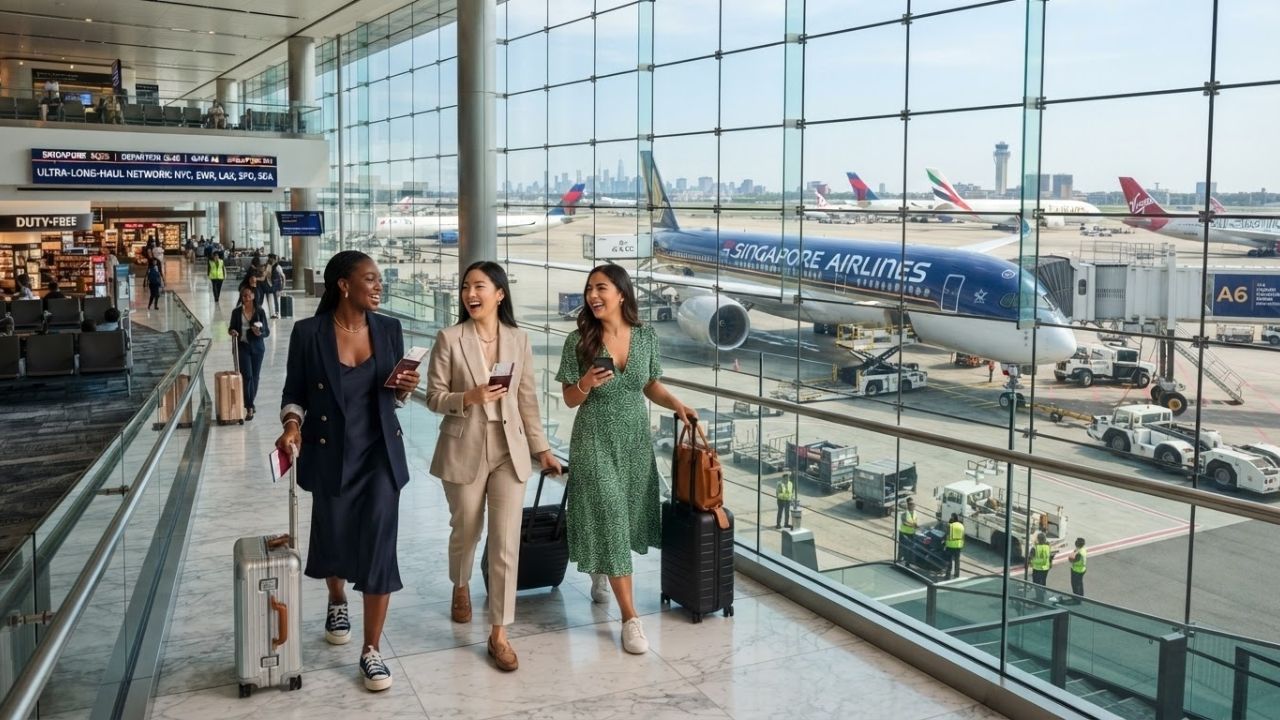
Image generated by AI
Bilateral flight schedule filings and fleet allocation reviews confirm that the Singapore Airlines US network will features five major nonstop gateways in late 2026. Operating some of the world's longest commercial routes, the carrier is utilizing its specialized Airbus A350-900ULR and standard long-haul A350 aircraft to link Singapore with economic hubs on both the East and West Coasts.
Aviation schedule filings indicate that nonstop long-range flights connect Singapore with John F. Kennedy International Airport (JFK), Newark Liberty International Airport (EWR), Los Angeles International Airport (LAX), San Francisco International Airport (SFO), and Seattle-Tacoma International Airport (SEA). This route alignment supports rising demand for time-saving, direct transpacific travel.
Scheduled Flight Frequencies and US Gateways in 2026
The carrier’s transatlantic and transpacific route profiles rank among the longest in global aviation, as detailed below:
Table 1: Singapore Airlines Longest A350 Routes in US Airports (2026)
| Global rank among SIA’s 11 longest A350 routes | US airport | Airport code | Non-stop route | Maximum scheduled duration in 2026 | Approximate frequency in the July 2026 schedule | Principal flight numbers |
|---|---|---|---|---|---|---|
| 1 | John F Kennedy International Airport, New York | JFK | Singapore–New York JFK | 19 hours 15 minutes | Daily | SQ23/SQ24 |
| 2 | Newark Liberty International Airport, New Jersey | EWR | Singapore–Newark | 19 hours 10 minutes | Daily | SQ21/SQ22 |
| 3 | Los Angeles International Airport, California | LAX | Singapore–Los Angeles | 17 hours 50 minutes | Ten weekly flights in the analysed schedule | SQ35/SQ36 and SQ37/SQ38 |
| 4 | San Francisco International Airport, California | SFO | Singapore–San Francisco | 17 hours 30 minutes | Twice daily | SQ31/SQ32 and SQ33/SQ34 |
| 5 | Seattle–Tacoma International Airport, Washington | SEA | Singapore–Seattle | Around 17 hours | Five weekly flights | SQ27/SQ28 |
Seating Configurations and Fleet Deployment Parameters
To operate flights exceeding 17 hours, the airline relies on two distinct cabin configurations:
Table 2: US Airport Airbus A350 Deployment Profiles (2026)
| US airport | Expected 2026 A350 deployment | Published seating configuration | Economy Class available? | Operational interpretation |
|---|---|---|---|---|
| New York JFK | A350-900ULR | 67 Business Class and 94 Premium Economy Class seats | No | A dedicated premium-heavy ultra-long-range operation designed for the world’s longest scheduled non-stop market. (Singapore Airlines) |
| Newark EWR | A350-900ULR | 67 Business Class and 94 Premium Economy Class seats | No | The original flagship ULR route. It remains one of the two longest scheduled non-stop passenger services globally. (Singapore Airlines) |
| Los Angeles LAX | Mixed A350 operation depending on flight and date, including A350-900ULR services | ULR: 67 Business and 94 Premium Economy; standard long-haul aircraft: 42 Business, 24 Premium Economy and 187 Economy seats | On standard-aircraft services | Passengers must check the aircraft and cabin map for their specific flight because not every LAX frequency necessarily uses the 161-seat ULR configuration. (Singapore Airlines) |
| San Francisco SFO | Mixed standard A350-900 and A350-900ULR operation | Either a three-cabin aircraft or the premium-only ULR configuration | Depends on flight | Singapore Airlines’ official route information confirms that some San Francisco services offer Economy while others carry only Business and Premium Economy cabins. (Singapore Airlines) |
| Seattle SEA | Standard long-haul A350-900 | Approximately 42 Business, 24 Premium Economy and 187 Economy seats | Yes | Seattle belongs to the airline’s ultra-long A350 network by distance and flying time, but it is not normally operated by the specialised 161-seat A350-900ULR. (Singapore Airlines) |
Route Comparisons for New York and New Jersey Corridors
Nonstop flights to JFK and Newark represent the top two longest scheduled passenger routes globally. Covering approximately 15,300 kilometers (9,500 miles), these operations bypass traditional European or Middle Eastern stopovers.
The specialized Airbus A350-900ULR operates daily flights to both airports. To support the commercial economics of these flights, the standard Economy cabin is removed, reducing aircraft weight and leaving a low-density, premium-focused cabin.
Mixed Fleet Operations at West Coast Gateways
Los Angeles and San Francisco flights utilize a mixed deployment strategy. Some flight numbers utilize standard A350-900 aircraft, while others are scheduled with the 161-seat ULR version.
This arrangement allows the carrier to balance business and leisure travel demand. San Francisco operates twice daily, allowing the airline to target Silicon Valley corporate travel with premium-only configurations while offering standard economy seats on alternate flights.
Standard Long-Haul Fleet Performance on the Seattle Route
The route to Seattle covers approximately 8,000 miles, with flight times averaging around 17 hours. Although classified as an ultra-long flight, the sector is operated with standard long-haul A350-900 aircraft.
This configuration includes a three-class layout: Business, Premium Economy, and standard Economy. It provides regional connectivity for the Pacific Northwest technology sector, complementing California and New York gateways.
US DOT Transatlantic Passenger Rights and Downgrade Rules
For travelers booking transpacific sectors under US DOT guidelines:
- Significant Flight Delays: If your flight from a US airport is canceled or delayed by more than six hours, you are entitled to a full refund to your original payment card if you choose to cancel.
- Downgrade Reimbursements: Due to mixed fleet operations on West Coast routes, a sudden aircraft swap (from standard to ULR) can result in cabin downgrades. If downgraded from Premium Economy to Economy, the airline must refund the fare difference, plus any ancillary seat-selection fees.
- Duty of Care: While US regulations do not mandate compensation during weather delays, standard airline commitments ensure hotel lodging and food vouchers are provided during overnight maintenance disruptions.
- Baggage Policies: Checked baggage limits are governed by the operating carrier's transpacific guidelines. Passengers should log bag tracking codes in the airline app.
Why This Matters
For the traveler, this means that selecting flight numbers SQ21 or SQ23 ensures a quieter, premium-only travel environment with no standard economy middle seats. From a logistical standpoint, the mixed aircraft scheduling at SFO and LAX requires passengers to verify their seat maps before booking to avoid unexpected cabin downgrades during aircraft swaps. Travelers should select seats in the middle of the Business cabin to minimize galley noise during the 19-hour flight.
Industry Outlook
Commercial airlines are retiring older four-engine fleets to meet carbon emission reduction goals. As twin-engine range capabilities expand, carriers will rely on advanced composites to operate direct point-to-point routes. Over the next year, expect airlines to implement automated biometric check-in gates to streamline boarding processes at US gateways. This operational strategy will reduce airport processing times.
Related Travel Guides
Disclaimer
This article is for informational and educational purposes only. It does not constitute legal, financial, or professional advice. While we strive to provide accurate and up-to-date information, travel policies, regulations, and conditions change rapidly. Always verify information with official sources before making travel decisions. Nomad Lawyer makes no representations about the accuracy, reliability, completeness, or suitability of the information provided. Readers should consult qualified professionals for advice specific to their circumstances. The views expressed in this article are those of the author and do not necessarily reflect the views of Nomad Lawyer.
Kunal K Choudhary
Co-Founder & Contributor
A passionate traveller and tech enthusiast. Kunal contributes to the vision and growth of Nomad Lawyer, bringing fresh perspectives and driving the community forward.
Learn more about our team →