
Typhoon Noul Disrupts China Aviation with Over 10000 Flights Delayed or Canceled
Typhoon Noul has heavily disrupted air travel in China, causing 8,816 flight delays and 2,152 cancellations across Guangzhou, Shanghai, and Shenzhen.

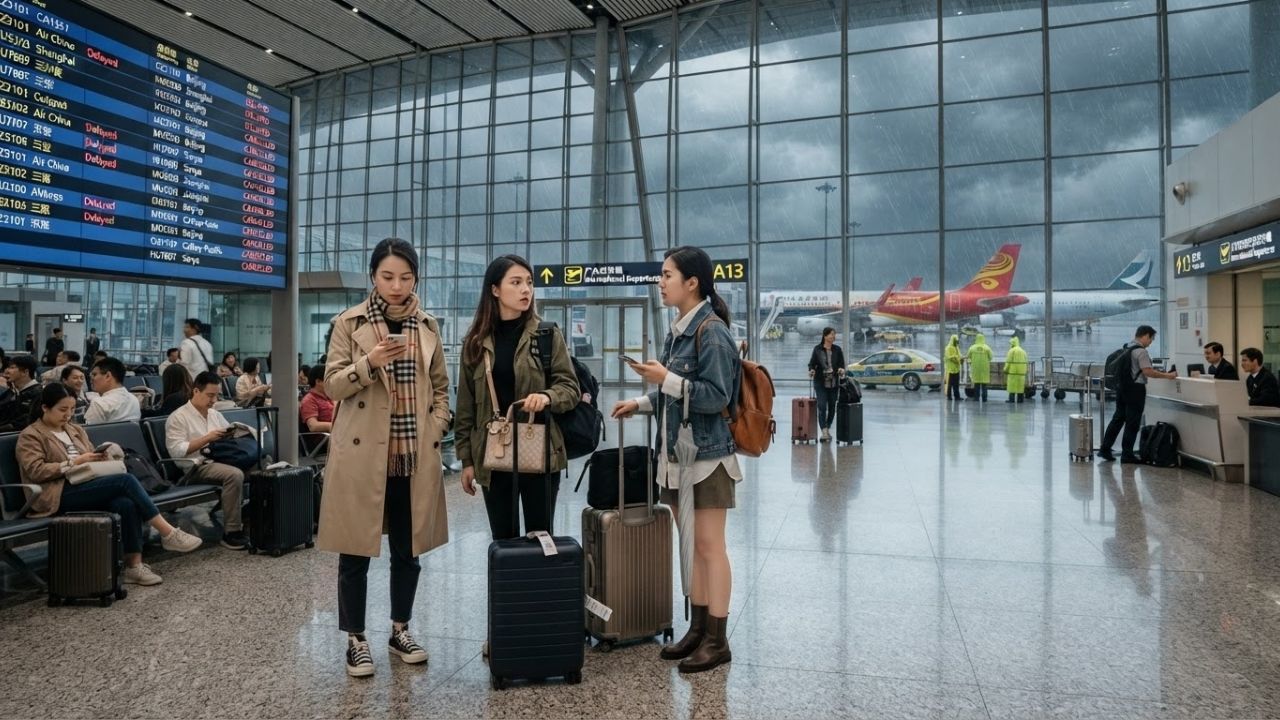
Image generated by AI
Typhoon Noul has heavily disrupted air travel in China, causing 8,816 flight delays and 2,152 cancellations across Guangzhou, Shanghai, and Shenzhen.
Bilateral weather logs and airport capacity tracking confirm that Typhoon Noul flight disruptions in China have resulted in 8,816 delays and 2,152 cancellations across major regional hubs. Strong winds and heavy precipitation have forced airlines to implement massive scheduling changes to protect passenger safety.
Data compiled from FlightAware on July 25 at 3:54 PM ET shows that major gateways in Guangdong, Shanghai, and Hong Kong faced high traffic reductions. Airlines, including China Eastern, China Southern, Air China, and Cathay Pacific, adjusted schedules to keep aircraft and crews positioned out of the storm's path.
Severe Weather Systems and Regional Airport Operations
Typhoon Noul brought intense convective activity, heavy rainfall, and wind shear to coastal sectors. These meteorological conditions make standard landing approaches unsafe.
Ground operations, including baggage handling, aircraft servicing, and cargo loading, slowed as airport authorities implemented safety checks. With wind speeds exceeding operational limits, carriers delayed departures, leading to cascading delays throughout domestic corridors.
Flight Interruption Metrics at Major Chinese Gateways
Disruptions were concentrated at major hubs, affecting domestic and transcontinental connections:
- Guangzhou Baiyun (CAN): Recorded 681 delays and 308 cancellations.
- Shanghai Pudong (PVG): Reported 650 delays and 60 cancellations, impacting long-haul transits.
- Shenzhen Bao’an (SZX): Registered 455 delays and 409 cancellations, causing domestic business travel halts.
- Hong Kong (HKG): Handled 404 delays and 281 cancellations as storms closed southern airspace.
- Beijing Capital (PEK): Managed 307 delays and 85 cancellations.
- Chengdu Tianfu (TFU): Logged 305 delays and 54 cancellations.
Other airports, including Shanghai Hongqiao (241 delays/62 cancellations), Xi’an Xianyang (276 delays/46 cancellations), Hangzhou Xiaoshan (315 delays/51 cancellations), and Nanjing Lukou (286 delays/43 cancellations), experienced delays.
Coastal and regional airports, including Qingdao Jiaodong (403 delays/16 cancellations), Urumqi Diwopu (264 delays/15 cancellations), Xiamen Gaoqi (247 delays/14 cancellations), Wuhan Tianhe (203 delays/48 cancellations), and Chongqing Jiangbei (235 delays/39 cancellations), faced flight backlog adjustments.
Outside the mainland, Macau International (76 delays/10 cancellations) and Taiwan Taoyuan (219 delays/22 cancellations) managed delays.
Carrier Scheduling Pressures and Fleet Delays
Airlines adjusted schedules to manage flight deck crew duty limits and coordinate aircraft swaps:
- China Eastern: Recorded 970 delays and 177 cancellations.
- China Southern: Filed 889 delays and 404 cancellations, representing the highest cancellation volume.
- Air China: Reported 345 delays and 207 cancellations.
- Cathay Pacific: Managed 156 delays and 196 cancellations.
- Shenzhen Airlines: Registered 346 delays and 61 cancellations.
- Hainan Airlines: Filed 260 delays and 44 cancellations.
- Spring Airlines: Logged 179 delays and 71 cancellations.
- XiamenAir: Reported 322 delays and 26 cancellations.
Tianjin Airlines (115 delays/20 cancellations), Sichuan Airlines (261 delays/7 cancellations), Shandong Airlines (307 delays/5 cancellations), and Shanghai Airlines (138 delays/4 cancellations) experienced disruptions.
Regional carriers, including Hong Kong Express (60 delays/25 cancellations), Hong Kong Airlines (34 delays/7 cancellations), China Airlines (72 delays/3 cancellations), EVA Air (58 delays/3 cancellations), and Air Macau (35 delays/3 cancellations), also modified schedules.
CAAC Regulations and Transit Passenger Rights Guidelines
For passengers affected by Typhoon Noul flight delays:
- Transit Passenger Rights: Under Civil Aviation Administration of China (CAAC) guidelines, if your delay occurs at a connecting airport (such as transiting through CAN or PVG), the airline must provide free meals, drinks, and hotel accommodation.
- Departure Airport Rules: If your flight is delayed due to weather at the airport of origin, the airline is not legally required to provide free lodging, though they must assist you in booking hotel rooms.
- Cancellations and Refunds: If a flight is canceled, passengers are entitled to a full ticket refund or free rebooking onto the next available flight.
- EU/UK Duty of Care: If you fly to China from the EU or UK on an EU/UK airline, the carrier's duty of care remains active under EU261. They must provide meals and hotels during weather-related delays at the European gateway.
Table 1: Airport Performance under Typhoon Noul (July 25, 2026)
| Airport Name | IATA Code | Delays Recorded | Cancellations Recorded | Primary Operations Status |
|---|---|---|---|---|
| Guangzhou Baiyun | CAN | 681 | 308 | Major hub delay peak |
| Shanghai Pudong | PVG | 650 | 60 | Key long-haul connection delays |
| Shenzhen Bao’an | SZX | 455 | 409 | Highest domestic cancellation rate |
| Hong Kong International | HKG | 404 | 281 | Regional transit corridor backlogs |
| Beijing Capital | PEK | 307 | 85 | Schedule recovery programs active |
| Chengdu Tianfu | TFU | 305 | 54 | Flow control restrictions |
| Hangzhou Xiaoshan | HGH | 315 | 51 | Weather alerts active |
| Nanjing Lukou | NKG | 286 | 43 | Flight adjustments active |
| Xi’an Xianyang | XIY | 276 | 46 | Ground delay programs |
| Shanghai Hongqiao | SHA | 241 | 62 | Slot restriction limits |
| Taiwan Taoyuan | TPE | 219 | 22 | Regional weather holding patterns |
| Macau International | MFM | 76 | 10 | Coastal wind warnings active |
Table 2: Airline Scheduling Adjustments (July 25, 2026)
| Airline Name | IATA Code | Delays Filed | Cancellations Filed | Fleet Management Status |
|---|---|---|---|---|
| China Eastern | MU | 970 | 177 | Highest delay burden nationwide |
| China Southern | CZ | 889 | 404 | Highest cancellation count |
| Air China | CA | 345 | 207 | Hub-and-spoke flow protections |
| Cathay Pacific | CX | 156 | 196 | Hong Kong terminal cancellations |
| Shenzhen Airlines | ZH | 346 | 61 | Regional route suspensions |
| XiamenAir | MF | 322 | 26 | Coastal weather modifications |
| Sichuan Airlines | 3U | 261 | 7 | West-route schedule maintenance |
| Hainan Airlines | HU | 260 | 44 | Fleet repositioning active |
| Spring Airlines | 9C | 179 | 71 | Low-cost schedule reviews |
| Shanghai Airlines | FM | 138 | 4 | Eastern hub flight delays |
Why This Matters
For the traveler, this means that transiting through southern Chinese hubs during typhoon season requires single-ticket bookings to ensure CAAC-mandated connecting protection. From a logistical standpoint, the high volume of cancellations at Shenzhen compared to Shanghai Pudong indicates that domestic routes are cut first to preserve international long-haul slots. Travelers should keep electronic boarding passes active on WeChat or Alipay to receive gate changes.
Industry Outlook
Airlines in Asia are coordinating with national meteorology departments to redirect aircraft to inland alternate airports before storms reach the coast. As hubs invest in rapid-drainage runway systems, ground handling delays caused by runway flooding will decrease. Over the next year, expect carriers to offer automatic train rebooking options for high-speed rail links during regional flight cancellations. This multimodal integration will stabilize passenger flows.
Related Travel Guides
Disclaimer
This article is for informational and educational purposes only. It does not constitute legal, financial, or professional advice. While we strive to provide accurate and up-to-date information, travel policies, regulations, and conditions change rapidly. Always verify information with official sources before making travel decisions. Nomad Lawyer makes no representations about the accuracy, reliability, completeness, or suitability of the information provided. Readers should consult qualified professionals for advice specific to their circumstances. The views expressed in this article are those of the author and do not necessarily reflect the views of Nomad Lawyer.
Kunal K Choudhary
Co-Founder & Contributor
A passionate traveller and tech enthusiast. Kunal contributes to the vision and growth of Nomad Lawyer, bringing fresh perspectives and driving the community forward.
Learn more about our team →