
Singapore Airlines Defeats Asian Travel Chaos With Massive Expansion: Launches Daily Airbus A350 Service to Hangzhou as China Aviation Recovers
Breaking airline news: Singapore Airlines dramatically expands its East China network with a daily Airbus A350 service to Hangzhou, defeating regional travel chaos as the China corridor surges to 115% of pre-pandemic levels.

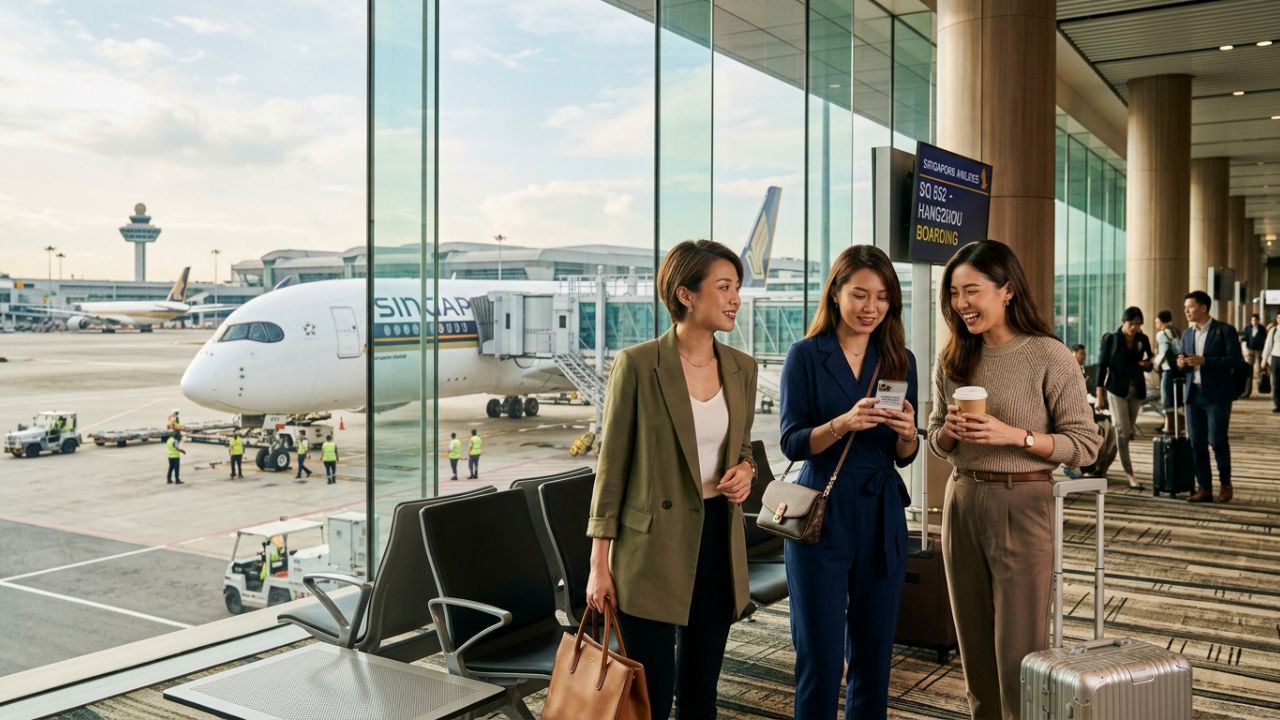
Image representing the strategic capacity expansion by Singapore Airlines as it launches a daily Airbus A350 service between Singapore and Hangzhou, bypassing regional airport disruptions and capitalizing on the massive 115% recovery in China-bound aviation traffic. (Image Credit: Aviation Capacity Tracking)
Singapore Airlines Defeats Asian Travel Chaos With Massive Expansion: Launches Daily Airbus A350 Service to Hangzhou as China Aviation Recovers
Bypassing Regional Airport Disruptions, the Singapore-China Corridor Surges to 115 Percent of Pre-Pandemic Levels
While massive segments of the global aviation industry remain hopelessly bogged down by rolling flight cancellations and severe airport disruptions, the critical Singapore-China corridor is experiencing a massive, explosive expansion. According to the latest breaking airline news and strategic aviation updates, Singapore Airlines has dramatically strengthened its mainland China footprint by inaugurating a massive new daily service between Singapore Changi Airport and Hangzhou. By directly injecting premium wide-body capacity into the rapidly expanding East China market, Singapore Airlines is effectively defeating the regional travel chaos that has plagued other Southeast Asian corridors. This aggressive move is driven by a massive surge in travel demand, completely supported by highly frictionless visa-free access and a powerful recovery in cross-border mobility.
The highly strategic expansion definitively proves that the Singapore-China aviation market has not merely recovered—it has absolutely eclipsed its former baseline. With passenger traffic on Singapore-China routes now operating at a staggering 115 percent of pre-pandemic levels, airlines are actively scaling frequencies rather than cautiously rebuilding. While travelers on less mature routes continue to battle severe travel chaos and unpredictable scheduling, the launch of these reliable, daily connections by Singapore Airlines and Shanghai Airlines provides absolute stability for both high-yield business travelers and mass-market tourism. By reinforcing Singapore Changi Airport as the ultimate global transit hub into the Chinese mainland, the airline is ensuring that passengers can seamlessly bypass the debilitating airport disruptions currently crippling other major Asian transit gateways.
Section-Wise Breakdown: The Anatomy of the Singapore-China Expansion
The massive scaling of the Singapore-China corridor is defined by highly calculated aircraft deployments targeting distinctly different economic hubs:
The Hangzhou Airbus A350 Expansion On June 1, 2026, Singapore Airlines officially inaugurated its highly anticipated daily flights between Singapore and Hangzhou, a rapidly growing technology and commerce super-hub in East China. This launch is highly strategic. Hangzhou is not treated as a marginal secondary city; it represents the absolute cutting edge of China's digital economy expansion. By establishing this massive daily connection, Singapore Airlines is aggressively tapping into a lucrative blend of corporate business travel and heavy outbound tourism. To accommodate this massive demand, the airline has deployed the formidable Airbus A350-900 on the route. Configured with a heavy layout of 40 business class seats and 263 economy class seats, this wide-body deployment definitively signals that Singapore Airlines anticipates intense, long-term aggregate demand. Hangzhou officially becomes the airline's ninth destination in mainland China, a move specifically designed to eliminate the travel chaos of routing through heavily congested domestic Chinese hubs.
The Shanghai Narrow-Body Rebuild In a parallel, highly coordinated expansion, Shanghai Airlines officially launched its own daily flights between Singapore and Shanghai Pudong International Airport on June 10, 2026. This fixed daily frequency directly supports consistent, high-volume passenger flow between two of the world's most critical financial centers. Unlike the wide-body Hangzhou deployment, Shanghai Airlines has strategically opted for the Boeing 737 MAX 8 narrow-body jet. Configured with exactly eight business class seats and 168 economy class seats, this deployment specifically targets the massive volume of visiting friends and relatives (VFR) traffic, alongside steady, moderate corporate travel. By utilizing the highly fuel-efficient 737 MAX 8, the airline ensures excellent load factors and operational reliability, definitively shielding passengers from the rolling flight cancellations that often plague over-committed, low-density international routes.
The Visa-Free Catalyst vs. Regional Disruptions The absolute foundation supporting this massive aviation expansion is the highly successful implementation of visa-free travel between Singapore and China. In aviation economics, removing administrative friction is the ultimate weapon against depressed travel demand. By eliminating complex visa requirements, business travelers and tourists can execute short-stay travel immediately, radically increasing flight frequencies. Dai Haoyu, senior vice president of marketing planning at Singapore Airlines, explicitly confirmed this, noting that the Hangzhou route is perfectly designed to cater to this highly flexible, dual-market demand. This policy-driven explosion completely contrasts with the severe travel chaos seen in the Singapore-Thailand corridor, which is currently struggling at a mere 59 percent of pre-pandemic capacity levels.
Flight Details: The Factual Singapore-China Aviation Matrix
To provide exact, factual clarity on this massive capacity scaling, aviation analysts have mapped the precise operational metrics of the newly launched routes and the broader recovery statistics. The following factual matrix details the exact breakdown of the Singapore-China aviation expansion:
Factual Singapore-China Aviation Capacity Matrix
| Operational Metric | Factual Aviation Data |
|---|---|
| Singapore Airlines - Hangzhou Route Launch | June 1, 2026 (Daily Frequency) |
| Hangzhou Aircraft & Configuration | Airbus A350-900 (40 Business / 263 Economy) |
| Shanghai Airlines - Shanghai Route Launch | June 10, 2026 (Daily Frequency) |
| Shanghai Aircraft & Configuration | Boeing 737 MAX 8 (8 Business / 168 Economy) |
| Total Singapore Airlines Group China Hubs | 22 Destinations (Includes Scoot subsidiaries) |
| Total Weekly Singapore-China Flights | Approximately 112 weekly flights (Singapore Airlines Group) |
| Singapore-China Market Recovery | ~115% of pre-pandemic levels |
| Singapore-Thailand Market Recovery | ~59% of pre-pandemic levels |
Data reflects the exact capacity deployments and recovery metrics verified in June 2026. (Source: Aviation Capacity Tracking)
Passenger Impact: Direct Routes Eliminate Missed Connections
For the traveling public, the dramatic expansion of direct, daily wide-body and narrow-body services between Singapore and East China represents a massive victory over regional travel chaos. Historically, accessing emerging economic hubs like Hangzhou required passengers to endure agonizing layovers in ultra-congested mega-hubs like Beijing or Shanghai Pudong, deeply exposing them to severe weather-related flight cancellations and incredibly stressful missed connections. By establishing direct, reliable point-to-point connections out of the world-class Changi transit hub, Singapore Airlines and Shanghai Airlines are guaranteeing passenger security. Travelers can now bypass the unpredictable domestic Chinese transit network entirely, eliminating the physical and psychological toll of sudden airport disruptions.
Industry Analysis: Scaling Beyond the Recovery Phase
Aviation analysts closely monitoring the Southeast Asian aviation grid emphasize that the Singapore-China corridor is entirely unique. While massive segments of the global aviation network are still desperately attempting to rebuild their 2019 baseline networks, the Singapore-China market has entered an aggressive, unbridled expansion cycle. Operating at 115% of historical levels, the sheer volume of traffic demands a highly diversified fleet strategy. The simultaneous deployment of the heavy Airbus A350-900 by Singapore Airlines and the highly efficient Boeing 737 MAX 8 by Shanghai Airlines proves that carriers are meticulously aligning aircraft types with highly granular demand data. With the Singapore Airlines Group now commanding approximately 112 weekly flights into China across 22 destinations, Changi Airport has firmly established itself as the absolute dominant gateway connecting the Chinese mainland to the global network.
Conclusion: A Calibrated Masterclass in Capacity Expansion
The simultaneous launch of daily services to Shanghai and Hangzhou marks a definitive, highly structural shift in regional aviation economics. While other corridors continue to battle depressing recovery rates and relentless travel chaos, the Singapore-China network has fundamentally transformed into an expansion juggernaut. Driven by the massive tailwinds of visa-free travel and surging dual-market demand, carriers are aggressively scaling operations with precision deployments of the Airbus A350-900 and Boeing 737 MAX 8. As Singapore Airlines deepens its absolute dominance in East China with over 112 weekly flights, passengers are the ultimate beneficiaries, gaining access to a highly reliable, high-frequency network that permanently bypasses the devastating airport disruptions defining the current era of commercial travel. (Source: Aviation Capacity Tracking via Nomad Lawyer)
Key Takeaways
- Massive Wide-Body Expansion: Singapore Airlines inaugurated a daily direct service to Hangzhou on June 1, 2026, utilizing a high-capacity Airbus A350-900.
- Targeted Narrow-Body Routing: Shanghai Airlines launched daily flights to Shanghai on June 10, 2026, deploying the highly efficient Boeing 737 MAX 8.
- Surging Recovery Metrics: Passenger traffic on Singapore-China routes has exploded to approximately 115% of pre-pandemic levels.
- Total Network Dominance: The Singapore Airlines Group (including Scoot) now serves 22 destinations across mainland China with approximately 112 weekly flights.
- Visa-Free Catalyst: The aggressive scaling of these routes is heavily supported by frictionless visa-free travel, dramatically accelerating both business and leisure passenger flow.
✈️ Frequently Asked Questions (Factual Aviation Capacity Data)
When did Singapore Airlines and Shanghai Airlines launch their new daily services to East China? Singapore Airlines officially inaugurated its daily flights to Hangzhou on June 1, 2026. Shanghai Airlines launched its daily service to Shanghai Pudong on June 10, 2026.
What specific aircraft is Singapore Airlines utilizing for the new Hangzhou route? Singapore Airlines is operating the route using a wide-body Airbus A350-900, configured with 40 business class seats and 263 economy class seats.
What specific aircraft is Shanghai Airlines deploying on the Singapore-Shanghai route? Shanghai Airlines is operating the route using a narrow-body Boeing 737 MAX 8, explicitly configured with 8 business class seats and 168 economy class seats.
Exactly how much has the Singapore-China aviation market recovered compared to pre-pandemic levels? Passenger traffic on the Singapore-China routes has massively surged, now operating at approximately 115 percent of pre-pandemic levels.
How does the China recovery compare to other regional corridors like Thailand? The recovery is drastically uneven; while the China corridor sits at 115%, Singapore-Thailand routes are currently struggling at approximately 59 percent of pre-pandemic levels.
How many destinations does the Singapore Airlines Group currently serve in mainland China? When combined with operations from its low-cost subsidiary Scoot, the Singapore Airlines Group now serves exactly 22 destinations across mainland China.
Exactly how many weekly flights does the Singapore Airlines Group operate into China? The Singapore Airlines Group currently operates a massive volume of approximately 112 weekly flights between Singapore and China.
Who confirmed the strategic dual-market demand approach for the new Hangzhou service? Dai Haoyu, senior vice president of marketing planning at Singapore Airlines, officially noted that the new route is strategically designed to cater to both leisure and business travelers.
🌍 Related Travel Guides & Flight Resources
- Navigate Airport Disruptions Like a Pro Master the art of surviving unexpected travel chaos with our expert strategies.
- Breaking Airline News & Evasion Routes Stay ahead of the delays with our real-time aviation updates and route intelligence.
- Global Flight Cancellation Defense Grid Essential legal rights and compensation tactics when your flight goes down.
⚖️ Disclaimer
The aviation capacity metrics, aircraft deployment configurations, and route recovery statistics provided in this report are for informational purposes only. The specific variables regarding the Singapore-China aviation corridor—including the exact configurations of the Airbus A350-900 and Boeing 737 MAX 8, the 115% recovery metric, and the 112 weekly group flights—are subject to ongoing review and strategic adjustment by corporate airline planners and civil aviation authorities. All data regarding the Hangzhou and Shanghai route launches has been officially sourced from aviation capacity tracking networks as of June 15, 2026. NomadLawyer does not guarantee the absolute accuracy or current validity of the information provided and assumes no liability for sudden aircraft equipment swaps, schedule modifications, unannounced flight cancellations, or any financial consequences resulting from the use of this content. Passengers are strongly advised to verify their specific aircraft type and seating configuration directly through the airline prior to departure.
Disclaimer
This article is for informational and educational purposes only. It does not constitute legal, financial, or professional advice. While we strive to provide accurate and up-to-date information, travel policies, regulations, and conditions change rapidly. Always verify information with official sources before making travel decisions. Nomad Lawyer makes no representations about the accuracy, reliability, completeness, or suitability of the information provided. Readers should consult qualified professionals for advice specific to their circumstances. The views expressed in this article are those of the author and do not necessarily reflect the views of Nomad Lawyer.
Kunal K Choudhary
Co-Founder & Contributor
A passionate traveller and tech enthusiast. Kunal contributes to the vision and growth of Nomad Lawyer, bringing fresh perspectives and driving the community forward.
Learn more about our team →