
Seven European Nations Launch Coordinated Eco-Tourism Circuit for Bird Watching Across Protected National Parks in 2026
Spain, France, Finland, Germany, Netherlands, UK, and Italy unite to create a sustainable bird-watching travel network spanning critical migratory corridors and pristine wetland ecosystems.

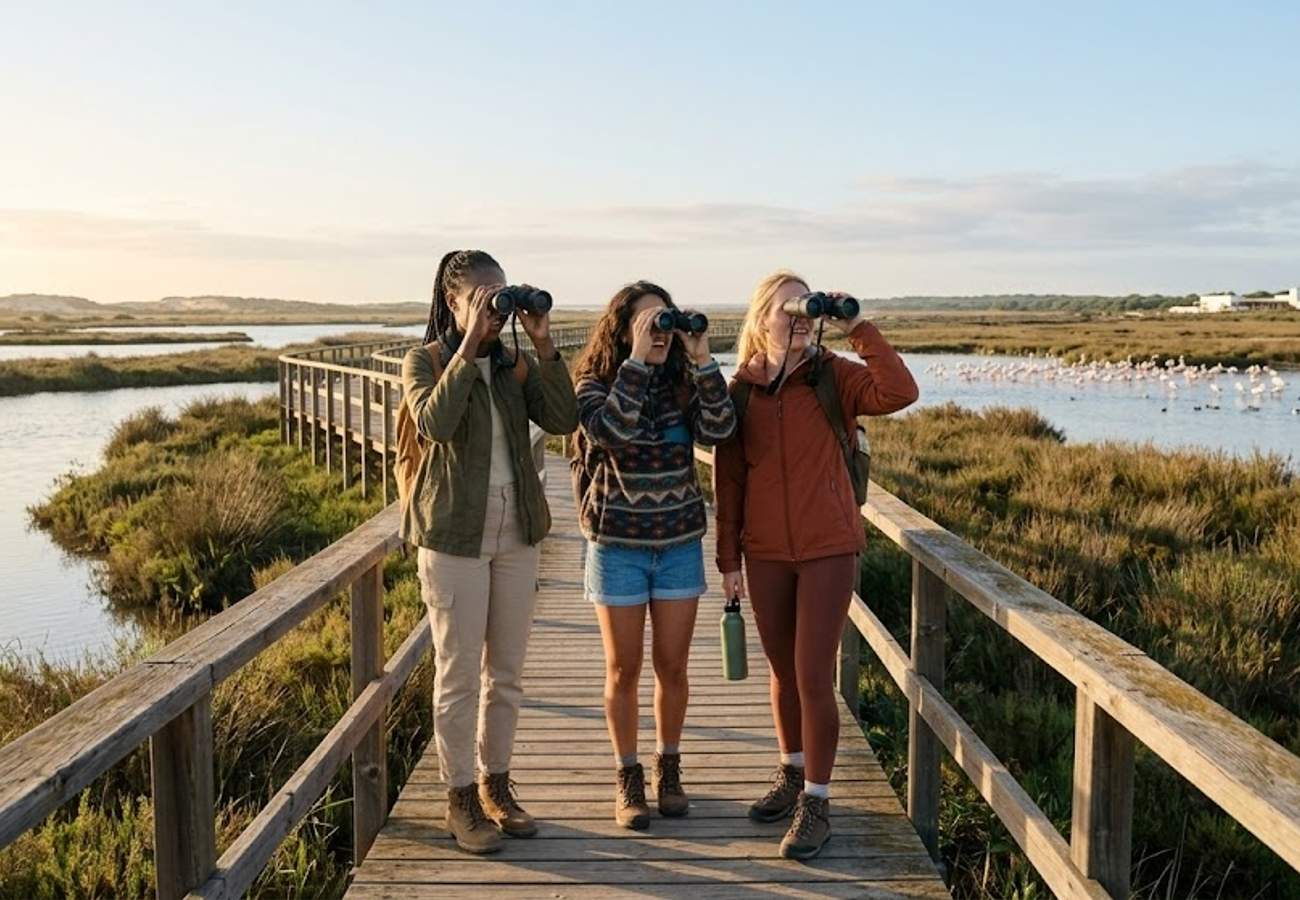
Image generated by AI
I've spent the better part of two decades chasing migratory birds across three continents, and I can tell you: what Europe is attempting right now is genuinely unprecedented. Seven nations—Spain, France, Finland, Germany, Netherlands, UK, and Italy—have just formalized a cross-border ecological circuit designed specifically for sustainable bird-watching travel. This isn't a vague partnership memo. These countries are coordinating real infrastructure, conservation protocols, and visitor management systems across interconnected flyways that funnel millions of birds annually between Africa, the Mediterranean, and the Arctic.
Spain's Doñana: Where the Atlantic Meets African Migration Routes
When I first visited Doñana National Park in Andalusia during the spring migration of 2019, I understood immediately why Spain anchors this entire initiative. The park sprawls across 135,000 hectares of lagoons, salt marshes, and coastal dunes—and it sits at the precise chokepoint where birds transitioning from sub-Saharan Africa to northern Europe concentrate in staggering densities.
I recommend arriving in the town of El Rocío (about 1.5 hours from Seville via the A-483) rather than approaching from Huelva. The western entrance at José Antonio Valverde Visitor Center opens at 8:00 AM, and early morning light here is incomparable. Over 300 bird species move through annually—imperial eagles, spoonbills, greater flamingos—but you need to time it right. Late March through April sees the densest spring passage; September through October brings equally spectacular autumn movements.
The Strait of Gibraltar 15 kilometers south amplifies this effect. Raptors funnel through in visible waves. I've watched thermal columns packed with buzzards, kites, and eagles so thick you couldn't count them. Local guides at the visitor center can brief you on daily sightings (they maintain detailed logs), and they'll tell you where the previous day's rarities showed up.
"Doñana is crowded during peak migration weeks. Skip the main lagoon tour and hire a private guide to explore the marshes behind Acebuche—you'll see the same birds with 10% of the tourists. The kingfishers and herons are ridiculous back there." — r/birdwatching
France's Camargue: The Flamingo Factory
The Camargue Regional Nature Park, roughly 80 kilometers southwest of Marseille, operates as Europe's flamingo stronghold and a wetland biodiversity engine. I've been three times, and each visit revealed new details about how French conservation authorities manage 400+ bird species within a landscape of salt marshes and lagoons that seems almost impossible to protect given its accessibility.
The Parc Ornithologique du Pont-de-Gau, positioned on the D570 between Arles and Saintes-Maries-de-la-Mer, opens daily at 9:00 AM (October–March closes at 5:00 PM; April–September closes at 6:00 PM). This is managed bird-watching infrastructure—elevated boardwalks, hides positioned at exact angles to eliminate your silhouette, and careful water management that concentrates species predictably. You'll see greater and lesser flamingos, purple herons, black-winged stilts. Bring a 300mm lens minimum if you're photographing.
The real magic happens during spring staging (mid-March to mid-May) when northbound African migrants pause to refuel. Shorebird diversity spikes dramatically. I watched a mixed flock of curlews, godwits, and sandpipers numbering in the thousands move across a single lagoon at the Salins de Giraud salt works (accessible via the D36). Local birders based in nearby Arles will tell you the Camargue's ecosystem is intricately tied to salt production cycles—the shallower, more saline ponds create specific feeding conditions that concentrate certain species.
Finland's Arctic Silence Zones: Where Noise Becomes the Enemy
Finland presented a completely different challenge when I visited Pallas-Yllästunturi National Park in northern Lapland last June. Here, at 67°N latitude, bird-watching becomes less about spectacle and more about intimacy with species you simply won't see further south.
The park (managed by Metsähallitus) covers 50,000 hectares of boreal forest interspersed with fells and open tundra. Access is via Ivalo town, roughly 320 kilometers northeast of Rovaniemi. Mid-June through July provides the midnight sun effect—continuous golden-hour lighting—which explains why this region has become a destination for serious wildlife photographers. Arctic species here include willow grouse, Eurasian woodcock, and various owl species that breed in near-total isolation.
The critical advantage Finland offers is "silence preservation." Protected zones enforce strict noise restrictions and vehicle limitations. I spent an entire morning sitting motionless near a larch forest at 1:00 AM (full daylight) listening to the ambient soundscape—no machinery, no voices beyond 50 meters. Bird behavior is dramatically different when human disturbance approaches zero. You'll observe natural foraging, mate-calling, and parental behavior that simply doesn't happen in busier ecosystems.
Book accommodations through Visit Inari or Ivalo-based lodges that understand the constraints. This isn't a casual destination; it requires patience and specific birding knowledge.
Germany's Alpine Precision: Elevation as Biodiversity Engine
Bavaria's national park system, particularly Berchtesgaden National Park (roughly 2 hours south of Munich via the B20), demonstrates how elevation gradients create stacked bird communities within compact geography. I explored this with a local guide from the park's research station in Bad Reichenhall, and the systematic nature of German conservation management became immediately apparent.
You move vertically through entirely different bird communities. Lower elevations (600–1,000 meters) support woodpeckers, nuthatches, and various songbirds. Mid-elevation zones (1,000–1,700 meters) transition to alpine thrushes, ring ouzels, and snow finches. Higher ridges (1,700+ meters) host golden eagles and choughs. The park maintains marked observation points with interpretive signage at each elevation zone.
German conservation authorities publish detailed species distribution maps and maintain accessible databases. This precision management means you can predict what you'll encounter with reasonable certainty, and you can plan routes accordingly. Spring (May–June) brings breeding birds and territorial displays; autumn (September–October) activates migration.
Netherlands' Engineered Wetlands: Humanity Rewilding Its Own Mistakes
Oostvaardersplassen, roughly 35 kilometers southeast of Amsterdam via the A2, represents perhaps the most radical bird-watching success story in Europe: a former dumping site and industrial zone transformed (since 1968) into a 6,000-hectare wetland supporting massive waterfowl populations.
I visited in March during pre-breeding season, when geese and diving ducks congregate in almost incomprehensible numbers. The landscape is entirely artificial—dikes, managed water levels, planted reed beds—yet it functions as a genuine ecological engine. Spoonbills breed here. White-tailed eagles hunt here. Cormorant colonies number in the thousands.
Access is via designated observation platforms around the perimeter (vehicle access is restricted to protect breeding birds). The eastern dike offers the best vantage points. Spring and autumn migrations bring the densest bird movements; winter supports overwintering populations of northern species seeking open water.
This site demonstrates that you don't need "pristine wilderness" for world-class bird-watching. Engineered ecosystems, managed with ecological intention, work.
UK's RSPB Network: Organized Observation Infrastructure
The Royal Society for the Protection of Birds manages over 200 reserves across the UK, and their approach to visitor infrastructure while maintaining bird welfare is the most advanced I've encountered anywhere.
Rutland Water, a 1,260-hectare reservoir in the East Midlands (roughly 1.5 hours north of London via the A1), exemplifies this model. The site's osprey reintroduction program (which began in 1996 after a 150-year absence) now supports 60+ breeding pairs. The visitor facilities include designated hides positioned to eliminate disturbance while enabling close observation and photography. I spent a morning in the North Arm hide in May and watched osprey courtship displays from perhaps 80 meters away—close enough to photograph eye detail, far enough that the birds showed no stress behavior.
The RSPB website provides real-time sighting logs for each reserve, updated by volunteer monitors. You can plan visits around confirmed species presence. This transforms bird-watching from random searching into strategic observation.
Italy's Mediterranean Crossroads
Italy completes this seven-nation circuit by anchoring the southern Mediterranean. The Strait of Messina and Sicily's wetlands concentrate both spring and autumn migrants at densities rivaling Spain's Strait of Gibraltar.
Gela, on Sicily's southern coast, attracts concentrations of warblers, wheatears, and raptors during spring passage (late March through April). Local birding communities maintain detailed sighting networks, though infrastructure is less developed than northern European sites.
Practical Visitor Guide
Best Times to Visit
Spring migration (mid-March through May) offers peak bird density and activity across all sites. Autumn (August through October) provides secondary but excellent opportunities. Winter is quieter except in Netherlands and UK, where overwintering waterbirds concentrate. Finland is summer-exclusive (June–July) due to weather and accessibility.
Safety and Navigation
All seven nations maintain high general safety standards. Park regulations exist specifically to protect birds, not visitors—respect closure areas and designated pathways. Bring insect repellent (particularly Finland and France). Accommodation books rapidly during migration peaks; reserve 3–4 months ahead for spring trips.
Budget Expectations
Spain and France: €40–80 per day for park access and guide services. Finland: €70–120 (accommodations are pricier; infrastructure is minimal). Germany and UK: €50–100. Netherlands: €30–60. Hire local guides for €100–200 daily—they provide real-time sighting intel and species identification you won't get alone.
Equipment
Minimum 8x42 binoculars (€300–600 quality range). For photography, 150–300mm telephoto lenses. Field guides covering European birds (Svensson's "The Handbook of the Birds of Europe, the Middle East and North Africa" is the regional standard).
Book these reserves early, move with intention, and understand that you're traveling within carefully balanced ecosystems—your presence is permitted, not guaranteed.
Related Travel Guides
Disclaimer
This article is for informational and educational purposes only. It does not constitute legal, financial, or professional advice. While we strive to provide accurate and up-to-date information, travel policies, regulations, and conditions change rapidly. Always verify information with official sources before making travel decisions. Nomad Lawyer makes no representations about the accuracy, reliability, completeness, or suitability of the information provided. Readers should consult qualified professionals for advice specific to their circumstances. The views expressed in this article are those of the author and do not necessarily reflect the views of Nomad Lawyer.
Raushan Kumar
Founder & Lead Developer
Full-stack developer with 11+ years of experience and a passionate traveller. Raushan built Nomad Lawyer from the ground up with a vision to create the best travel and law experience on the web.
Learn more about our team →