
Security Failures Leave Dozens Stranded at European Airports in April 2026
Security failures leave passengers stranded across European airports in April 2026 as staff shortages and new EU biometric checks combine to disrupt dozens of flights. Hundreds of travelers face missed departures, compensation battles, and delayed onward connections.

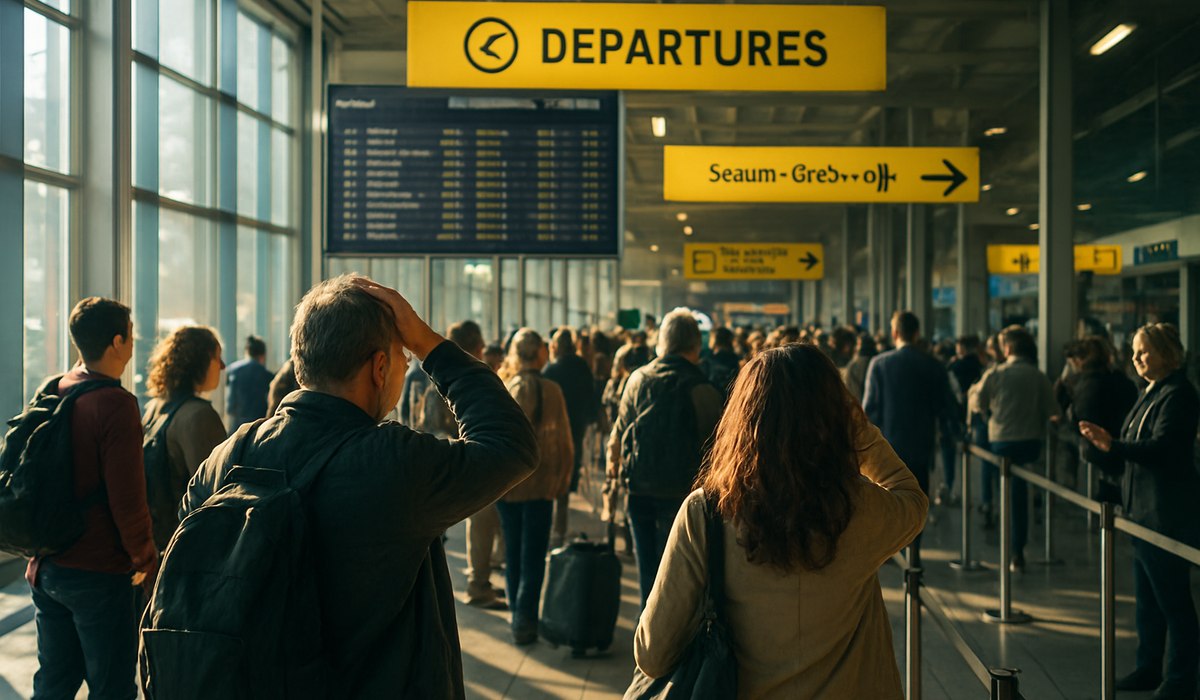
Image generated by AI
Security Failures Leave Travelers Stranded Across Europe
European airports faced a coordinated crisis in April 2026 as security staffing breakdowns and newly implemented EU biometric checks combined to leave dozens of passengers stranded at departure gates and watching aircraft depart empty. Across France, Italy, Portugal, and the United Kingdom, security failures have disrupted hundreds of flights, trapped non-EU travelers in hours-long border queues, and triggered a cascade of missed connections and passenger compensation claims. At Vatry Airport near Reims, France, a Ryanair flight to Marrakech departed without its 192 ticketed passengers after security staff failed to appear for their scheduled shifts, effectively closing the outbound screening checkpoint. Simultaneously, Milan Linate Airport in Italy saw an EasyJet Manchester flight depart with only 34 of 156 booked passengers after new biometric entry-exit system checks created bottlenecks that stranded more than 100 travelers. The convergence of these operational failures raises critical questions about airport resilience, passenger rights enforcement, and the readiness of European infrastructure to handle growing travel demand.
Ghost Departures: When Security Staff No-Shows Leave Passengers Behind
Staff shortages at European security checkpoints have reached crisis levels, with numerous airports reporting unfilled shifts during peak travel periods. The Vatry Airport incident highlights how quickly a single staffing failure can cascade into passenger abandonment. When security personnel did not report for duty on the morning of the departure, airport management faced a stark choice: ground the aircraft indefinitely or operate it empty to preserve crew scheduling and downstream route assignments.
The decision to allow the flight to depart without passengers has drawn fierce criticism from consumer advocacy groups and stranded travelers. Under current EU regulations, airlines bear primary responsibility for passenger compensation when disruptions fall within their control. However, when security failures leave the responsibility blurred between airport operators and carriers, travelers often find themselves in a compensation gray zone. Passengers at Vatry reported receiving minimal communication about rebooking options, accommodation support, or their legal entitlements under EU261 regulations.
Industry observers note that security staffing resilience is now as critical to airline operations as aircraft maintenance. When staffing margins run too thin, a single absence can paralyze an entire checkpoint. Airports across Europe have implemented contingency protocols, but compliance remains inconsistent. For travelers, the takeaway is sobering: security failures leave entire flight manifests vulnerable to empty departures, a situation that could intensify as summer peak season approaches.
The Vatry Airport Incident and the Staffing Crisis
The Vatry Airport incident on April 12, 2026, became a watershed moment exposing systemic weaknesses in European airport security operations. Located in the Champagne region of eastern France, Vatry handles roughly 600,000 passengers annually and relies on contracted security staff provided by third-party firms. When multiple security officers failed to clock in for the morning shift, the checkpoint closed, and no passengers could access the boarding area.
The Ryanair flight was scheduled to depart for Marrakech, Morocco, at 8:45 a.m., carrying leisure travelers and families seeking Easter week sun. By 8:00 a.m., airport management recognized the staffing shortfall could not be remedied within the next 45 minutes. The airline and airport operator then made the decision to allow the aircraft to push back and depart as scheduled, preserving crew duty limits and avoiding cascading delays to subsequent flights on the narrow-body aircraft's daily schedule.
One hundred ninety-two passengers arrived at the airport to find the security checkpoint closed and their flight already airborne. Airport staff offered rebooking on later Ryanair flights, but many passengers required same-day travel for connecting flights and business commitments. The incident has since prompted calls for mandatory staffing level requirements, backup contractor agreements, and clearer passenger notification protocols. Passenger complaints filed with France's aviation authority cite inadequate communication and lack of compensation, though the legal responsibility remains contested between the airport operator and the airline.
EU Biometric Entry Exit System Compounds Border Delays
The European Union's new biometric Entry Exit System (EES), which went fully operational on April 10, 2026, requires non-EU nationals to submit fingerprints and facial scans at automated kiosks or manual border control booths. While designed to strengthen security and track visitor flows, the system has created unexpected bottlenecks on departure, not arrival.
At Milan Linate Airport, an EasyJet flight to Manchester became a case study in how biometric processing can disrupt scheduled departures. The aircraft was scheduled to depart at 11:30 a.m. with 156 passengers booked. However, non-EU nationals in the passenger manifest were required to complete biometric exit scans before boarding. When queues at the biometric kiosks exceeded three hours, border control staff manually processed remaining passengers. By the time boarding closed, only 34 passengers had cleared the exit biometric checkpoint. The remaining 122 travelers were forced to rebook on flights one to three days later, incurring hotel costs and disrupting onward connections across the United Kingdom.
Similar incidents have been recorded at major hubs in Rome, Madrid, Lisbon, and Barcelona. Some airports have responded by pausing EES kiosks during peak hours to redirect traffic to manual processing lanes, but this workaround creates its own delays. Industry data indicates that biometric exit processing now adds 15 to 45 minutes per non-EU traveler during busy periods. For security failures leave passengers increasingly dependent on accurate airport timing estimates, and the EES rollout has rendered many pre-travel guides obsolete.
Passenger Rights and Compensation in Security-Caused Disruptions
When security failures leave passengers unable to board scheduled flights, the question of who pays—and how much—remains legally murky. EU Regulation 261/2004 entitles passengers to compensation ranging from €250 to €600 when airlines cause delays or cancellations exceeding three hours. However, the regulation explicitly exempts "extraordinary circumstances" beyond the airline's control, a category that may or may not include airport security staffing failures.
Passengers stranded at Vatry Airport have filed complaints arguing that since Ryanair operates the aircraft and sells the ticket, the airline bears responsibility regardless of which entity controls the security checkpoint. Ryanair has countered that airport operator responsibility for security staffing makes the incident an extraordinary circumstance beyond carrier control. The dispute is currently winding through French administrative courts with no precedent to guide resolution.
In cases involving the EES biometric delays, passengers have had slightly better legal footing. Because the exit biometric requirement is a government mandate, not an airline decision, courts in Italy and Spain have been more inclined to view these as extraordinary circumstances. However, airlines have still been ordered to provide meals, accommodation, and rebooking under EU care regulations, even if compensation for the flight cancellation is denied.
Consumer advocacy organizations now recommend that stranded passengers pursue claims through their credit card companies and travel insurance providers rather than relying on airline goodwill or EU compensation channels. Documentation—including boarding pass, airport receipts, and photographs of queue lengths—strengthens any claim significantly.
What This Means for Travelers: Action Checklist
Travelers departing from European airports should take the following steps to protect themselves against security-related disruptions:
-
Arrive at the airport three hours before international departures, not the standard two hours. Security queues and biometric processing now require additional buffer time.
-
Document your actual arrival time at the security checkpoint by photographing the timestamp on your boarding pass. If queues cause you to miss your flight, this evidence supports compensation claims.
-
Ask security staff directly about expected wait times and whether the biometric exit system is operational. If told that waits exceed 90 minutes, notify your airline immediately and ask about rebooting options before boarding closes.
4
Disclaimer
This article is for informational and educational purposes only. It does not constitute legal, financial, or professional advice. While we strive to provide accurate and up-to-date information, travel policies, regulations, and conditions change rapidly. Always verify information with official sources before making travel decisions. Nomad Lawyer makes no representations about the accuracy, reliability, completeness, or suitability of the information provided. Readers should consult qualified professionals for advice specific to their circumstances. The views expressed in this article are those of the author and do not necessarily reflect the views of Nomad Lawyer.
Raushan Kumar
Founder & Lead Developer
Full-stack developer with 11+ years of experience and a passionate traveller. Raushan built Nomad Lawyer from the ground up with a vision to create the best travel and law experience on the web.
Learn more about our team →