
Russia Air Travel Alert: Moscow Defends Airspace Safety as Ukraine Warnings Spark Route Scrutiny
Airlines review flight paths as Ukraine issues new airspace warnings, while Moscow vows uninterrupted civil aviation across its domestic and international hubs.

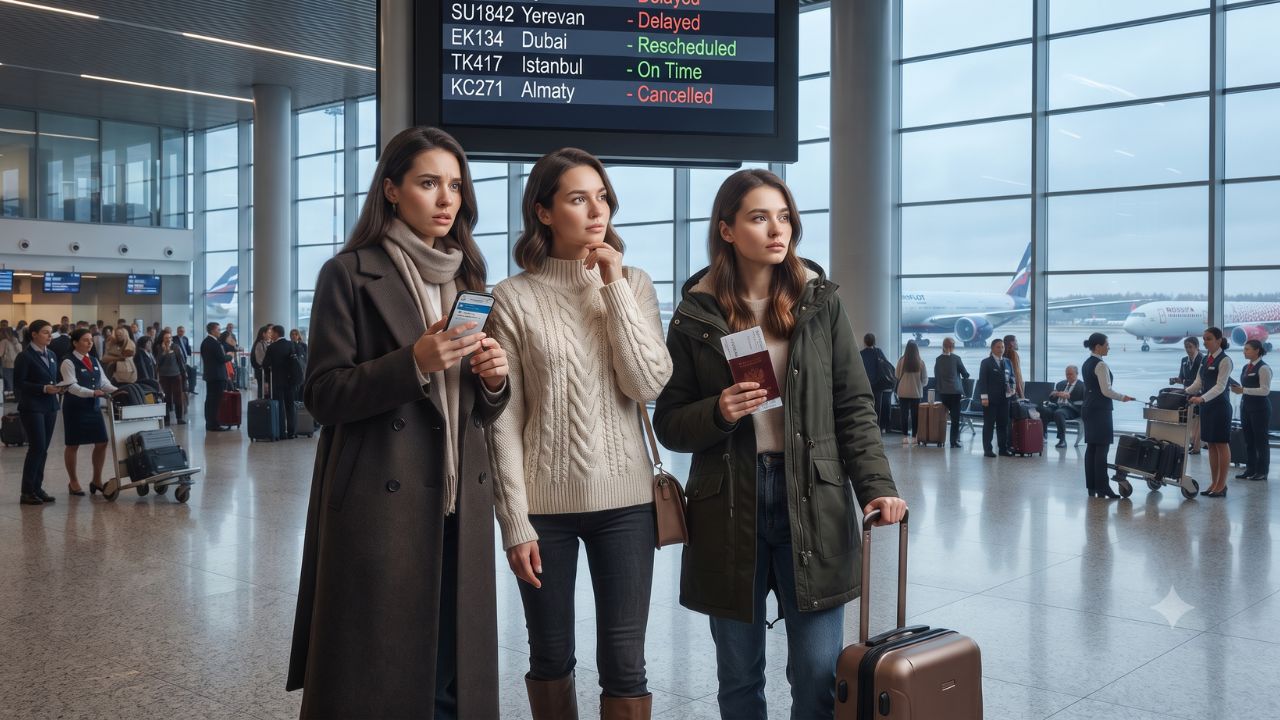
Image generated by AI
Heightened security warnings issued by Ukrainian authorities regarding military drone activity near Russian airspace have triggered renewed risk assessments among international carriers, even as Moscow officials insist that civil aviation corridors remain fully protected and operational.
Geopolitical Friction Over Eastern European Flight Paths
Commercial aviation across Eastern Europe and Northern Eurasia is facing renewed scrutiny following formal warnings issued by Ukrainian authorities to international airlines and global aviation regulators. Kyiv warned of escalating hazards for commercial aircraft operating in or adjacent to Russian sovereign airspace, citing intensifying cross-border drone strikes, electronic warfare jamming, and active air defense operations.
In response, the Federal Air Transport Agency of Russia (Rosaviatsiya) and Moscow municipal authorities forcefully rejected the advisory, affirming that the nation’s air traffic management systems and multi-layered defense architecture guarantee the safety of all scheduled civilian flights. Moscow reiterated that domestic operations and international links to non-aligned nations will proceed without interruption.
Nevertheless, the competing narratives have injected fresh volatility into international flight operations. While Western airlines have avoided Russian skies since bilateral sanctions were enacted in 2022, dozens of international carriers from the Middle East, Türkiye, Central Asia, and East Asia continue to rely on Russian air corridors as vital transit bridges linking Europe and Asia.
The Bifurcated Global Sky: Who Flies Through Russia in 2026?
The global commercial aviation network remains starkly divided regarding the use of Russian airspace, creating sharp competitive contrasts in flight times, fuel burn, and ticket pricing:
| Airline Category & Origin | Operational Policy & Routing Behavior | Major Airlines Operating | Passenger Impact & Route Economics |
|---|---|---|---|
| European & North American Carriers | Total avoidance of Russian airspace since 2022 | British Airways, Lufthansa, Air France, United, Delta | 2-to-4-hour detours over Central Asia; higher ticket prices & fuel surcharges |
| Gulf & Middle Eastern Carriers | Maintain scheduled connections to Moscow & St. Petersburg | Emirates, FlyDubai, Qatar Airways, Etihad, Gulf Air | Seamless one-stop global connections via Dubai, Doha, and Abu Dhabi hubs |
| Turkish Carriers | High-frequency transit bridge linking Russia to Europe/Americas | Turkish Airlines, Pegasus Airlines, AJet | Istanbul serves as primary international transit hub for Russian travelers |
| Chinese & East Asian Airlines | Full overflight privileges across Siberian corridors | Air China, China Eastern, China Southern | Significant flight-time advantage on nonstop Europe–Asia trunk routes |
| Russian Domestic Carriers | Full operations across domestic network | Aeroflot, S7 Airlines, Rossiya, Ural Airlines | Periodic airport ground holds during localized air defense alerts |
Operational Realities: Ground Holds, Detours, and "Plan Kovyor"
For travelers flying into or across Russia, the primary practical disruption stems from localized security protocols rather than blanket airspace shutdowns.
When unidentified aerial objects or drone incursions are detected near major metropolitan centers, Russian aviation authorities initiate a specialized security protocol known as "Plan Kovyor" (Carpet Plan):
- Immediate Airspace Freezes: All civilian takeoffs and landings at affected airports are temporarily halted, and aircraft in flight are ordered to enter holding patterns or divert to designated alternate airfields.
- Moscow Airport Vulnerability: The capital’s primary international hubs—Sheremetyevo (SVO), Domodedovo (DME), and Vnukovo (VKO)—have intermittently executed temporary Carpet holds, causing cascading departure delays and unscheduled diversions to regional hubs like St. Petersburg (LED), Nizhny Novgorod (GOJ), or Kazan (KZN).
- Southern Airspace Closures: A broad network of regional civilian airports in southwestern Russia near the conflict zone—including Belgorod, Voronezh, Kursk, and Rostov-on-Don—have remained closed to commercial aviation continuously since February 2022, concentrating passenger traffic onto overland railway corridors.
Environmental and Economic Toll: The Circumnavigation Penalty
The ongoing fragmentation of Eurasian airspace carries severe ecological and economic consequences. Prior to 2022, the Siberian corridor represented the most fuel-efficient, direct great-circle route connecting London, Paris, and Frankfurt with Tokyo, Seoul, Beijing, and Shanghai.
Circumnavigating Russian territory forces Western carriers to route south via the Caucasus, Central Asia, and the Middle East, or north over the Arctic. This detour adds between 1,000 and 1,800 nautical miles, extending flight times by two to four hours and consuming an additional 8 to 12 tons of jet fuel per long-haul wide-body flight. The resulting surge in carbon emissions runs directly counter to international aviation net-zero sustainability goals.
Local Insider Guidance for Travelers Navigating Russia-Linked Travel
For foreign travelers, dual citizens, and business personnel with essential journeys involving Russia, navigating current travel conditions requires rigorous preparation:
- Prepare for Strict Cash-Only Economics: Because international Visa, Mastercard, American Express, and SWIFT services remain entirely suspended within the Russian Federation, foreign-issued credit and debit cards will not function anywhere in the country. Bring pristine, unblemished United States Dollars (USD) or Euros (EUR) in cash to exchange for Russian Rubles (RUB) at authorized airport and downtown bank kiosks, or arrange a local Mir debit card upon arrival through select Russian banking apps.
- Bypass Airport Shuttle Flights with the Sapsan High-Speed Train: If traveling between Moscow and St. Petersburg, avoid air shuttles vulnerable to airport ground stops. Instead, book the high-speed Sapsan electric bullet train departing from Moscow’s Leningradsky Station to St. Petersburg’s Moskovsky Station. The 650-kilometer journey takes just 3 hours and 45 minutes, operating with punctuality, complimentary Wi-Fi, and complete immunity to airspace restrictions.
- Rely Exclusively on Aeroexpress Airport Trains: Avoid highway taxis or ride-shares when transferring to Moscow airports. Road traffic along the Moscow Ring Road (MKAD) and Leningradskoye Highway can cause travelers to miss rescheduled departures. Take the Aeroexpress electric trains, which depart every 30 minutes from central metro hubs (Belorussky for Sheremetyevo, Paveletsky for Domodedovo, Kievsky for Vnukovo) delivering reliable 35-to-45-minute terminal transit.
- Download Regional Navigation and Translation Apps: Google Maps and western transit tools lack real-time transit telemetry inside Russia. Download Yandex Maps (for metro and street navigation), Yandex Go (for authorized taxi hailing), and Yandex Translate with offline language packs prior to crossing the border.
- Savor Authentic Moscow Heritage Dining During Layovers: If experiencing extended flight waits in Moscow, explore the historic city center and sample traditional winter gastronomy: rich beetroot borscht served with hot garlic buns (pampushki), Siberian pelmeni dumplings bathed in herb butter, and traditional hot sbiten (a honey, ginger, and clove infusion) at historic cafes along Nikolskaya Street near Red Square.
Long-Term Tourism Outlook: The Enduring Impact of Airspace Fragmentation
The ongoing standoff over Russian airspace safety demonstrates how deeply geopolitical fractures dictate global traveler mobility. While Moscow remains committed to showcasing its domestic stability and maintaining open skies with non-Western partners, international airlines will continue to operate under heightened risk-management frameworks.
Until comprehensive diplomatic and aviation agreements restore unified airspace standards across Eastern Europe, travelers between continents will continue navigating higher fares, longer travel times, and an increasingly divided global sky.
Frequently Asked Questions: Russia Air Travel and Airspace Safety
Are commercial international flights still flying into Russia in 2026? Yes. While European, American, and Canadian carriers do not operate to Russia, airlines from the Gulf (such as Emirates, FlyDubai, and Qatar Airways), Türkiye (Turkish Airlines, Pegasus), China (Air China, China Eastern), and Central Asia operate scheduled flights to Moscow and other Russian cities.
Why did Ukraine issue warnings regarding Russian airspace? Ukrainian authorities warned international carriers about potential risks arising from intensified military operations, long-range drone strikes, and active air defense measures in and near Russian airspace.
What is "Plan Kovyor" (Carpet Plan) at Russian airports? "Plan Kovyor" is an emergency airspace protocol initiated by Russian air traffic controllers when unidentified aerial objects or drone threats are detected, temporarily halting flight operations and diverting aircraft until the area is cleared.
Do international credit cards work for travelers in Russia? No. Foreign Visa, Mastercard, and American Express cards do not function in Russia due to financial sanctions. Travelers must carry cash in USD or EUR to exchange for Rubles or obtain a domestic Mir payment card.
Related Travel Guides
Disclaimer
This article is for informational and educational purposes only. It does not constitute legal, financial, or professional advice. While we strive to provide accurate and up-to-date information, travel policies, regulations, and conditions change rapidly. Always verify information with official sources before making travel decisions. Nomad Lawyer makes no representations about the accuracy, reliability, completeness, or suitability of the information provided. Readers should consult qualified professionals for advice specific to their circumstances. The views expressed in this article are those of the author and do not necessarily reflect the views of Nomad Lawyer.
Preeti Gunjan
Contributor & Community Manager
A passionate traveller and community builder. Preeti helps grow the Nomad Lawyer community, fostering engagement and bringing the reader experience to life.
Learn more about our team →