
Radio Fault Triggers Widespread Disruption Across UK Southern Rail Network
A critical GSM-R radio system failure on 7 May 2026 crippled southern England's rail network, stranding thousands of passengers and triggering mass cancellations across multiple operators including South Western Railway and Great Western Railway.

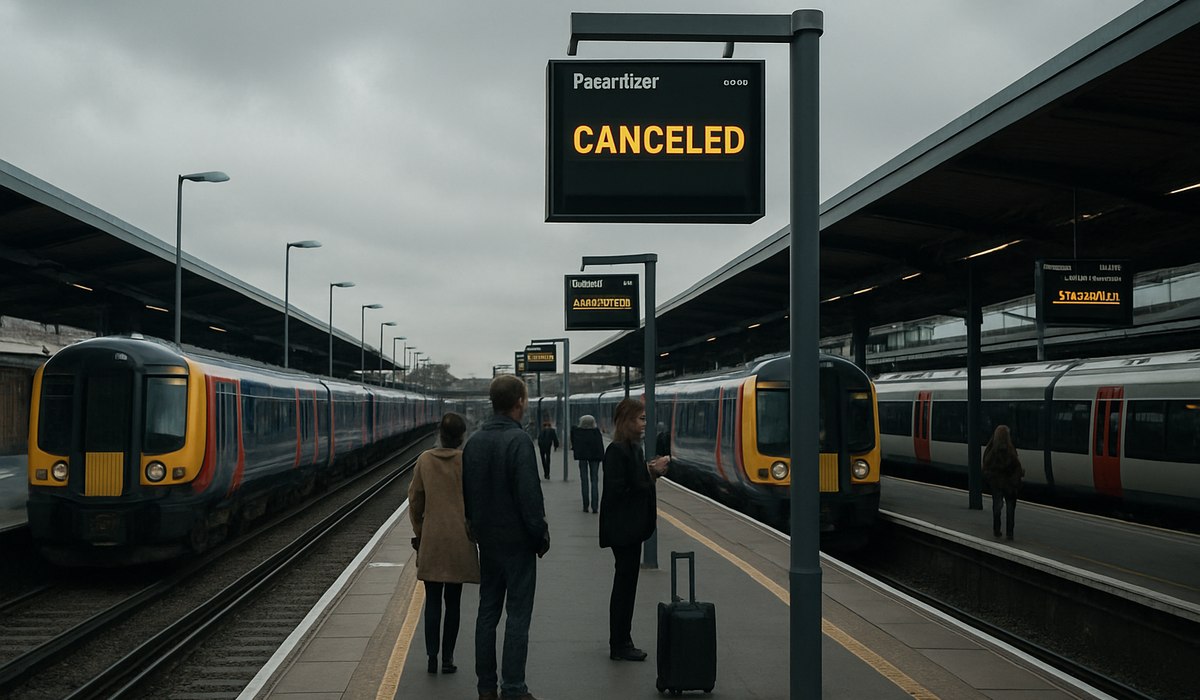
Image generated by AI
Critical Radio Fault Halts Southern England Rail Services
On Thursday, 7 May 2026, a catastrophic GSM-R radio system failure cascaded across southern England's railway network, stranding thousands of commuters and intercity passengers. The fault in driver-signaller communication infrastructure forced operators to impose emergency speed restrictions and service cuts. Services through major London hubs including Waterloo and Victoria experienced the heaviest disruption, with multiple operators—including South Western Railway, Great Western Railway, Southern, Thameslink, Gatwick Express, and CrossCountry—simultaneously implementing cancellations and severe delays lasting well beyond the initial fault resolution.
GSM-R Radio System Failure Halts Southern Rail Routes
The GSM-R (Global System for Mobile Communications–Railway) network underpins safety-critical voice communication between train drivers and railway signallers across the UK's busiest corridors. When this dedicated radio system failed on the morning of 7 May, operators faced an immediate operational crisis. Standard safety protocols require trains to reduce speed or remain stationary when driver-signaller contact cannot be reliably maintained, effectively paralyzing capacity on densely trafficked commuter and intercity routes.
Technical teams identified the core fault by late morning, but the cascade effect persisted for hours afterward. Train diagrams were disrupted, rolling stock remained out of position, and staff scheduling fell into chaos across the network. This residual impact proved almost as damaging as the initial outage itself. Journey planners showed delays of 45 to 90 minutes on affected routes, with many services cancelled outright.
The radio fault triggers exposed critical dependencies on aging infrastructure that lacks redundancy at key chokepoints. Industry analysts noted that the GSM-R network, while essential for safety, represents a single point of failure for multiple train operators sharing London's terminal infrastructure.
Cascade Effect: How Driver-Signaller Communication Loss Impacts Train Operations
When driver-signaller radio communication deteriorates or fails entirely, the railway network shifts into a degraded operating mode. Without reliable voice contact, signallers cannot authorize trains to proceed at normal speeds through occupied sections of track. Drivers must assume a more conservative posture, treating all signals as restrictive until they receive explicit voice confirmation.
This operational constraint instantly reduces network capacity by 60–70% on affected lines. A typical busy commuter corridor handling 24 trains per hour during peak periods might manage only 8–10 trains during degraded mode. The mathematical consequences are brutal: queues form at approach signals, dwell times at stations extend, and passengers waiting to board experience mounting crowding.
Recovery from such failures proves slower than the outage itself. Once the GSM-R system was restored on 7 May, operators could not immediately restore full timetables. Trains were scattered across the network in wrong positions, crew members were out of sync with their assigned duties, and passengers stranded by early terminations required rerouting to alternative services. These widespread rail disruptions rippled through the entire day, affecting evening commutes even after morning technical repairs were complete.
Multiple Operators Affected Across London and South England Corridors
The radio fault triggers impacted every major train operator serving southern England simultaneously. South Western Railway, which connects London to Surrey, Hampshire, Dorset, Wiltshire, and Devon, reported service alterations across its entire network. Great Western Railway, linking the capital with the Thames Valley and West Country, experienced similar broad disruption.
Southern Railway's suburban services into Victoria and London Bridge were severely constrained. Thameslink's cross-London route, which carries over 250,000 daily passengers, operated at heavily reduced capacity. Gatwick Express services to London's busiest airport terminal faced cancellations, stranding business and leisure travellers with critical connections. London Overground and CrossCountry services added further operational strain to an already-saturated alternative routing situation.
The interconnected nature of London's rail infrastructure meant that a single system failure cascaded instantly across multiple operators and ticket types. Passengers holding advance tickets on cancelled trains faced short-notice rerouting to less convenient services or different London terminals. Those on peak-time season tickets experienced severe crowding on replacement buses and remaining train services. The compensation machinery began processing claims immediately, with consumer advocacy groups emphasizing the importance of passenger record-keeping.
Network Recovery Timeline and Ongoing Passenger Disruption
By 11:00 GMT on 7 May, technical teams had stabilized the GSM-R radio system's core functionality. However, this technical victory did not translate into immediate service restoration. Operators required several additional hours to redistribute rolling stock, realign crew positioning, and rebuild timetable discipline across fragmented networks.
Morning peak commuters faced the worst conditions, with trains standing at signals and passengers receiving confusing or contradictory information about alternative routing options. By midday, some London terminals had reopened previously disrupted lines, offering passengers partial relief through alternative routing via less-congested corridors. However, the interlinked nature of southern England's rail infrastructure meant that few genuine alternatives existed for passengers on primary routes.
Afternoon and evening services remained subject to 30–60 minute delays as the network gradually returned to normal operations. Some regional services continued running at reduced frequency late into the evening. Operators advised passengers to check real-time journey planners constantly, as timetables updated frequently throughout the day. The incident reinforced vulnerabilities in a rail network heavily dependent on aging safety communication systems lacking modern redundancy safeguards.
| Metric | Data |
|---|---|
| Failure Date | Thursday, 7 May 2026 |
| Peak Delay Duration | 45–90 minutes on affected routes |
| Time to Core Fix | Late morning (approximately 4–5 hours) |
| Time to Full Recovery | 12+ hours (through full operating day) |
| Operators Affected | 7+ major train companies |
| System Impact | GSM-R radio network (driver-signaller communication) |
| Capacity Reduction | 60–70% during degraded operations |
| Primary Hubs Hit | London Waterloo, London Victoria, London Bridge |
What This Means for Travelers
The 7 May 2026 radio fault triggers disruption demonstrates that modern rail passengers remain vulnerable to infrastructure failures despite digital automation. If you're planning southern England rail journeys, consider these protective measures:
-
Check real-time journey planners immediately before departing for stations, as timetable disruptions can develop within minutes during system failures.
-
Build additional travel time into critical connections, particularly when traveling to or from London terminals on busy morning or evening peaks.
-
Understand your compensation rights: passengers delayed over 15 minutes are typically eligible for delay repay claims through Train Charities or rail operator portals.
-
Maintain detailed travel records including booking confirmations, ticket photographs, and timestamped screenshots of journey planner disruption notices when claims become necessary.
-
Consider alternative routing options before traveling—having multiple London terminal options available can prove invaluable during widespread network failures.
-
Download offline maps of London's terminal connections, as digital signage and staff information can become overwhelmed during major disruptions.
-
Verify your ticket terms: advance-purchase tickets may offer limited flexibility during disruptions, while season and flexible tickets typically provide more rerouting options.
FAQ
Q: What is GSM-R and why is it critical for rail operations?
A: GSM-R (Global System for Mobile Communications–Railway) is a dedicated radio network enabling voice communication between train drivers and railway signallers. This communication is safety-critical; without reliable contact, trains must operate at reduced speeds, severely limiting network capacity and passenger throughput.
Q: How long do typical GSM-R system failures last?
A: The 7 May
Preeti Gunjan
Contributor & Community Manager
A passionate traveller and community builder. Preeti helps grow the Nomad Lawyer community, fostering engagement and bringing the reader experience to life.
Learn more about our team →