
Aviation Updates: Qantas 17-Hour London to Perth Flight Forced into Emergency Fuel Stop, Exposing Travel Chaos Risks
A Qantas Boeing 787 operating one of the world's longest routes was forced to divert 1,500 km to a regional mining airport after extreme headwinds devastated its fuel reserves.

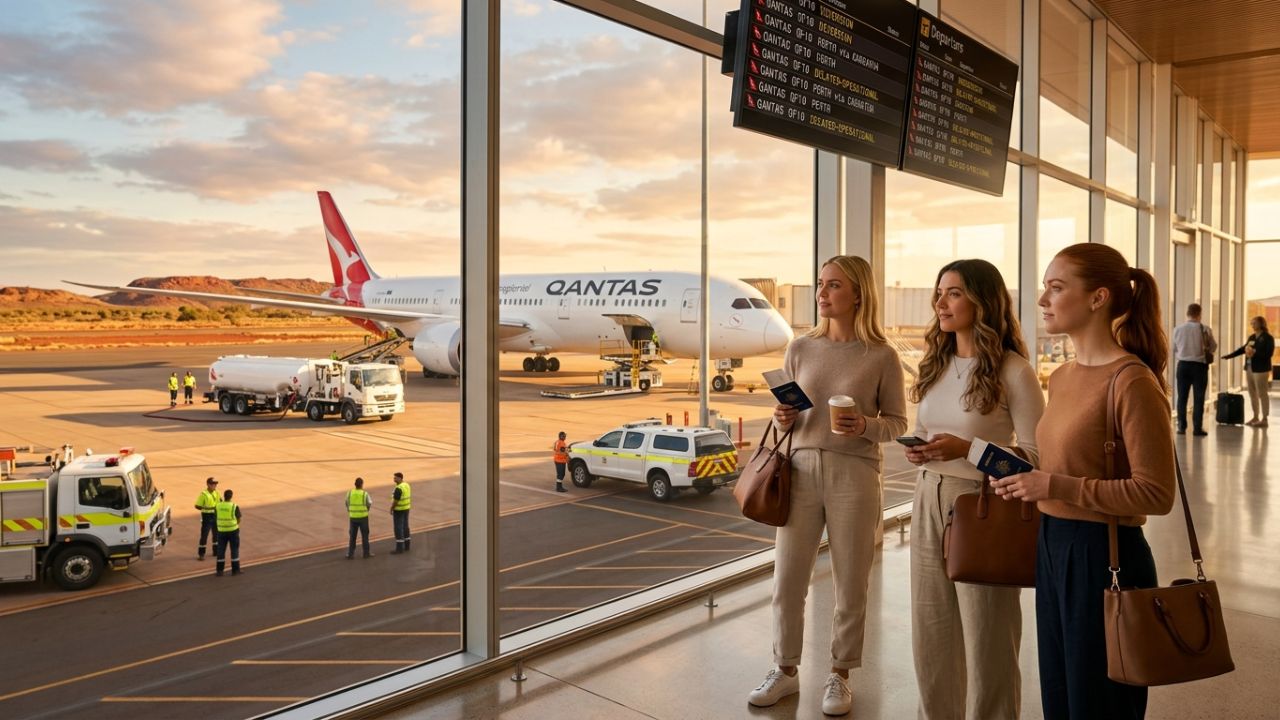
Image generated by AI
Aviation Updates: Qantas 17-Hour London to Perth Flight Forced into Emergency Fuel Stop, Exposing Travel Chaos Risks
In a dramatic mid-air incident that perfectly highlights the severe operational fragility of ultra-long-haul flying, a Qantas Dreamliner was forced to abandon its trajectory, executing a massive 1,500-kilometer diversion simply to secure enough fuel to survive the journey.
Image generated by AI
As mainstream airline news platforms and urgent aviation updates continue to broadcast a massive surge in peak-season airport disruptions, the inherent vulnerability of ultra-long-haul flying has been spectacularly exposed. On June 23, 2026, a Qantas Boeing 787 Dreamliner operating the legendary 17-hour non-stop service from London to Perth encountered a massive mid-flight crisis. Confronted by incredibly fierce, unforeseen headwinds over the final oceanic sectors, the aircraft’s meticulously calculated fuel reserves were rapidly decimated. Forced into a high-stakes operational decision to prevent catastrophic fuel exhaustion, the flight crew abandoned the direct route to Perth and executed a massive 1,500-kilometer diversion to Karratha Airport. While this specific event did not directly trigger systemic flight cancellations, it serves as a glaring, real-world stress test of extreme aviation infrastructure, proving that even the most advanced aircraft are fundamentally susceptible to the sudden atmospheric shifts that dictate modern travel chaos.
Expanded Overview: The Fragility of the Ultra-Long-Haul
When analyzing the extreme mechanics of 17-hour commercial flights, the margin for atmospheric error is functionally nonexistent.
The London–Perth corridor is officially ranked among the absolute longest commercial services globally. While modern aircraft like the Boeing 787 are specifically engineered for this exact mission profile, they remain heavily bound by strict safety regulations requiring minimum fuel margins. When jet streams violently shift mid-flight, drastically increasing fuel burn over incredibly remote oceanic sectors, pilots are stripped of their options. The priority immediately shifts from schedule adherence to sheer survival. This specific diversion perfectly illustrates that as airlines continuously push the absolute physical limits of modern aircraft, they are inadvertently creating highly fragile routes where a simple change in wind direction can instantly plunge an itinerary into complete operational disarray.
Section-Wise Breakdown: The Mid-Air Fuel Crisis
Operating as flight QF10, the Qantas Dreamliner departed London Heathrow Airport on what was expected to be a standard, seamless ultra-long-haul execution.
However, after enduring more than 16 hours airborne, the operational reality violently shifted. Encountering stronger-than-expected headwinds, the aircraft began burning fuel at a rate completely beyond the advanced pre-flight mathematical calculations. Realizing that continuing directly west to Perth would violate mandatory, non-negotiable fuel reserve safety regulations, the flight crew was forced into a massive precautionary operational decision. They executed a dynamic route recalculation mid-flight, instantly scrubbing the Perth arrival and locking in a diversion trajectory that would ultimately shock both passengers and regional aviation strategists alike.
Section-Wise Breakdown: The Karratha (Pilbara) Lifeline
The decision to divert to Karratha Airport was not random; it was a desperate reliance on newly upgraded Australian infrastructure.
Located approximately 1,500 kilometers north of Perth, Karratha primarily serves as a domestic feeder for the massive Pilbara mining region and very rarely handles widebody international aircraft. However, just weeks prior to this massive incident, Karratha Airport had been officially upgraded and legally designated as an alternate international airport specifically to handle larger jets. This real-world test proved absolutely critical. The airport's upgraded runway easily facilitated the safe landing of the massive Boeing 787. The aircraft remained on the tarmac for approximately one hour, executing an emergency refueling protocol before finally launching back into the sky to complete its severely delayed arrival into Perth later that afternoon.
Flight Details: Diversion Operational Matrix
The exact operational telemetry outlining this highly dramatic ultra-long-haul diversion, detailing the specific aircraft deployment and the massive geographic detour, has been consolidated into the mandatory matrix below.
Qantas QF10 Diversion Operational Matrix
| Operational Metric | Flight Data |
|---|---|
| Operating Carrier | Qantas |
| Flight Number | QF10 |
| Aircraft Type | Boeing 787 Dreamliner |
| Original Route | London Heathrow to Perth |
| Diversion Location | Karratha Airport (1,500 km north of Perth) |
| Date of Incident | June 23, 2026 |
| Primary Cause | Mid-flight atmospheric headwinds depleting fuel reserves |
| Refueling Duration | Approximately 1 hour |
Passenger Impact: Surviving the 18-Hour Itinerary
For the passengers trapped aboard QF10, the experience of a 17-hour flight being suddenly extended is a grueling physical and psychological endurance test.
While the flight crew never declared a formal emergency and passenger safety was completely guaranteed throughout the diversion, the operational fallout was immense. An unexpected fuel stop triggers massive arrival time variability, entirely destroying subsequent onward domestic connections out of Perth. Furthermore, these massive delays push highly regulated crew duty times to their absolute legal limits, often forcing airlines into incredibly complex aircraft rotation schedules to prevent the delay from cascading into a wave of subsequent flight cancellations.
Industry Analysis: Stress-Testing Project Sunrise
Aviation strategists explicitly note that this Karratha diversion serves as a highly alarming, live-fire rehearsal for Qantas’ massive future ambitions.
The airline is currently pouring billions into its ambitious "Project Sunrise" program, actively preparing highly modified Airbus A350-1000 ultra-long-range aircraft to execute completely non-stop services from Sydney directly to London and New York. This specific Boeing 787 incident absolutely validates the extreme operational complexity of extreme-range aviation. It proves beyond all doubt that regardless of the aircraft's theoretical range, real-world fuel sensitivity over ultra-long sectors absolutely requires a massive, highly capable network of contingency infrastructure to prevent catastrophic airborne emergencies.
Conclusion: Redefining Regional Infrastructure
Ultimately, the massive June 23 diversion of Qantas flight QF10 highlights a fundamental, structural shift in global aviation strategy. The fact that a 17-hour flight from London was forced to seek emergency refuge in a remote Australian mining town perfectly illustrates that ultra-long-haul routes are entirely dependent on highly distributed, secondary infrastructure. As global carriers aggressively expand their extreme-range networks, regional airports like Karratha are no longer just domestic outposts; they are highly strategic, international safety valves. Without these massive infrastructure upgrades, the modern ambition of non-stop, ultra-long-haul travel would instantly collapse under the brutal realities of atmospheric disruption and extreme travel chaos.
Key Takeaways
- Massive Diversion: On June 23, 2026, Qantas flight QF10 from London Heathrow to Perth was forced into an emergency fuel stop.
- Fuel Depletion: After 16 hours of flying, severe, unexpected atmospheric headwinds decimated the Boeing 787 Dreamliner’s mandatory fuel reserves.
- The Karratha Lifeline: The aircraft diverted 1,500 kilometers north to Karratha Airport, a regional mining hub recently upgraded to handle widebody international jets.
- Project Sunrise Implications: The mid-air crisis serves as a massive stress test for Qantas' future ultra-long-haul operations using the Airbus A350-1000.
- Infrastructure Shift: The incident proves that secondary regional airports are now absolutely critical safety valves required to prevent catastrophic ultra-long-haul failures.
FAQ: Qantas London to Perth Flight Diversion
Why did the Qantas flight from London to Perth divert? Qantas flight QF10 was forced to divert due to extreme, unpredicted atmospheric headwinds over the final oceanic sectors, which caused the Boeing 787 Dreamliner to burn fuel faster than calculated, threatening its mandatory safety reserves.
Where did the Qantas QF10 flight stop for fuel? The aircraft executed a massive 1,500-kilometer diversion, safely landing at Karratha Airport—a regional facility in Western Australia’s Pilbara region that was recently upgraded to handle international widebody jets.
When did this Qantas diversion occur? The highly dramatic 17-hour flight diversion occurred on June 23, 2026, causing the aircraft to remain on the tarmac in Karratha for approximately one hour before finally completing its journey to Perth.
Related Travel Guides
SpiceJet Receives 16 Million Government Crisis Fund Travel Chaos 2026
Indonesia AirAsia Suspends Daily Route Travel Chaos 2026
Ultra Long Haul Flight Survival and Jet Lag Guide 2026
Disclaimer: This article is strictly for informational purposes. The aviation route data, specific flight incident details (Qantas QF10, June 23, 2026), diversion locations (Karratha Airport), and aircraft telemetry (Boeing 787 Dreamliner, Airbus A350-1000) are based on operational reports available at the time of publication. Ultra-long-haul airline network planning, mandatory fuel reserve regulations, and specific emergency diversion protocols are highly dynamic and subject to continuous, strict oversight by international aviation authorities. Passengers must explicitly verify exact flight availability, routing timetables, and carrier safety records directly with Qantas prior to booking travel.
Disclaimer
This article is for informational and educational purposes only. It does not constitute legal, financial, or professional advice. While we strive to provide accurate and up-to-date information, travel policies, regulations, and conditions change rapidly. Always verify information with official sources before making travel decisions. Nomad Lawyer makes no representations about the accuracy, reliability, completeness, or suitability of the information provided. Readers should consult qualified professionals for advice specific to their circumstances. The views expressed in this article are those of the author and do not necessarily reflect the views of Nomad Lawyer.
Raushan Kumar
Founder & Lead Developer
Full-stack developer with 11+ years of experience and a passionate traveller. Raushan built Nomad Lawyer from the ground up with a vision to create the best travel and law experience on the web.
Learn more about our team →