
Aviation Updates: Massive Northeast Airspace Gridlock Forces Piedmont Flight PT5974 to Execute Emergency Diversion Triggering New York Travel Chaos
As severe operational constraints violently suffocate Watertown, Piedmont Airlines flight PT5974 abruptly diverts to Syracuse, plunging passengers into agonizing airport disruptions.

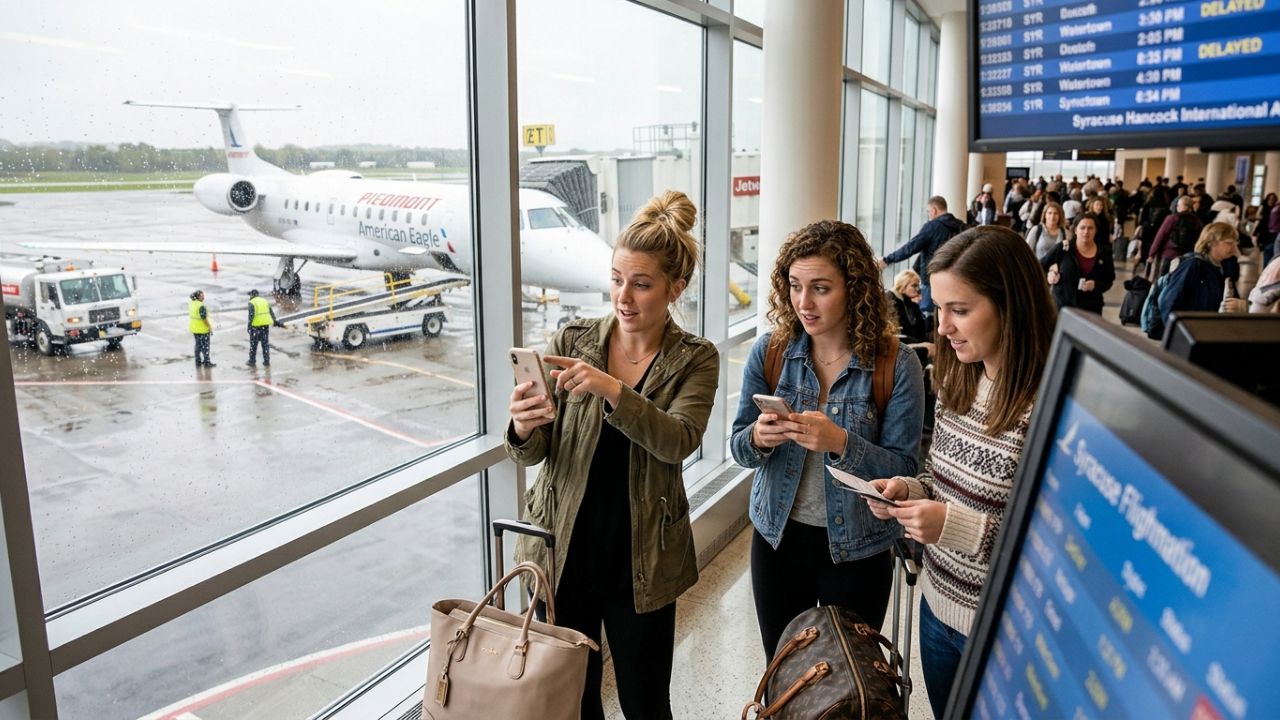
Image generated by AI
Aviation Updates: Massive Northeast Airspace Gridlock Forces Piedmont Flight PT5974 to Execute Emergency Diversion Triggering New York Travel Chaos
As incredibly severe operational constraints and massive regional airline network limitations completely suffocate the smaller aviation gateways of New York, exhausted passengers aboard Piedmont Airlines flight PT5974 are plunged into terrifying travel chaos following a massive mid-air diversion that forcibly aborted their trajectory toward Watertown, triggering severe airport disruptions and rippling violently into the Syracuse aviation grid.
While incredibly exhausted domestic passengers desperately navigate an incredibly brutal peak travel season defined by rolling flight cancellations and severe, localized airport disruptions, a massive, highly concerning mid-air anomaly is actively shattering the absolute highest levels of American commercial aviation stability. According to the absolute latest breaking airline news, Piedmont Airlines flight PT5974 (operating as American Eagle), utilizing an Embraer ERJ-145 regional jet, has officially executed a highly disruptive, unscheduled mid-air diversion. Desperate to ensure that severe, unverified infrastructure limitations did not completely destroy the safety parameters of the heavily congested Northeast corridor, the flight crew violently aborted the scheduled trajectory from Philadelphia International Airport to Watertown International Airport. At the time of reporting, real-time operational tracking systems confirmed that on June 22, 2026, the aircraft executed an abrupt tactical maneuver, landing safely at Syracuse Hancock International Airport to escape a potential logistical failure at the smaller regional airfield.
This highly critical operational maneuver explicitly exposes the East Coast corridor not just as a vital domestic transit feed, but as a deeply fragile capacity zone where sudden weather variables or capacity limitations trigger cascading logistical failures. By violently interrupting the flight path, this systemic disruption is directly driving massive travel chaos that routinely plagues travelers attempting to transit through under-resourced regional gateways. Because traditional legacy transit nodes frequently suffer from severe tarmac congestion leading to massive, unannounced communication breakdowns, this current diversion serves as an absolute warning. It completely bypasses the terrifying logistical nightmares of simple thunderstorms, representing a highly structural safety intervention that forces major regional carriers—specifically Piedmont Airlines—into a brutal, high-stakes battle of immediate risk assessment and agonizing mid-air rerouting just to secure safe operational margins.
Aviation Updates: The Collapse of the Philadelphia-Watertown Route
This massive, highly structural shift in regional network stability perfectly illustrates the intense, incredibly fragile nature of modern domestic mobility.
According to highly detailed, official aviation updates, this strategic safety failure was explicitly triggered by severe operational constraints affecting the destination airport. The sheer density of these preventative safety protocols applies across the high-frequency regional scheduling model, effectively capping inbound flow when infrastructure limits are breached. Because regional airports like Watertown operate under tighter infrastructure constraints, their operational readiness is highly sensitive to runway conditions, visibility changes, and wind patterns. Continuing a flight into an environment with severe capacity limitations is currently a massive logistical gamble. This massive breakdown prevents a unified, highly reliable transit model, instead generating severe, cascading knock-on delays that ripple violently across the entire air traffic system, directly breaking vital flight paths connecting Pennsylvania to the restricted airspace of upstate New York.
Section-Wise Breakdown: Navigating the Paralyzed Flight Path
The sudden, massive evolution of these critical transit failures actively impacts several incredibly distinct, highly sensitive operational dynamics spanning multiple state lines.
The Philadelphia Departure and Stable Cruise
At the absolute core of this massive operational pivot is the initial trajectory originating in Pennsylvania. Flight PT5974 began as a routine domestic service, departing from Gate F33 in Philadelphia precisely on time. The Embraer ERJ-145 climbed normally, following its planned northbound routing through the incredibly busy US Northeast corridor. During the climb and cruise phases, the flight maintained a perfectly stable profile with no reported technical faults and no emergency declarations. However, because regional airlines rely on incredibly tight fleet rotations, the sudden realization that Watertown was effectively locked down actively subjected the passengers to impending airport disruptions before they even initiated their descent.
The Mid-Air Crisis and Watertown Constraints
The ultimate execution of this highly destructive disruption occurred as the aircraft approached the later stages of its journey. Aircraft approaching smaller regional airports are completely reliant on clear weather and perfect runway sequencing. Faced with the terrifying reality of operational constraints affecting Watertown, air traffic control authorities implemented widespread rerouting. For regional flights like PT5974, waiting indefinitely in mid-air poses a significant logistical risk due to tighter fuel margins. The cockpit crew, coordinating with air traffic management, sensibly decided to completely abandon the original destination, prioritizing passenger safety above the original schedule.
The Syracuse Diversion Strategy
Instead of risking integration into the limited-capacity airspace of Watertown, the crew explicitly targeted Syracuse Hancock International Airport. Syracuse serves as the ideal relief valve for the congested New York corridor because it boasts longer runways, more advanced navigation systems, and the absolute ability to handle diversions without causing system-wide congestion. The regional jet successfully executed a safe landing approximately five minutes ahead of its adjusted arrival time. The aircraft taxied to Gate 1 in a routine manner, which successfully neutralized the immediate threat but violently deposited the stranded passengers into an unfamiliar terminal.
Flight Details and Verified Disruption Impact Matrix
To fully understand the exact structural parameters of this massive performance collapse and how airlines are desperately attempting to navigate complex regional airspace congestion, the following matrix explicitly details the operational failures directly recorded by tracking metrics.
Confirmed Piedmont PT5974 Diversion Matrix
| Operational Metric | Confirmed Flight Data |
|---|---|
| Airline | Piedmont Airlines (American Eagle) |
| Flight Number | PT5974 |
| Aircraft Type | Embraer ERJ-145 |
| Date | June 22, 2026 |
| Original Route | Philadelphia (Gate F33) to Watertown |
| Diversion Airport | Syracuse Hancock International (Gate 1) |
| Incident Type | Precautionary Airspace / Capacity Diversion |
Data explicitly reflects the massive, highly structural operational disruption currently paralyzing the Watertown-bound gateway, directly forcing Piedmont Airlines to violently abandon the daily flight schedule.
Passenger Impact: The Financial and Emotional Toll
For the highly demanding passengers actively engaged in this massive domestic mobility crisis, traditional, highly anticipated peak travel is currently viewed as completely terrifying and incredibly unpredictable.
The immediate consequence of these massive mid-air diversions is measured in the dozens of passengers violently displaced inside the Syracuse terminal. Passengers facing these massive airport disruptions are forced to seek alternative arrangements, suffering intense anxiety as they endure prolonged terminal waits and agonizing uncertainty regarding ground transport. Families returning home and business travelers rushing to critical events in Watertown are explicitly warned that their carefully planned itineraries are currently in a state of rolling failure. The unexpected landing means missed car services, ruined local events, and severe out-of-pocket expenses while Piedmont Airlines operational teams coordinate onward ground transportation or alternative rebooking arrangements to finally transport the passengers to their intended destination.
Industry Analysis: The Economics of Systemic Safety
Aviation structural analysts strictly point out that this massive, multi-national operational diversion perfectly illustrates the extreme, highly vital importance of heavily optimized, continuous airspace capacity management.
Aviation data explicitly indicates that regional carriers are absolutely desperate to secure rapid alternate landings to actively combat the terrifying reality of capacity saturation. The US Northeast airspace is one of the busiest globally, handling continuous flows of regional traffic. When smaller airports like Watertown face infrastructure constraints or weather sensitivity, real-time decision-making is critical. The Embraer ERJ-145 is designed for operational flexibility, allowing quick adjustments when destinations cannot accommodate arrivals. Until expanded airport infrastructure stabilizes smaller regional markets, relying on deeply fragile air traffic control systems completely destroys the reliance on scheduled corporate rotations, forcing passengers to absorb the massive delays associated with modern uncompromising safety limits.
Conclusion: A Highly Congested Northeast Future
The massively evolving infrastructure dynamics directly defining the integration of regional passenger volume into the New York network violently reflect a much broader, highly critical structural transformation currently dominating how American commercial aviation is physically managed in 2026.
Rather than violently forcing massive domestic traffic through deeply congested, delay-prone regional networks that ignore potential capacity limits, global travelers must actively reconsider routing without massive buffer times. As Piedmont Airlines aggressively struggles to secure ground transport for stranded passengers at Syracuse, travelers actively navigating the incredibly busy summer sector must absolutely remain highly vigilant. To actively survive potential travel chaos this evening, passengers must aggressively monitor all breaking aviation updates, actively utilize airline mobile applications for rapid rebooking, and perfectly understand that escaping modern airport disruptions fundamentally requires accepting that flights destined for Watertown are currently in a state of rolling, highly sensitive failure.
Key Takeaways
- Massive Mid-Air Diversion: Piedmont Airlines flight PT5974 violently aborts its Philadelphia to Watertown route, diverting to Syracuse.
- Aircraft Type: The massive disruption involved an Embraer ERJ-145 regional jet.
- Capacity Constraints: Systemic infrastructure limitations and operational constraints at Watertown forced the massive safety diversion.
- Avoiding Hub Gridlock: The flight crew intentionally diverted to Syracuse Hancock International to utilize longer runways and advanced navigation systems.
- Passenger Survival Strategy: Stranded travelers are aggressively urged to consult airline gate agents for replacement ground transport assignments, and actively seek alternative options to bypass the ongoing travel chaos.
Related Travel Guides
Massive UAE Visa Bombshell: Strict New 30-Day Escape Window Announced
Travel Chaos Cripples Spain as Iberia and Ryanair Suffer 1,079 Delays
Disclaimer
This article is for informational and educational purposes only. It does not constitute legal, financial, or professional advice. While we strive to provide accurate and up-to-date information, travel policies, regulations, and conditions change rapidly. Always verify information with official sources before making travel decisions. Nomad Lawyer makes no representations about the accuracy, reliability, completeness, or suitability of the information provided. Readers should consult qualified professionals for advice specific to their circumstances. The views expressed in this article are those of the author and do not necessarily reflect the views of Nomad Lawyer.
Preeti Gunjan
Contributor & Community Manager
A passionate traveller and community builder. Preeti helps grow the Nomad Lawyer community, fostering engagement and bringing the reader experience to life.
Learn more about our team →