
Mürren, Switzerland: Why This Car-Free Alpine Village Is Redefining Sustainable Travel in 2026
Discover Mürren, the revolutionary car-free Alpine village at 1,638 meters that's becoming the gold standard for sustainable tourism. Learn why travelers are flocking to this Swiss paradise for authentic mountain experiences.

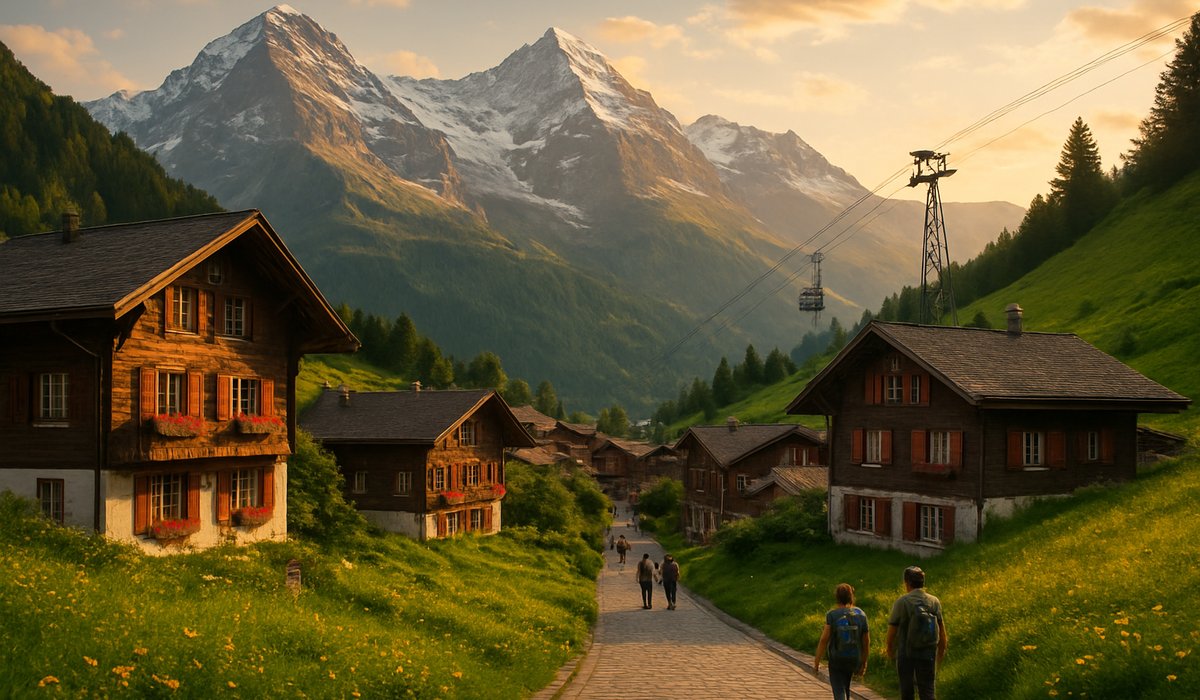
Image generated by AI
Quick Summary
- Car-Free Alpine Hub: Mürren sits at 1,638 meters elevation with zero automobile traffic, creating unprecedented tranquility
- Revolutionary Access: The Schilthornbahn cable car reaches the village in 4 minutes at a 159.4% gradient—one of the world's steepest
- Sustainable Model: Mürren demonstrates how destinations can preserve natural environments while delivering premium tourism experiences
- Year-Round Adventure: 50+ kilometers of ski slopes in winter; vibrant hiking and paragliding trails in summer
- Global Trend Setter: Tourist boards worldwide are studying Mürren's car-free infrastructure as a blueprint for future sustainable destinations
Mürren: The Alpine Village Redefining Sustainable Tourism Standards
Mürren is quietly becoming a global benchmark for how mountain destinations can thrive without automobiles. Perched deep in Switzerland's Bernese Oberland at 1,638 meters (5,374 feet), this intimate village of roughly 430 year-round residents has cracked the code that eluded larger Alpine resorts: maintaining authentic, peaceful experiences while scaling tourism infrastructure. No cars means no exhaust fumes drifting across meadows, no traffic noise shattering mountain silence, and no congestion-induced stress for visitors seeking refuge from bustling city life. Instead, travelers discover cobblestone pathways, traditional timber chalets adorned with geranium boxes, and unobstructed panoramic views of iconic peaks including the Eiger, Mönch, and Jungfrau.
The village's mountainous setting automatically enforced car-free living for centuries, but what's revolutionary is how Mürren has modernized this constraint into its primary competitive advantage. While other Alpine destinations grapple with balancing tourism volume against environmental preservation, Mürren has already solved the equation: embrace the car-free lifestyle as your core identity, and build world-class infrastructure that makes pedestrian-only living not just tolerable, but desirable.
From Footpaths to Flying Cables: Mürren's Transportation Revolution
For most of Mürren's existence, residents depended on footpaths, mule tracks, and sheer determination to navigate the Alpine terrain. Traveling between villages meant overcoming steep gradients and unpredictable weather, with journeys taking hours—sometimes days. This isolation fundamentally shaped the community's character: tight-knit, self-reliant, and deeply connected to mountain life's rhythms.
The first major transportation breakthrough arrived in 1891, when engineers completed the mountain railway linking Mürren to the neighboring village of Grütschalp. Suddenly, the multi-hour journey compressed into minutes, opening access to visitors beyond hardened mountaineers. However, this initial connection proved to be mere prologue.
The true game-changer emerged with the Schilthornbahn, a cable car system that stands as one of the world's most audacious engineering achievements. With a gradient of 159.4%, the Schilthornbahn whisks passengers from the valley floor to Mürren's elevation in approximately four minutes. The ride itself has become an attraction—rather than a burden—offering passengers unobstructed views across the Alpine landscape as they ascend. The Schilthorn summit, reached by the upper cable car section, stretches to 2,970 meters (9,744 feet) and serves as the terminus for a legendary 16-kilometer ski descent that attracts advanced skiers globally. This infrastructure achievement transformed Mürren from peripheral mountain hamlet to legitimate Alpine destination while avoiding the automobile infrastructure that has plagued other resorts.
The Charm of Cobblestones: Architecture and Authentic Alpine Character
Step onto Mürren's pedestrian streets, and you've entered a living time capsule of Alpine village life. The village's defining structures—hand-crafted timber chalets and stone cottages—date primarily to the 13th and 14th centuries, though many have been sensitively restored to accommodate modern visitor expectations. Traditional wooden facades remain dominant, many adorned with hand-carved details and window boxes perpetually overflowing with alpine flowers. The architecture creates an inherently intimate streetscape where neighbors encounter one another naturally, shopkeepers know regulars by name, and the human scale of interaction feels irreplaceable in our digitally-mediated world.
The car-free environment directly contributes to Mürren's charm preservation. Without asphalt-cutting utilities, drainage systems, and the physical infrastructure that automobiles demand, the village's medieval street patterns have survived largely unaltered. Narrow cobblestone lanes that predate automobile traffic can remain exactly as they were centuries ago, creating an authentic sensory experience impossible to replicate in car-dependent villages.
Along these pathways, you'll encounter cozy family-run inns with small dining rooms warmed by tile stoves, restaurants specializing in traditional Swiss Alpine cuisine—particularly cheese fondue, raclette, and hearty Alpine pasta dishes—and modest shops stocked with legitimate local products: artisanal Swiss chocolates, hand-crafted cowbells, and traditional clothing items. These establishments thrive not through aggressive marketing but through reputation cultivated over generations. Visitors who discover one return repeatedly and refer friends, creating a slower, more organic tourism economy than blast-marketing generates.
A Hub for British Winter Sports Innovation
Mürren's tourism transformation began in the late 1800s when British skiers "discovered" the village's exceptional slopes. As winter sports transitioned from Nordic cross-country traditions to Alpine downhill techniques, wealthy British adventurers recognized Mürren's potential. Steep terrain combined with reliable snowfall created ideal conditions for perfecting downhill technique, and British magazines began publishing feature stories about "the Swiss slopes where modern skiing was pioneered." This early reputation attracted ski schools, competitive racers, and entrepreneurs who built the Hotel Mürren Palace—once acclaimed as Switzerland's first truly luxurious mountain hotel.
This British-sponsored development created Mürren's golden era as an exclusive Alpine retreat. Wealth and accessibility meant the village attracted royalty, celebrities, and industrial magnates seeking exclusive experiences without mass-tourism crowds. The Hotel Mürren Palace symbolized this era: opulent, prestigious, and deliberately exclusive. Though the specific hotel has evolved over time, this heritage of premium Alpine tourism remains central to Mürren's identity.
Today, this historical foundation provides credibility. Unlike newly-invented mountain resorts that feel manufactured, Mürren carries legitimate pedigree tracing back to skiing's pioneering era. Travelers seeking authentic mountain heritage find genuine substance rather than theme-park artifice.
Year-Round Alpine Adventure: Winter Paradise and Summer Transformation
While Mürren's winter reputation attracts serious skiers globally, few realize the village transforms into an equally compelling summer destination.
Winter: Advanced Terrain and Alpine Challenges
Mürren operates more than 50 kilometers of groomed ski slopes ranging from gentle learner runs to expert-only descents. The signature 16-kilometer Schilthorn descent attracts advanced skiers annually—dropping 2,000 meters (6,560 feet) in a single continuous run challenging even experienced skiers. Winter season typically runs December through March, with March conditions offering spring snow that transitions between frozen mornings and slushy afternoons. Snow reliability benefits from elevation; spring storms continue depositing fresh powder into late March.
The village maintains ski schools staffed by certified instructors, equipment rental facilities, and après-ski establishments that warm skiers with hot chocolate, local wines, and hearty comfort food. The car-free environment means ski equipment gets transported by cable car and hand-carried—a minor inconvenience that prevents the automotive congestion that afflicts other major Alpine resorts.
Summer: Hiking, Paragliding, and Mountain Biking
As winter snow melts (typically May through June), emerald meadows flourish across the surrounding slopes. The landscape transforms into a paraglider's paradise—Mürren ranks among Europe's premier paragliding destinations, with north-facing slopes generating thermals that provide hours of flight time. Experienced paragliders launch from the Schilthorn summit; beginners can arrange tandem flights with certified instructors.
Hiking opportunities expand dramatically: from gentle valley walks through wildflower meadows to technical mountain trails connecting Mürren with neighboring Alpine villages. The famous Birmenweg trail descends gently toward Gimmelwald while offering consistent panoramic views. Summer visitors typically wear hiking boots rather than ski boots, discover mountain restaurants serving cold refreshments at mid-route points, and experience the Alpine environment at slower, more contemplative pace than winter allows.
Mountain biking has emerged as significant draw during summer months. The car-free infrastructure means cyclists needn't compete with automobile traffic, and cable car capacity accommodates bikes transported uphill for downhill-focused rides. Trails range from family-appropriate grass tracks to technical single-track demanding advanced skills.
Living Without Wheels: How the Car-Free Lifestyle Shapes Community
In modern context, living without automobile access seems improbable—yet Mürren residents and visitors adapt with surprising ease.
All private vehicles park in the valley below, accessed via cable car. Essential goods arriving by truck stop at the valley terminus, where small electric carts and hand-pushed carts transport supplies up steep pathways. Elderly residents with mobility challenges benefit from cable car accessibility and refuse collection systems adapted for pedestrian villages. Emergency services including fire trucks and ambulances remain stationed below, with patient transport via cable car when necessary. While imperfect, the system functions adequately because Mürren's population has normalized car-free living across generations.
For visitors accustomed to automobile convenience, the initial transition feels constraining. Yet most discover that car-free living removes a layer of complexity from vacation experience. Without the mental load of driving, navigation, parking anxiety, and traffic stress, visitors experience measurable relaxation. They walk slowly through villages, notice architectural details automobiles obscure, encounter other villagers more readily, and report higher satisfaction than car-dependent destinations provide. Vacation becomes contemplative rather than logistically stressful.
The car-free environment has created stronger neighborhood community bonds. Without automobile-dominated streetscapes requiring defensive driving behaviors, neighbors recognize each other regularly, shopkeepers interact personally with customers, and children play safely in streets without traffic hazards. The village operates essentially as extended family rather than anonymous collection of residents.
Mürren's Blueprint: Attracting Global Attention as Sustainable Tourism Model
As climate anxiety and overtourism reshape destination preferences, tourism boards worldwide study Mürren's car-free model as potential solution.
The village demonstrates that sustainable infrastructure needn't reduce tourism appeal—it can enhance it. Visitors specifically choose Mürren partly because of its car-free status, willing to pay premium prices for experiences unavailable in automobile-dependent destinations. Environmental consciousness itself has become a luxury selling point; travelers sacrifice convenience specifically to support sustainable practices.
Mürren's cable car system offers particular relevance for other mountain communities. Rather than requiring devastating road-building through sensitive ecosystems, cable cars provide efficient alpine access using minimal ground disturbance. The Schilthornbahn's 159.4% gradient demonstrates that extreme topography—normally considered liability—becomes asset under proper engineering. Other Alpine destinations with similar slopes could theoretically implement similar systems, though capital costs and engineering complexity remain prohibitive for smaller communities.
The village also illustrates how tourism economics work when destinations refuse to chase growth-at-any-cost paradigms. By maintaining strict car-free policies, limiting accommodations, and emphasizing premium experiences over budget travel, Mürren has avoided boom-bust cycles plaguing other resorts. Tourism remains steady, manageable, and economically beneficial rather than destructive.
The Perfect Marriage of Tradition and Modernity
Mürren challenges the false dichotomy between authenticity and modern comfort.
Visitors encounter medieval architecture, historic streets, and centuries-old cultural traditions—yet accommodations offer contemporary amenities, restaurants serve internationally-influenced cuisine alongside traditional Swiss dishes, and digital connectivity remains available despite geographic isolation. This balance proves remarkably elusive in Alpine tourism; most destinations sacrifice one dimension for another. Mass-market resorts like Interlaken offer modern infrastructure but lose authenticity; tiny backwater villages preserve tradition but offer limited services. Mürren navigates the middle path successfully.
Traditional Swiss cuisine—particularly cheese fondue, raclette, and Alpine pastas utilizing locally-produced dairy—remains centerpiece of dining experiences. Yet restaurants source ingredients globally, prepare dishes using contemporary techniques, and cater to dietary preferences modern travelers expect. Accommodations blend timber-frame aesthetics with efficient heating, quality mattresses, and reliable plumbing. The result feels authentic without requiring visitors to sacrifice comfort.
FAQ: Everything Travelers Ask About Mürren
Q: How do I get luggage to my accommodation without cars? A: Cable car companies have luggage protocols. You'll transport bags via cable car, then walk or arrange porter assistance for final delivery. Plan accordingly and travel light when possible.
Q: Can I visit Mürren year-round? A: Yes, though winter offers skiing while summer provides hiking and paragliding. Shoulder seasons (May and late September) offer excellent hiking with fewer crowds.
Q: Is Mürren expensive compared to other Swiss Alpine villages? A: Yes. Limited accommodation inventory and exclusivity drive premium pricing. Budget $150-300 nightly for mid-range accommodations, $300+ for upscale options.
Q: What's the nearest commercial airport? A: Zurich Airport (ZRH) lies approximately 120 kilometers away, requiring 90-minute ground transport via train. Interlaken Airport (BRN) is closer—roughly 25 kilometers distant with connections to Mürren via rail and cable car.
Q: Do I need hiking experience to enjoy Mürren? A: Not necessarily. While experienced hikers enjoy technical routes, casual walkers find plenty of scenic, manageable trails. Cable car access means you can hike downhill, eliminating strenuous ascents for less-experienced visitors.
The Future of Alpine Tourism: Mürren as Sustainability Pioneer
As global tourism grapples with environmental impact and destination burnout, Mürren represents a compelling alternative model. The village proves that low-impact infrastructure, car-free design, and strict capacity management needn't eliminate tourism appeal—they can enhance it. Travelers increasingly seek meaningful experiences over collection-focused sightseeing, and Mürren delivers exactly that: profound engagement with Alpine culture, landscape, and community.
The Schilthornbahn demonstrates how creative infrastructure solves accessibility challenges without environmental destruction. Cobblestone streets and preserved architecture prove that tourism infrastructure can respect historic fabric. Traditional Swiss culture remains vibrant when visitors engage authentically rather than as spectators. These lessons ripple outward: other Alpine destinations observe Mürren's success with rising interest.
Whether Mürren itself becomes victim of its own popularity—overwhelmed by tourists seeking the exact authentic experiences that tourism destroys—remains uncertain. Yet the village has carefully managed growth across generations. Accommodation remains deliberately limited; tour operators actively discourage large group bookings; local governance maintains strict car-free policies regardless of entrepreneurial pressure. These guardrails suggest Mürren may navigate the narrow path between accessibility and preservation better than competing resorts.
For travelers seeking pure Alpine experiences, sustainable tourism practices, and genuine mountain culture, Mürren represents exactly where global tourism should evolve. Visit while the village maintains its distinctive character—and bring respect for the community's determined commitment to car-free simplicity.
Disclaimer
This article is for informational and educational purposes only. It does not constitute legal, financial, or professional advice. While we strive to provide accurate and up-to-date information, travel policies, regulations, and conditions change rapidly. Always verify information with official sources before making travel decisions. Nomad Lawyer makes no representations about the accuracy, reliability, completeness, or suitability of the information provided. Readers should consult qualified professionals for advice specific to their circumstances. The views expressed in this article are those of the author and do not necessarily reflect the views of Nomad Lawyer.
Preeti Gunjan
Contributor & Community Manager
A passionate traveller and community builder. Preeti helps grow the Nomad Lawyer community, fostering engagement and bringing the reader experience to life.
Learn more about our team →