
British Airways, Lufthansa, Cathay Pacific, Singapore Airlines, and KLM Navigate Middle East Aviation Crisis as Dubai, Doha, Riyadh, and Tel Aviv Routes Face Summer 2026 Suspension and Partial Resumption Chaos
British Airways plans partial July Dubai and Doha resumptions while Lufthansa, KLM, Cathay Pacific, and Singapore Airlines maintain extended Gulf suspensions — as Emirates restores 137 destinations and India's 9M Gulf traveler market becomes the recovery's critical stabilizer.

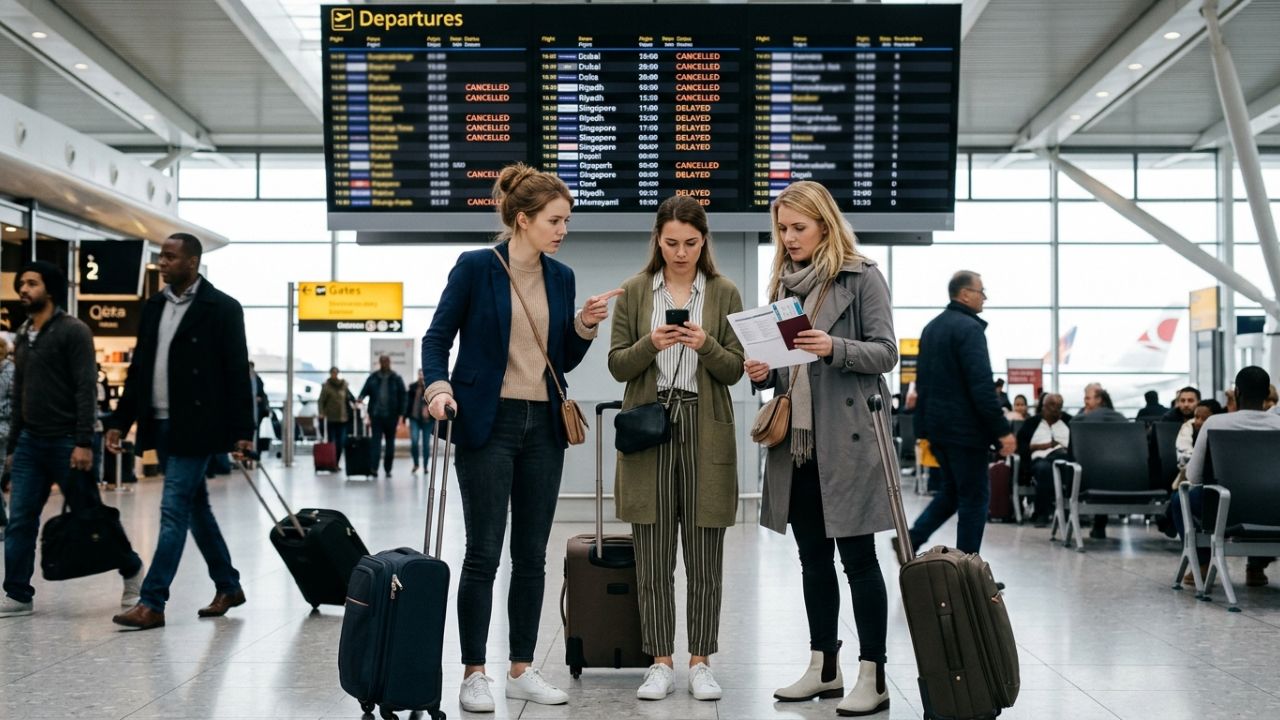
Image generated by AI
British Airways, Lufthansa, Cathay Pacific, Singapore Airlines, and KLM Navigate Fragmented Recovery as Dubai, Doha, Riyadh, and Tel Aviv Routes Face Extended Suspensions and Partial July Resumptions Amid Middle East Aviation Crisis in Summer 2026
Published on May 13, 2026
The partial reopening of Gulf airspace should have been a moment of straightforward relief for the millions of travelers whose summer 2026 plans were built around Dubai, Doha, Abu Dhabi, Riyadh, and Tel Aviv — but the reality emerging as airlines rebuild their Middle East route networks is considerably more complicated, more fragmented, and more strategically consequential than a simple "back to normal" narrative can accommodate. British Airways is planning to resume selected services to Dubai and Doha from July 2026, while maintaining suspensions on Bahrain and Amman for significantly longer. Lufthansa has extended suspensions on routes to Dubai, Abu Dhabi, Beirut, Riyadh, Muscat, Tehran, and Tel Aviv — one of the broadest Middle East suspension footprints of any global carrier. Singapore Airlines has suspended Dubai until August. Cathay Pacific and KLM continue their own Gulf suspension strategies. Meanwhile, on the other side of the divide, Emirates has already restored services to 137 destinations across 72 countries, Qatar Airways is rebuilding toward 150+ destinations, and Etihad Airways is expanding gradually — creating a two-speed recovery where Gulf carriers race ahead while European and Asian airlines remain cautiously grounded. For travelers planning Middle East travel, Europe–Asia connections through Gulf hubs, or simply trying to understand what has happened to fares that have risen 12–22% on Europe–Asia routes — this is the complete, current status of one of 2026's most consequential aviation stories.
Quick Summary:
- British Airways plans to resume Dubai (DXB) and Doha (DOH) services from July 2026 — Bahrain and Amman suspensions continue into the second half of the year.
- Lufthansa Group has implemented the broadest European suspension policy — routes to Dubai, Abu Dhabi, Riyadh, Muscat, Tehran, Beirut, and Tel Aviv remain paused for extended periods.
- Singapore Airlines has suspended its Dubai service until August 2026. Finnair has suspended Doha. Cathay Pacific has extended suspensions on Dubai and Riyadh.
- Emirates is leading the Gulf carrier recovery — services restored to 137 destinations across 72 countries. Qatar Airways is rebuilding toward 150+ destinations.
- Rerouted flights between Europe and Asia are adding 45 minutes to 3 hours to selected routes — increasing operating costs by an estimated 8–15% per rerouted long-haul service.
- Average airfare prices on Europe–Asia routes have risen 12–22% as a direct consequence of rerouting measures and reduced airline competition on Gulf corridor connections.
- India's Gulf travel market — over 9 million Indian travelers visited Gulf countries in 2025 — is the critical recovery stabilizer, with IndiGo, Air India, and Air India Express maintaining selective Gulf services due to strong passenger demand.
The Scale of the Crisis: Four Gulf Airports That Handle the World's Transit Traffic
To understand why the Middle East aviation disruption has had global ripple effects extending far beyond the region itself, it is essential to understand the extraordinary concentration of international transit traffic that flows through a small number of Gulf airports.
Dubai International Airport processed an estimated 92.3 million passengers in 2025 — making it the world's busiest international airport by international passenger volume and a cornerstone of global long-haul transit routing for travelers between Europe, Africa, the Indian subcontinent, Southeast Asia, and Australia.
Hamad International Airport in Doha handled approximately 52 million passengers — Qatar Airways' global hub whose extraordinary transit experience (the world's finest duty-free retail environment, exceptional lounge facilities, and a route network extending to 150+ destinations) had made it the preferred connection point for premium travelers on Europe–Asia and Europe–Australia itineraries.
Abu Dhabi International Airport (29 million passengers) and King Khalid International Airport in Riyadh (37 million passengers) complete the Gulf's extraordinary transit quartet — four airports collectively processing over 210 million passengers annually, the vast majority of whom are transit travelers connecting between intercontinental routes.
When the conflict-driven airspace disruptions forced the closure or restriction of key Gulf air corridors, these transit hubs — and the hundreds of global airline routes that depended on them for connectivity — faced simultaneous and cascading disruption. Airlines that had built their entire business model around Gulf hub connectivity suddenly faced the choice of rerouting around restricted airspace (at significant fuel and time cost), suspending routes entirely (at significant commercial cost), or finding alternative hub connections (at significant passenger experience cost).
British Airways: A July Resumption That Comes with Critical Caveats
British Airways' decision to plan partial July 2026 resumptions to Dubai and Doha is the most watched European airline recovery move — and the specific route-by-route granularity of its resumption strategy reveals the fragmented nature of the broader recovery.
Dubai resumption from July means British Airways passengers can once again book the carrier's direct Heathrow–Dubai service — one of BA's highest-volume routes, connecting London's Heathrow with the UAE's extraordinary tourism, retail, and business landscape. The Dubai resumption also restores British Airways as a transfer option for passengers connecting through Dubai to destinations in South Asia, Southeast Asia, and Australia via Emirates codeshares and interline agreements.
Doha resumption from July restores British Airways' Heathrow–Hamad International service, benefiting business travelers and tourists accessing Qatar's extraordinary tourism landscape — the National Museum of Qatar's extraordinary desert rose architecture, Souq Waqif's traditional market ambiance, Katara Cultural Village, and the beaches and lagoons of the Pearl-Qatar residential island.
But the Bahrain and Amman suspensions — continuing beyond July — illustrate the granular risk assessment that governs each resumption decision. Bahrain's airspace adjacency to sensitive regional zones and Amman's position in the geopolitically complex Jordan/Israel/Palestine/Syria convergence have led British Airways to maintain caution on routes where risk calculus remains unfavorable despite Gulf corridor improvement.
Lufthansa's Broadest Suspension Footprint: The Conservative European Standard
Lufthansa Group's extended suspension of routes to Dubai, Abu Dhabi, Riyadh, Muscat, Tehran, Beirut, and Tel Aviv represents the most comprehensive Gulf/Middle East suspension policy of any major global carrier — and it reflects a deliberate strategic conservatism that prioritizes fleet protection, insurance cost management, and passenger confidence over rapid route restoration.
The commercial logic of Lufthansa's conservative strategy is not simply risk aversion — it reflects the airline's specific fleet situation, operating under Boeing and Airbus delivery delays that have left several European carriers with fewer available aircraft than their pre-crisis schedules assumed. When aircraft availability is constrained, airlines face a binary choice: operate existing aircraft on restored Gulf routes at uncertain load factors and elevated insurance premiums, or maintain those aircraft on the stable, high-load European and transatlantic routes that deliver more predictable revenue.
For Lufthansa passengers who had booked the carrier's exceptional Business Class (with its fully flat beds and direct aisle access on long-haul) for Gulf destination travel, the extended suspension has created significant rebooking challenges — particularly for passengers who specifically chose Lufthansa for the carrier's Frankfurt hub connectivity to secondary German cities, Switzerland, and Austria.
The Lufthansa Group's extended suspensions also include SWISS and Austrian Airlines on their own Gulf route portfolios — meaning the entire European premium carrier cluster has effectively exited the Middle East market simultaneously, creating a premium business travel vacuum that Gulf carriers are scrambling to fill.
Emirates and Qatar Airways: Two-Speed Recovery Reshaping Global Transit
While European and Asian carriers extend suspensions, Emirates and Qatar Airways are executing the most aggressive airline network restoration strategies in the history of the Gulf aviation sector — and the competitive implications for global aviation reach far beyond the Middle East.
Emirates' restoration of services to 137 destinations across 72 countries is an extraordinary operational achievement — reflecting the airline's extraordinary fleet depth (over 250 wide-body aircraft in service), its extraordinary Dubai hub infrastructure, and the remarkable operational resilience of a carrier built specifically to serve as the world's global transit platform.
For global travelers, Emirates' rapid restoration means that Dubai International Airport is functioning as a viable long-haul transit hub — albeit with some frequency reductions and schedule adjustments relative to pre-crisis levels. Travelers connecting London–Dubai–Sydney, Frankfurt–Dubai–Bangkok, or New York–Dubai–Mumbai itineraries can once again access these connections through Emirates, even as British Airways, Lufthansa, and other Western carriers maintain their own suspensions.
Qatar Airways' reconstruction toward 150+ destinations from Hamad International Airport provides the same transit function from Doha — and Qatar Airways' extraordinary Qsuite Business Class product (widely regarded as the finest business class seat in the world) makes the carrier's Doha hub the preferred connection for premium travelers willing to book despite the ongoing regional context.
India's 9 Million Gulf Travelers: The Recovery's Critical Stabilizer
One of the most significant and underreported dimensions of the Middle East aviation recovery is the extraordinary resilience of Indian outbound travel demand to the Gulf — and the role of Indian airlines in maintaining corridor stability when European and Asian carriers suspended.
More than 9 million Indian travelers visited Gulf countries in 2025 — a figure that reflects India's extraordinary demographic and economic ties to the UAE, Qatar, Saudi Arabia, Kuwait, Bahrain, and Oman. Indian nationals constitute the largest single expatriate community in the UAE (nearly 3.5 million), Qatar (over 700,000), and Kuwait (over 1 million) — meaning a substantial proportion of India–Gulf travel is not discretionary tourism but essential family, community, and labor connectivity that persists regardless of geopolitical context.
IndiGo, Air India, and Air India Express have maintained selective Gulf services throughout the disruption period, providing the passenger flow continuity that Gulf airports and hotels have depended on to sustain occupancy levels during the European carrier suspension window.
For Gulf tourism authorities, India's travel resilience has been the crucial bridge between the crisis and recovery phases — Dubai hotel occupancy is expected to remain above 70% in the second half of 2026 significantly because Indian leisure travel, medical tourism, and family visit traffic has remained largely intact even as European visitor numbers declined.
Guide for Travelers:
- British Airways passengers: BA's July Dubai and Doha resumption means bookings from July 2026 onward are now available at ba.com. If you had a British Airways Bahrain or Amman booking, contact BA Customer Service for rebooking on alternative carriers or refund options — EU261/2004 may apply to canceled services.
- Lufthansa passengers: Lufthansa's extended Gulf suspensions remain in effect. Affected passengers should contact Lufthansa customer service (+49 69 86 799 799) for rebooking onto alternative Lufthansa Group carriers (SWISS, Austrian) via non-Gulf routing, or request full refunds on suspended routes.
- Singapore Airlines Dubai resumption August 2026: Singapore Airlines' August Dubai resumption means SQ passengers should check singaporeair.com from July for booking availability. SQ's A380 Emirates codeshare partnership may provide an interim Dubai access option via connecting services.
- Alternative routing through Doha (Qatar Airways): For travelers whose European carrier has suspended Dubai/Riyadh routes, Qatar Airways' rapid Doha network restoration provides the most comprehensive Gulf hub alternative — and Qsuite availability makes this an upgrade opportunity for business travelers.
- Travel insurance for Middle East itineraries: Comprehensive travel insurance covering geopolitical cancellation is essential for any Middle East booking through the summer of 2026. Ensure your policy explicitly covers "government-imposed airspace closures" as a cancellation trigger — many standard policies exclude geopolitical events.
- Expect 12–22% higher fares on Europe–Asia routes: Budget for elevated airfare on any Europe–Asia routing that previously transited through Gulf hubs. The combination of reduced carrier competition and rerouting fuel surcharges has pushed fares substantially above pre-crisis levels across multiple route pairs.
- Allow extra connection time at Gulf hubs: Rerouted flight arrivals may affect departure coordination — if transiting through Dubai, Doha, or Abu Dhabi this summer, book minimum 2.5-hour connection windows rather than the conventional 90-minute Gulf hub standard.
- Monitor real-time travel advisories: UK FCDO (gov.uk/foreign-travel-advice), German Auswärtiges Amt (auswaertiges-amt.de), and the US State Department (travel.state.gov) are the most current sources for per-destination risk assessments affecting the Middle East corridor.
Related Travel Guides
- Global Airspace Crisis: Russia, Iran, and Gulf Closures Force Qatar, Emirates, and Lufthansa to Reroute 2026
- British Airways Flight BA1458 Declares Squawk 7700 Emergency at Edinburgh Airport
- KLM Boeing 787 U-Turns Over Ireland After Engine Valve Failure on Amsterdam–JFK Route
The Middle East aviation crisis of 2026 is not resolving neatly or uniformly — and that asymmetry between the Gulf carriers racing ahead and the European airlines maintaining caution is the defining aviation narrative of the summer season. For travelers, it creates an environment of unusual complexity: British Airways returns to Dubai in July but not Bahrain. Lufthansa remains absent from Abu Dhabi and Riyadh. Singapore Airlines won't fly to Dubai until August. But Emirates' 137-destination restoration and Qatar Airways' extraordinary Doha hub recovery mean that the Gulf's global transit function is rebuilding — just not with the same carrier lineup that operated it before the crisis began. Dubai's hotels will fill above 70%. India's 9 million Gulf travelers will keep flying. And the airlines that committed to the Gulf's long-term significance — Emirates, Qatar Airways, and Etihad — will emerge from this crisis with strengthened market positions that will shape global aviation for years. Book flexibly. Insure comprehensively. And trust that one of the world's greatest aviation corridors is, gradually but definitively, finding its way back.
Disclaimer
This article is for informational and educational purposes only. It does not constitute legal, financial, or professional advice. While we strive to provide accurate and up-to-date information, travel policies, regulations, and conditions change rapidly. Always verify information with official sources before making travel decisions. Nomad Lawyer makes no representations about the accuracy, reliability, completeness, or suitability of the information provided. Readers should consult qualified professionals for advice specific to their circumstances. The views expressed in this article are those of the author and do not necessarily reflect the views of Nomad Lawyer.
Kunal K Choudhary
Co-Founder & Contributor
A passionate traveller and tech enthusiast. Kunal contributes to the vision and growth of Nomad Lawyer, bringing fresh perspectives and driving the community forward.
Learn more about our team →