
British Airways Flight BA1458 Declares Squawk 7700 Emergency After Co-Pilot Falls Ill Mid-Descent, Making Safe Emergency Landing at Edinburgh Airport from London Heathrow
British Airways Flight BA1458 from London Heathrow to Edinburgh declared a Squawk 7700 general emergency at 13,000 feet after the co-pilot fell seriously ill during descent, landing safely with full emergency services mobilized.

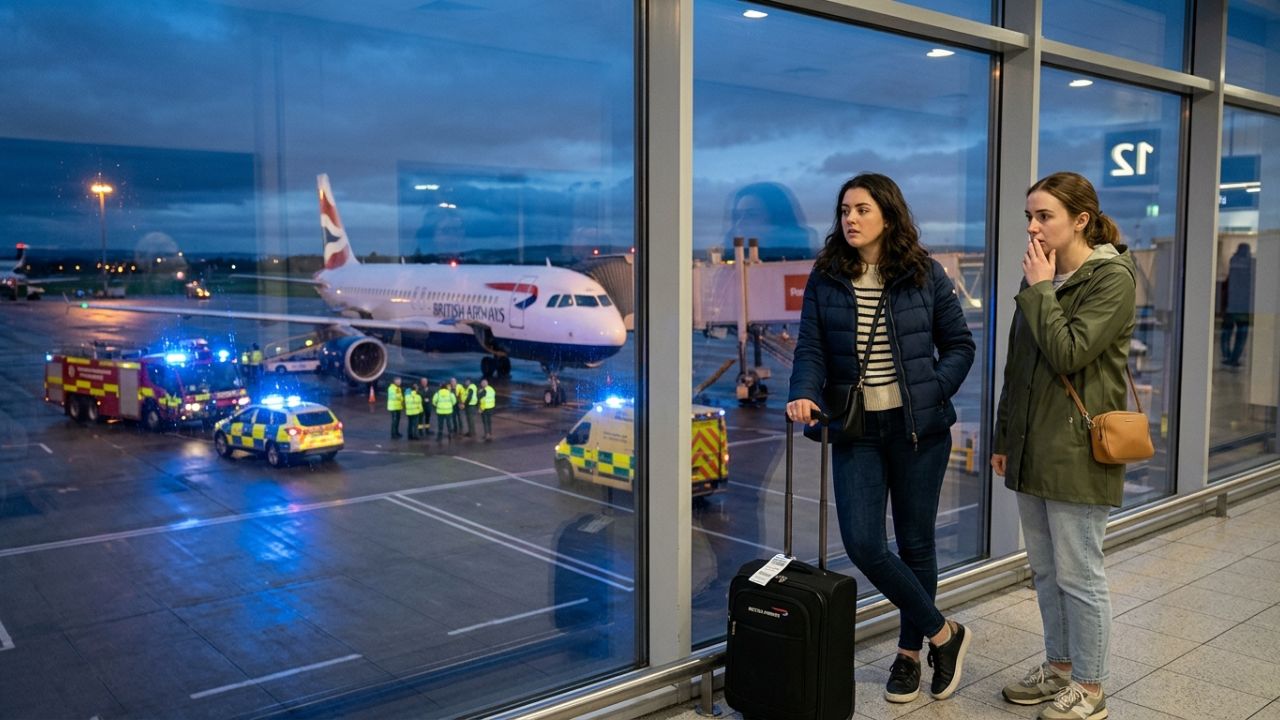
Image generated by AI
British Airways Flight BA1458 Declares Squawk 7700 Emergency After Co-Pilot Falls Ill at 13,000 Feet During Descent, Making Safe Emergency Landing at Edinburgh Airport from London Heathrow
Published on May 13, 2026
At approximately 5:00 PM on Monday, as British Airways Flight BA1458 began its routine descent into Edinburgh Airport after departing London Heathrow, a medical emergency transformed a routine domestic hop into a textbook example of aviation safety systems working exactly as they should. The Airbus A320 operating the Heathrow-to-Edinburgh service was at approximately 13,000 feet when its crew activated Squawk 7700 — the international aviation emergency transponder code that immediately signals a general emergency to every air traffic controller within range, triggering a coordinated response across Edinburgh Airport's emergency infrastructure. The cause: the co-pilot had fallen seriously ill. What followed in the minutes that remained before touchdown was a precise, proficient, and professionally executed emergency response involving the remaining flight crew, Edinburgh Airport ATC, ground emergency services, and medical teams — culminating in a safe landing with no passenger injuries and no disruption to Edinburgh Airport's broader operations. This is the complete account of what happened, how aviation safety protocols performed, and what every traveler should understand about how these emergencies are managed.
Quick Summary:
- British Airways Flight BA1458 (London Heathrow LHR → Edinburgh Airport EDI) declared a Squawk 7700 general emergency while descending into Edinburgh at approximately 13,000 feet.
- The emergency was triggered by the co-pilot falling seriously ill during the aircraft's descent phase — one of the more critical moments of any commercial flight.
- The aircraft, an Airbus A320, was operating a regular scheduled service that had departed Heathrow at approximately 5:00 PM.
- Squawk 7700 — the universal transponder code for a general aviation emergency — was transmitted, immediately alerting Edinburgh ATC and triggering the airport's full emergency response protocol.
- Edinburgh Airport emergency services including medical teams, emergency vehicles, and fire response units mobilized on the runway in advance of the aircraft's arrival.
- The Airbus A320 landed safely with no passenger injuries and no further complications. All passengers disembarked normally.
- British Airways confirmed the safe landing but did not publicly disclose the specific nature of the co-pilot's medical condition, in line with standard crew medical privacy protocols.
What Is Squawk 7700 — and Why Does Activating It Change Everything?
For the millions of air travelers who have never heard the term Squawk 7700, understanding what this code means — and what its activation immediately triggers — is essential to understanding the precise speed and comprehensiveness of the response to Flight BA1458's co-pilot emergency.
Every commercial aircraft is equipped with a transponder — an electronic device that continuously broadcasts the aircraft's identity, altitude, and position to air traffic control radar systems. Pilots assign their aircraft a specific four-digit transponder code (called a "squawk") at the beginning of every flight — a code that identifies the aircraft within the ATC system throughout the journey.
Squawk 7700 is the universally recognized four-digit code for a general emergency. When a pilot selects 7700 on their transponder, it triggers an immediate, unmissable alert on every ATC radar screen that can detect the aircraft. The aircraft appears on those screens with a distinctive visual indicator — a bright, immediately visible emergency flag — that instructs controllers to immediately prioritize that specific aircraft above all other traffic in their sector.
At 13,000 feet — still within Edinburgh's approach zone but with sufficient altitude to execute a safe managed descent — the BA1458 crew's Squawk 7700 activation gave Edinburgh ATC and airport emergency services the maximum possible advance warning to prepare the runway, mobilize medical teams, and clear the approach for an unimpeded final descent and landing.
How Flight BA1458's Crew Managed the Emergency
The central operational reality of the BA1458 emergency is one that aviation safety systems are specifically designed to accommodate: a two-pilot commercial aircraft can be safely operated by one pilot in the event of the other's incapacitation.
Commercial aviation's two-pilot minimum crew standard — established by international civil aviation authorities decades ago — exists precisely because of medical emergency scenarios like the one that unfolded aboard BA1458. Any pilot qualified to operate a commercial aircraft type holds the training, certification, and procedural knowledge to manage that aircraft through approach, final, and landing without a second pilot actively participating in aircraft control.
British Airways' extensive pilot training program — which includes simulator-based incapacitation drills that specifically practice the scenario of managing a commercial aircraft approach and landing with a single active pilot — is the invisible infrastructure that made the BA1458 emergency manageable from the moment the co-pilot's condition became apparent.
The remaining flight crew member — with Edinburgh ATC providing priority routing, cleared runway, and full emergency services standing by — executed exactly the procedure they have trained for: maintain aircraft control, follow the established emergency descent and approach profile, communicate clearly with ATC, and deliver the aircraft and its passengers to the ground safely.
Edinburgh Airport's Emergency Response: A Coordinated, Professional, and Effective Mobilization
Edinburgh Airport's response to the Squawk 7700 alert from BA1458 exemplifies the emergency preparedness standards that major UK airports are required to maintain under Civil Aviation Authority regulations.
Upon receiving the emergency transponder alert from ATC, Edinburgh Airport's Airport Rescue and Fire Fighting (ARFF) service mobilized immediately — with fire tenders, medical response vehicles, and emergency personnel deploying to pre-positioned standby locations adjacent to the expected landing runway. This pre-positioning is standard procedure for all Squawk 7700 declarations: emergency vehicles are in place before the aircraft arrives, not dispatched after landing.
Medical teams were specifically positioned to reach the co-pilot as soon as the aircraft stopped and the door opened — providing the fastest possible transition from aviation emergency to clinical medical care.
The aircraft approached Edinburgh's runway, cleared of all other traffic by ATC, and landed without further complication. Emergency vehicles accompanied the aircraft on the runway rollout as standard protocol. The aircraft then moved to the gate, where passengers disembarked normally — an ordinary arrival ending for an approach that had been anything but.
The Medical Privacy Standard: Why British Airways Didn't Disclose the Co-Pilot's Condition
British Airways' decision not to publicly disclose the specific nature of the co-pilot's medical condition is not evasion — it is compliance with a well-established and entirely appropriate standard of aviation crew medical privacy.
Pilot medical conditions are governed by strict confidentiality frameworks under both UK data protection law and aviation medical certification regulations administered by the UK Civil Aviation Authority (CAA). An individual crew member's specific medical status — including the nature of any in-flight medical emergency — is their personal medical information, protected from public disclosure regardless of the circumstances under which it became relevant.
Airlines are permitted to confirm that a medical emergency occurred, that it was handled according to established protocols, and that the aircraft landed safely. Beyond that, the specific clinical detail belongs to the affected individual and their treating medical team — not the airline's public communications department.
This privacy standard is consistent across all major airlines globally. It protects crew members from having sensitive personal health information become a matter of public record simply because an emergency occurred during their professional duties.
Aviation Safety in Context: Why These Emergencies Are Managed So Effectively
The BA1458 incident — while alarming in the moment for those on board and alarming in headline form for those reading about it afterward — is in fact a demonstration of aviation safety infrastructure working with extraordinary effectiveness.
Consider the full chain of safety systems that activated in response to a single medical emergency at 13,000 feet:
The transponder system immediately communicated the emergency to every relevant ATC facility within radar range. The ATC response cleared the approach corridor and prepared the runway within minutes of the alert. The airport emergency services mobilized without instruction, following standing procedures triggered automatically by the emergency code. The aircraft's engineering — designed to be safely operated by a single qualified pilot — removed the second crew member's incapacitation as a safety threat to the flight. The pilot's training — specifically including single-pilot emergency operation — transformed a serious medical event into a managed approach and landing without passenger harm.
This layered safety architecture is why commercial aviation remains the statistically safest mode of long-distance transportation available to modern travelers.
Guide for Travelers:
- Squawk 7700 does not mean the aircraft is crashing — it means the crew has declared a general emergency and triggered maximum priority handling from ATC. If you ever hear that your flight has "declared an emergency," the correct response is to follow all crew instructions calmly. The system is working exactly as designed.
- For nervous flyers: The two-pilot commercial aviation standard specifically exists to ensure that a single pilot incapacitation never creates an unmanageable emergency. Every commercial pilot is trained to manage approach and landing alone if necessary.
- Flight BA1458 continues to operate normally — this was an isolated medical incident involving an individual crew member, not a systemic issue with the aircraft, the route, or British Airways' operations.
- British Airways customer service: Passengers on BA1458 who were affected by any delay or disruption should contact British Airways Customer Relations at ba.com/help or 0344 493 0787 (UK) for any compensation or delay assistance claims relevant to the EU261/UK261 passenger rights framework.
- UK261 passenger rights: Under UK regulations derived from EU261, passengers facing significant delays on UK-operated flights may be entitled to assistance and compensation depending on the delay duration and circumstances. A delay caused by a genuine in-flight medical emergency may be classified as an "extraordinary circumstance" — confirm your specific eligibility directly with British Airways.
- Edinburgh Airport information: Edinburgh Airport is Scotland's busiest international airport, serving the extraordinary Scottish capital with connections to London, Europe, and international destinations. The airport operates a reliable bus service (Airlink 100) to Edinburgh city centre in approximately 25 minutes.
- Best time to visit Edinburgh: August is Edinburgh's most vibrant month — the extraordinary Edinburgh Festival Fringe, the Edinburgh International Festival, and the Royal Military Tattoo transform the city into the world's greatest performing arts gathering. September–October delivers the magnificence of Scottish autumn — fewer crowds, spectacular foliage in the Royal Mile's closes and Arthur's Seat, and the full depth of Edinburgh's extraordinary heritage.
Related Travel Guides
- UK Flight Disruptions: Emirates, British Airways, and KLM Cancel 12 Flights Across Heathrow, Gatwick, and Manchester
- Etihad Airways Denies Fire on Chennai to Abu Dhabi Flight EY343 After Technical Issue
- UK, Germany, and France to Enjoy Cheaper Summer Airfares Despite 80% Fuel Surge
British Airways Flight BA1458 landed safely at Edinburgh Airport on Monday evening — and the full story of that landing is a story of aviation safety working precisely as it was designed to work, under precisely the conditions it was designed to handle. A co-pilot fell ill. The remaining crew activated Squawk 7700. ATC cleared the corridor. Edinburgh Airport mobilized. The A320 descended safely. Every passenger disembarked without injury. The co-pilot received medical care. The entire emergency response — from the first Squawk 7700 transmission at 13,000 feet to the aircraft at the gate — unfolded with the calm, practiced professionalism that British Airways and Edinburgh Airport's emergency teams train for continuously. London Heathrow to Edinburgh remains one of the UK's most traveled domestic routes — a journey above the extraordinary landscapes of northern England and the Scottish Borders that hundreds of thousands of passengers make every year in complete safety. Tuesday's incident does not change that. The system worked. The crew performed. The passengers were safe.
Disclaimer
This article is for informational and educational purposes only. It does not constitute legal, financial, or professional advice. While we strive to provide accurate and up-to-date information, travel policies, regulations, and conditions change rapidly. Always verify information with official sources before making travel decisions. Nomad Lawyer makes no representations about the accuracy, reliability, completeness, or suitability of the information provided. Readers should consult qualified professionals for advice specific to their circumstances. The views expressed in this article are those of the author and do not necessarily reflect the views of Nomad Lawyer.
Kunal K Choudhary
Co-Founder & Contributor
A passionate traveller and tech enthusiast. Kunal contributes to the vision and growth of Nomad Lawyer, bringing fresh perspectives and driving the community forward.
Learn more about our team →