
Middle East Aviation Crisis 2026: 85 Flights Cancelled and 766 Delayed Across Riyadh and Dubai Hubs
Widespread operational failures across Gulf aviation networks have led to 85 cancellations and 766 delays, severely impacting travel through Riyadh, Dubai, and Doha.

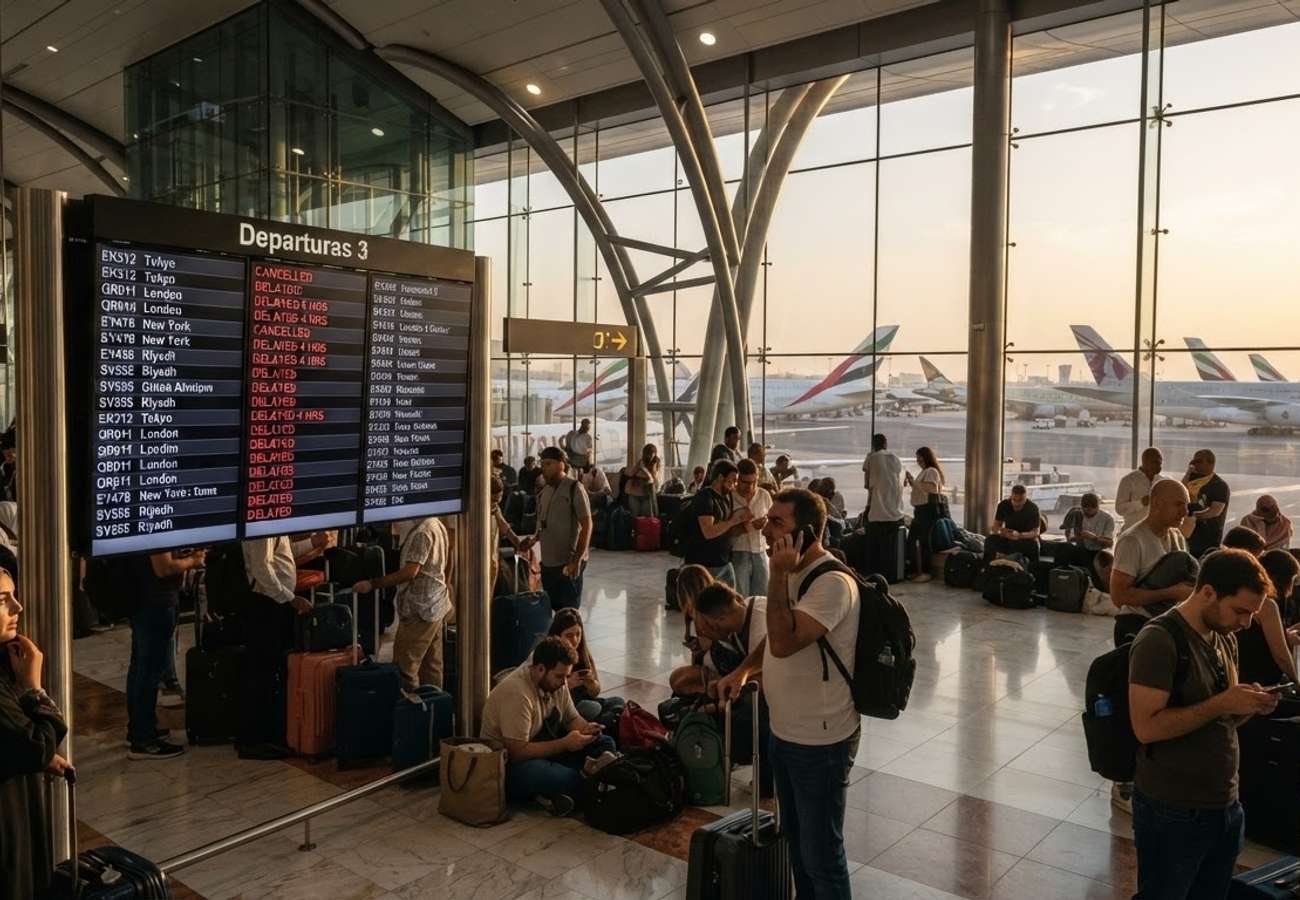
Image generated by AI
Over 800 flights have been disrupted across the Gulf region, with 85 total cancellations and 766 delays paralyzing major transit hubs in Saudi Arabia, the UAE, Qatar, and Egypt. This operational collapse has stranded thousands of passengers, exposing the extreme fragility of the interconnected aviation networks that link Asia, Europe, and Africa.
The current instability is attributed to a combination of acute operational pressures, sudden network adjustments, and an unsustainable surge in demand on primary international corridors. As carriers struggle to synchronize their schedules, the ripple effect has turned key gateways into bottlenecks, leaving travelers facing significant uncertainty.
Regional Hubs Face Severe Operational Bottlenecks
The scale of the disruption is most evident at the primary gateways of the Middle East. Dubai International Airport emerged as the epicenter of the delays, recording 236 delayed services and two cancellations. Given Dubai's status as a global nexus, these delays have a compounding effect on connecting traffic moving between three continents.
Saudi Arabia's aviation infrastructure has faced similar strain. King Khalid International Airport in Riyadh reported 107 delays and 24 cancellations. Simultaneously, King Abdulaziz International Airport in Jeddah saw 83 delays and 14 cancellations. These figures are particularly impactful given the role of these airports in facilitating both high-stakes business travel and religious pilgrimage.
In Qatar, the impact was concentrated at Hamad International Airport in Doha, which recorded 95 delays and two cancellations. Meanwhile, the United Arab Emirates saw further pressure at Sharjah International Airport, where 78 flights were delayed and five were cancelled.
City-Specific Impact and Airport Performance Data
The disruption pattern indicates that while the largest hubs suffered the highest volume of delays, smaller regional airports in Saudi Arabia faced a higher proportion of outright cancellations.
Cairo International Airport in Egypt stood out as a major point of failure outside the Gulf, recording 144 delays and two cancellations. This disruption significantly hampered travel flows across the broader Middle East and North Africa (MENA) region.
Within Saudi Arabia, domestic connectivity was hit hard. Gizan Regional Airport saw 15 cancellations, while Najran Domestic Airport recorded 12 cancellations. Notably, both airports reported zero delays, suggesting that airlines opted to cancel flights entirely rather than attempt to manage scheduling slips. Abha Regional Airport experienced a mix of both, with 23 delays and nine cancellations.
Middle East Aviation Disruption Statistics (August 14, 2026)
| Airport / City | Delays | Cancellations |
|---|---|---|
| Dubai International (DXB) | 236 | 2 |
| Cairo International (CAI) | 144 | 2 |
| King Khalid International, Riyadh (RUH) | 107 | 24 |
| Hamad International, Doha (DOH) | 95 | 2 |
| King Abdulaziz International, Jeddah (JED) | 83 | 14 |
| Sharjah International (SHJ) | 78 | 5 |
| Abha Regional | 23 | 9 |
| Gizan Regional | 0 | 15 |
| Najran Domestic | 0 | 12 |
Airline Performance and Carrier Reliability
The operational crisis has not spared any specific tier of airline, affecting both full-service national carriers and low-cost providers.
Saudia was the hardest hit in terms of total service loss, recording 36 cancellations and 52 delays. This reflects the systemic pressure currently facing the Saudi Arabian aviation sector. In the UAE, the low-cost sector saw significant volatility; Air Arabia reported 68 delays and five cancellations, while flydubai recorded 86 delays and one cancellation.
Other carriers struggling to maintain schedules include flynas, with 47 delays and one cancellation, and Israir, which recorded 36 delays and one cancellation. For Israir, delays accounted for 52% of its total affected operations during this period.
Strategic Advice for Displaced Passengers
For travelers currently navigating this chaos, industry observers suggest a proactive approach to minimize further losses.
First, passengers must verify flight statuses directly via airline mobile apps or official websites. Airport flight boards often lag behind real-time operational changes, leading to passengers arriving for flights that have already been scrubbed from the schedule.
Connecting passengers are urged to build significant buffers into their itineraries. When transiting through high-pressure hubs like Doha, Dubai, or Cairo, the likelihood of missing a connection has increased exponentially.
Regarding cancellations, travelers should prioritize official rebooking channels. Industry experts warn against purchasing new, independent tickets before confirming the airline's rebooking options, as doing so may waive the passenger's right to statutory compensation or free alternatives.
Why This Matters: The Fragility of the "Hub-and-Spoke" Model
From a logistical standpoint, this event serves as a stark reminder of the "single point of failure" risk inherent in the Middle East's aviation strategy. The region relies heavily on a few massive hubs to funnel global traffic. When a hub like Dubai or Riyadh experiences a synchronized failure, it doesn't just affect local passengers—it creates a global vacuum.
For the traveler, this means that a delay in a city they aren't even visiting can still result in their flight being cancelled. The interconnectedness that makes Gulf travel efficient during normal times becomes a liability during a crisis. As these airports push toward higher capacities in 2026, the margin for error has vanished. Any minor operational shift now triggers a regional domino effect.
Aviation stability in the Gulf is no longer a guarantee, but a precarious balance.
Related Travel Guides
Disclaimer
This article is for informational and educational purposes only. It does not constitute legal, financial, or professional advice. While we strive to provide accurate and up-to-date information, travel policies, regulations, and conditions change rapidly. Always verify information with official sources before making travel decisions. Nomad Lawyer makes no representations about the accuracy, reliability, completeness, or suitability of the information provided. Readers should consult qualified professionals for advice specific to their circumstances. The views expressed in this article are those of the author and do not necessarily reflect the views of Nomad Lawyer.
Raushan Kumar
Founder & Lead Developer
Full-stack developer with 11+ years of experience and a passionate traveller. Raushan built Nomad Lawyer from the ground up with a vision to create the best travel and law experience on the web.
Learn more about our team →