
Miami International Airport Operations Disrupted After Cargo Aircraft Incident Triggers FAA Ground Stop

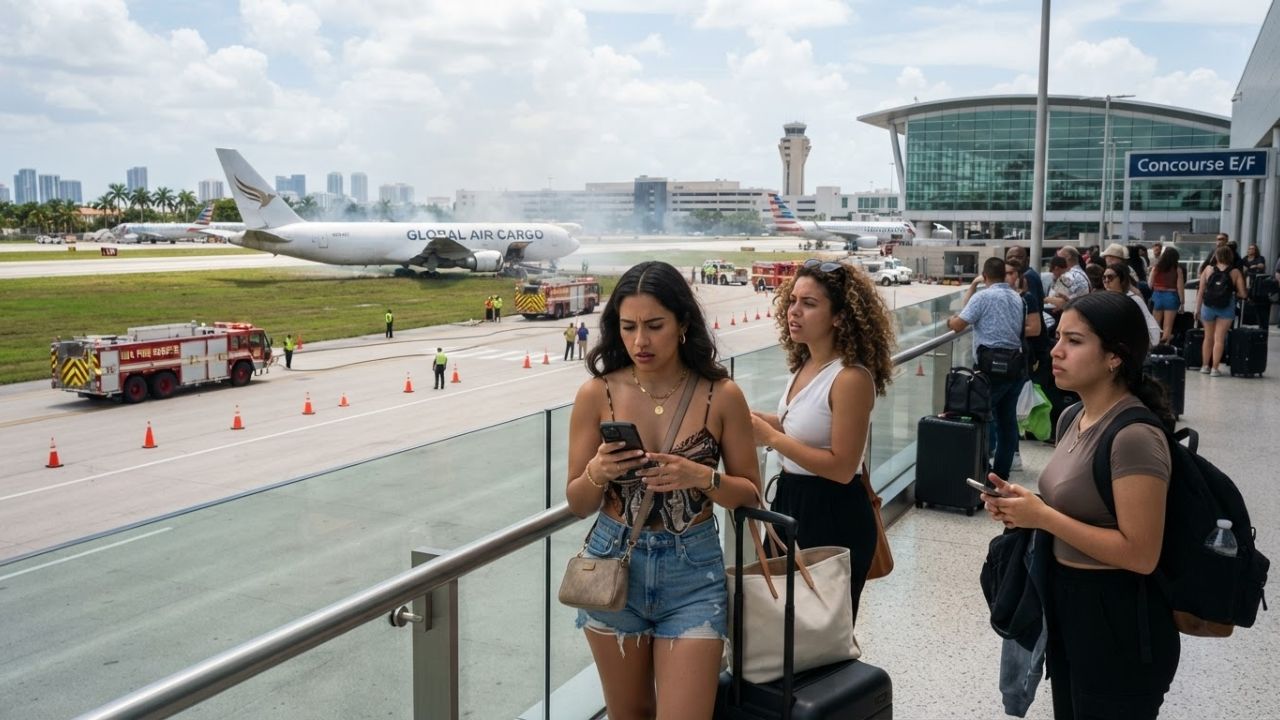
A runway excursion and post-landing fire involving an Amazon Prime Air Boeing 767-300 cargo aircraft at Miami International Airport triggered an immediate FAA ground stop and widespread flight delays across South Florida. With multi-agency investigations underway and runway restrictions in place, passengers connecting through Miami for international flights and PortMiami cruise departures face significant schedule adjustments.
The aviation incident unfolded when Prime Air Flight 7598, operated by cargo carrier 21 Air, arrived at Miami International Airport from Luis Muñoz Marín International Airport in San Juan, Puerto Rico. Upon touching down, the Boeing 767-300 overran the runway surface in the northwest section of the airport airfield, struck multiple vehicles near the perimeter corridor, and caught fire.
Multi-Agency Emergency Response on the Airfield
Miami-Dade Fire Rescue initiated a massive tactical response, deploying more than 60 emergency units and approximately 200 personnel to contain the blaze, cool compromised aircraft fuel tanks, assist victims, and secure the perimeter. Public safety officials confirmed fatalities and injuries at the scene, with medical teams treating the injured and transporting victims to area trauma centers.
In response to the active emergency, the Federal Aviation Administration (FAA) issued a ground stop halting inbound arrivals and outbound departures. While operations gradually resumed, temporary closures of adjacent runways and taxiways in the northwest airfield quadrant reduced peak runway capacity, triggering cascading departure delays and inbound gate holds across passenger concourses.
Both the FAA and the National Transportation Safety Board (NTSB) have initiated on-site investigations to determine mechanical, runway surface, meteorological, and operational factors contributing to the accident.
Ripple Effects for Caribbean, Latin America, and Cruise Connections
Miami International Airport operates as the primary transatlantic and hemispheric transit hub for South Florida, moving tens of millions of passengers annually. Because cargo operations share runway infrastructure with major commercial airlines, airfield disruptions immediately ripple across passenger schedules.
The disruption carries sharp consequences for several traveler segments:
- PortMiami Cruise Passengers: Miami serves as the world’s leading cruise gateway. Travelers flying in on same-day itineraries for afternoon ship embarkations risk missing departure cutoffs if regional flights encounter rolling delay holds.
- International Connecting Travelers: As the premier gateway linking the continental United States with South America, Central America, and the Caribbean, missed bank connections in Miami leave long-haul travelers facing overnight rebooking queues.
- Cargo and Logistics Flow: Beyond passenger travel, the temporary closure of key freight aprons disrupts express mail and e-commerce supply chains moving through South Florida's distribution network.
Local Insider Tips: Navigating South Florida Delays and Cruise Transfers
If traveling into or through South Florida during this period of operational recovery, heed these strategic navigation recommendations:
- Build a Day-Prior Cruise Buffer: Never fly into Miami on the actual morning of a cruise departure. Arriving 24 hours in advance protects against unpredictable air traffic control delays and ensures a relaxed embarkation at PortMiami.
- Utilize Fort Lauderdale (FLL) or Palm Beach (PBI): If your flight into Miami is cancelled or facing extensive holding patterns, request that your airline rebook you into Fort Lauderdale-Hollywood International Airport (just 30 miles north) or Palm Beach International Airport.
- Connect via Rail Instead of Highway Gridlock: If diverting to Fort Lauderdale or West Palm Beach, bypass Interstate 95 airport traffic by boarding the Brightline higher-speed passenger train directly into Downtown Miami’s Central Station, minutes from PortMiami and South Beach.
- Explore Neighborhood Enclaves During Layover Delays: If stranded overnight near the airport, take a short rideshare to historic Little Havana along Calle Ocho for authentic cubano sandwiches and cafecitos, or wander the open-air street murals and galleries of the Wynwood Arts District.
Tourism Outlook: Infrastructure Resilience at a Hemispheric Crossroads
Miami's tourism economy relies directly on the operational dependability of its transport terminals. While aviation authorities, emergency personnel, and airlines work through the immediate aftermath of the Prime Air Flight 7598 crash, the incident underscores the intense operational coordination required to keep dual-use passenger and cargo facilities functioning safely.
Travelers with upcoming flights through Miami should continuously monitor airline mobile applications for automated waiver alerts, register for text notification updates, and allow extra transit time at security checkpoints as regular flight operations normalize.
Related Travel Guides
Disclaimer
This article is for informational and educational purposes only. It does not constitute legal, financial, or professional advice. While we strive to provide accurate and up-to-date information, travel policies, regulations, and conditions change rapidly. Always verify information with official sources before making travel decisions. Nomad Lawyer makes no representations about the accuracy, reliability, completeness, or suitability of the information provided. Readers should consult qualified professionals for advice specific to their circumstances. The views expressed in this article are those of the author and do not necessarily reflect the views of Nomad Lawyer.
Raushan Kumar
Founder & Lead Developer
Full-stack developer with 11+ years of experience and a passionate traveller. Raushan built Nomad Lawyer from the ground up with a vision to create the best travel and law experience on the web.
Learn more about our team →