
Malaysia and Türkiye Unlock New Asia to Europe Air Network as AirAsia and Pegasus Launch Codeshare
Malaysia and Türkiye Unlock New Asia to Europe Air Network as AirAsia and Pegasus Launch Codeshare. Latest travel news, updates, and expert analysis.

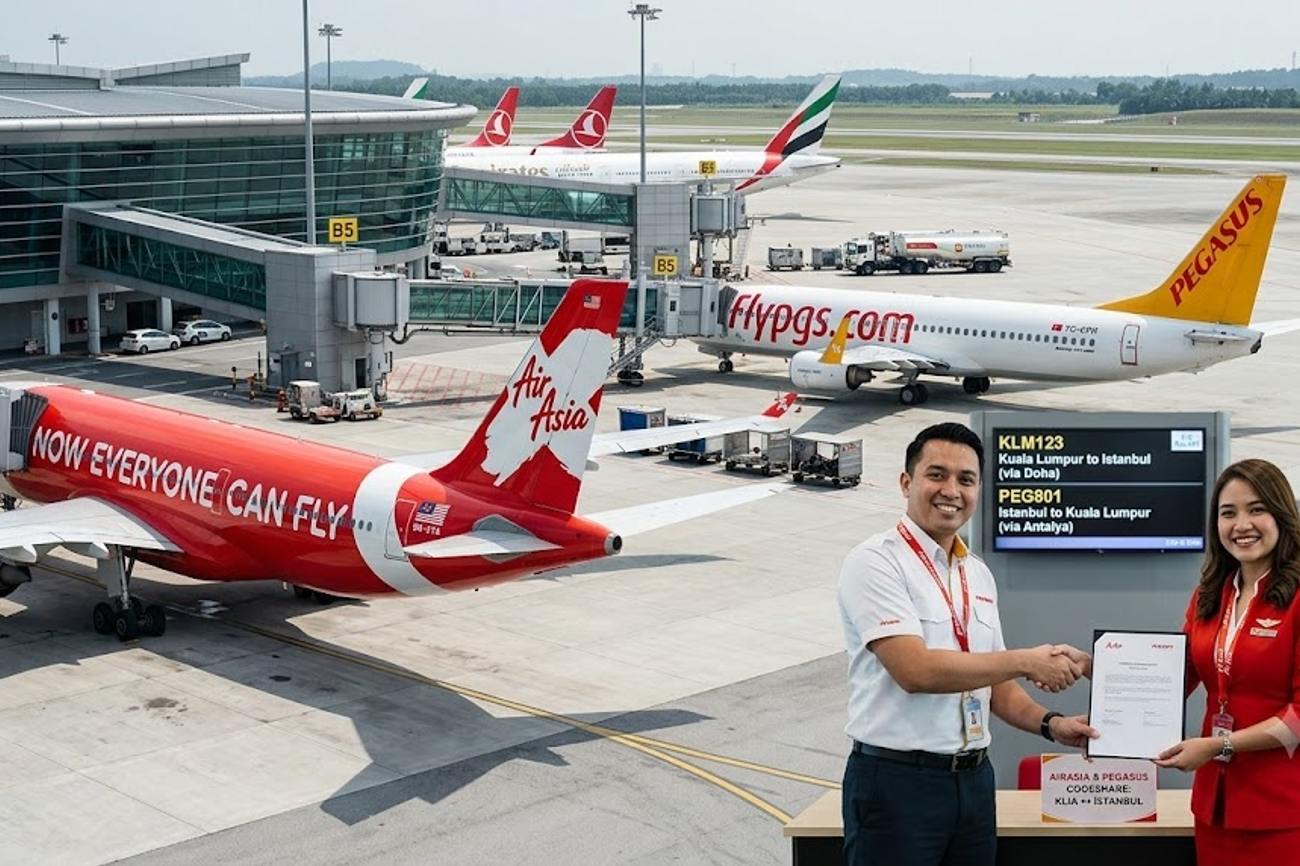
Image generated by AI
While budget backpackers and transcontinental voyagers historically endured exhausting self-transfers lugging baggage between unrelated low-cost airlines, the first codeshare alliance in AirAsia's entire history has officially dismantled that barrier between Asia and Europe. Formalized on 2 September 2026, the landmark partnership between Malaysia-based AirAsia and Turkish carrier Pegasus Airlines unites two massive budget aviation footprints through Kuala Lumpur International Airport (KLIA) and Istanbul Sabiha Gökçen International Airport (SAW). By consolidating single-ticket reservations, automated baggage through-check, and integrated flight schedules, travelers can now cross from London, Zurich, or Athens into the heart of Southeast Asia without paying legacy airline airfares or risking stranded luggage.
A Transcontinental Aviation Bridge Built on Low-Cost Innovation
The operational spine of this transcontinental partnership is the non-stop route linking Kuala Lumpur with Istanbul Sabiha Gökçen, inaugurated by long-haul carrier AirAsia X in November 2025. Operating four flights per week, the service will scale up to seven weekly flights by February 2027, creating a seamless daily connection between the two continents. Under the codeshare framework, Pegasus passengers originating across Europe can book the Istanbul–Kuala Lumpur crossing directly through Pegasus distribution channels, while AirAsia customers gain unified access to European gateways.
The initial route rollout opens direct connecting itineraries to five major European destinations: London Stansted, Moscow Vnukovo, Ankara Esenboğa, Zurich, and Athens. Over the coming months, the alliance is slated to progressively incorporate more than 100 additional routes across the combined networks. For long-distance flyers, the single-ticket booking arrangement eliminates the vulnerability of self-transferring across separate airlines, providing legal transfer protections, guaranteed rebooking during disruptions, and direct luggage transfers straight through to their ultimate port of entry.
This union establishes a powerful alternative to established Gulf carrier transfer hubs. Pegasus has transformed Sabiha Gökçen, situated on Istanbul’s Anatolian shore, into a high-frequency transit springboard spanning Türkiye, the Mediterranean, and Europe. In parallel, Kuala Lumpur serves as AirAsia's primary mega-hub, anchoring an expansive regional system spanning over 140 destinations across ASEAN nations—including Thailand, Indonesia, Vietnam, the Philippines, and China—with extending wings reaching Australia.
What Makes Kuala Lumpur and Istanbul Magnetic Stopovers
Rather than treating Sabiha Gökçen or Kuala Lumpur as sterile boarding gates, enlightened travelers can leverage this corridor to experience two of the world's most evocative cultural capitals.
Istanbul represents humanity's great geographic hinge, straddling the Bosphorus Strait where Europe meets Asia. Landing at Sabiha Gökçen places travelers squarely on the city's Asian side, an atmospheric district favored by locals over the touristed European old town. Wandering through Kadıköy's vibrant market streets reveals fishmongers calling out daily catches, vintage bookshops tucked beneath leafy sycamores, and pastry shops churning out pistachios, clotted cream, and syrup-drenched baklava. The historic heart of the former Byzantine and Ottoman empires, protected by the UNESCO World Heritage Centre, remains easily accessible via scenic public commuter ferries that glide across the Bosphorus toward Sultanahmet’s minarets for the price of a standard subway fare.
At the opposite end of the corridor, Kuala Lumpur unfolds as an intoxicating intersection of Malay, Chinese, and Indian civilizations set against equatorial rainforests. Beneath the soaring steel pinnacles of the Petronas Twin Towers lies a city celebrated for its legendary street dining culture. In historic neighborhoods like Petaling Street and Kampung Baru, open-air hawkers dish out fragrant coconut-infused nasi lemak, smoky wok-tossed char kway teow, and slow-simmered herbal claypot broths. This dual gateway pairing allows long-haul travelers to savor Turkish tea in a Bosphorus waterfront garden in the morning and dine on spicy Peranakan curries in tropical Malaysia by evening.
Visitor Insider Tips: Navigating Transit, Terminals, and Local Flavors
- Sabiha Gökçen Airport Transit Hack: If your layover at Istanbul Sabiha Gökçen (SAW) exceeds five hours, skip expensive airport taxis. Board the M4 metro line directly beneath the SAW terminal, which whisks you straight to Kadıköy Port on the Asian shoreline in 50 minutes for less than $1 USD. From Kadıköy, catch a public municipal ferry across the Bosphorus to Eminönü or Karaköy, enjoying breezy sea views and warm simit (sesame-crusted bread rings) tossed to wheeling seagulls.
- KLIA Terminal 2 Navigation: AirAsia flights operate exclusively from KLIA Terminal 2 (formerly klia2). If booking an onward flight on a legacy carrier out of KLIA Terminal 1, board the KLIA Ekspres train connecting the two terminals in just three minutes for 2 MYR. To reach central Kuala Lumpur, take the non-stop KLIA Ekspres to KL Sentral station in 28 minutes, bypassing suburban highway bottlenecks.
- Optimal Layover Planning: Until the Kuala Lumpur–Istanbul frequency transitions to daily service in February 2027, the current four-times-weekly schedule demands careful connection planning. Book itineraries with a minimum layover window of 3.5 to 4 hours at Sabiha Gökçen to accommodate customs clearance and terminal navigation comfortably.
- Cultural Etiquette Realities: When entering mosques in Türkiye, dress modestly: women must cover their hair with a scarf, and both men and women must cover their knees and shoulders, removing shoes at the entrance carpet. In Malaysia, always use your right hand when offering money, gifts, or pointing, and remember to remove footwear before entering traditional homes, temples, and village longhouses.
- Unmissable Street Specialties: In Istanbul, recharge near the docks with balık ekmek (fresh grilled mackerel sandwiches seasoned with lemon and sumac) paired with pickled turnip juice (şalgam). In Kuala Lumpur, visit Jalan Alor or ICC Pudu to sample iced teh tarik (pulled milk tea) accompanied by warm roti canai and spicy dahl dip.
Cultural and Environmental Context: Reconnecting Historic Trade Corridors
The aviation alliance between Malaysia and Türkiye revives maritime trade bonds that stretch back more than five centuries. During the 16th century, the Ottoman Empire maintained active diplomatic and naval alliances with the Sultanates of Aceh and Johor, dispatching craftsmen, scholars, and trade vessels across the Indian Ocean to the Straits of Malacca. Today, this contemporary air corridor strengthens educational exchanges, artisanal trade, and bilateral tourism promoted by both Tourism Malaysia and Go Türkiye.
From a sustainable tourism standpoint, the distributed network structure plays a vital role in counteracting over-tourism. Instead of funneling millions of visitors exclusively into crowded Western European capitals or saturated Southeast Asian beach resorts, the codeshare disperses travel demand into secondary heritage capitals. European voyagers can easily connect via Kuala Lumpur to conservation-minded community eco-reserves in Sarawak and Sabah on the island of Borneo, while Asian travelers gain affordable access to Anatolian historical hubs like Ankara Esenboğa and the Aegean coastline through Pegasus's regional flights.
FAQ: Navigating the AirAsia-Pegasus Asia-Europe Corridor
Do I have to re-check my luggage during a layover in Istanbul? No. On eligible codeshare tickets booked as a single itinerary, your luggage is checked straight through from your departure airport to your final destination, eliminating baggage claims during your transit at Istanbul Sabiha Gökçen.
When will daily flights operate between Kuala Lumpur and Istanbul? AirAsia X currently flies four times per week between Kuala Lumpur and Istanbul Sabiha Gökçen, with plans to expand the schedule to daily seven-day-a-week operations by February 2027.
What European cities are available on the codeshare right now? The initial phase links Kuala Lumpur via Istanbul to London Stansted, Moscow Vnukovo, Ankara Esenboğa, Zurich, and Athens, with plans to add more than 100 additional connecting destinations over time.
Can I leave the airport during a long layover at Sabiha Gökçen? Yes, provided your nationality qualifies for visa-free entry or an official Turkish e-Visa. The M4 metro connects the airport terminal directly to Kadıköy on the Bosphorus in approximately 50 minutes.
By uniting two dynamic budget networks across the Bosphorus and the Malacca Strait, transcontinental travel between Europe and Asia has never been more accessible or culturally rewarding.
Related Travel Guides
- AirBaltic Launches Chapter 11 Process in the US Court As Latvia’s Flag Carrier Moves to Build a Stronger Future
- Wizz Air Is Now Set To Unlock Better Winter Flights To The UAE As Affordable Middle East Flights Return
- Air China and China Southern Raise the Stakes as China Flight Overbooking Rules Bring Tougher Protections
Disclaimer
This article is for informational and educational purposes only. It does not constitute legal, financial, or professional advice. While we strive to provide accurate and up-to-date information, travel policies, regulations, and conditions change rapidly. Always verify information with official sources before making travel decisions. Nomad Lawyer makes no representations about the accuracy, reliability, completeness, or suitability of the information provided. Readers should consult qualified professionals for advice specific to their circumstances. The views expressed in this article are those of the author and do not necessarily reflect the views of Nomad Lawyer.
Raushan Kumar
Founder & Lead Developer
Full-stack developer with 11+ years of experience and a passionate traveller. Raushan built Nomad Lawyer from the ground up with a vision to create the best travel and law experience on the web.
Learn more about our team →