
Malaysia Airlines Flight MH079 Boeing 737-800 Aborts Takeoff at Hong Kong International Airport After Abnormal Vibration and Tyre Burst Forces Emergency Stop on Kuala Lumpur Departure
Malaysia Airlines Flight MH079, a Boeing 737-800 operating Hong Kong to Kuala Lumpur on May 11, 2026, performed a rejected takeoff at 8:45 AM after the crew detected unusual vibration and a mechanical sound, causing a tyre burst during emergency braking. All aboard safe.

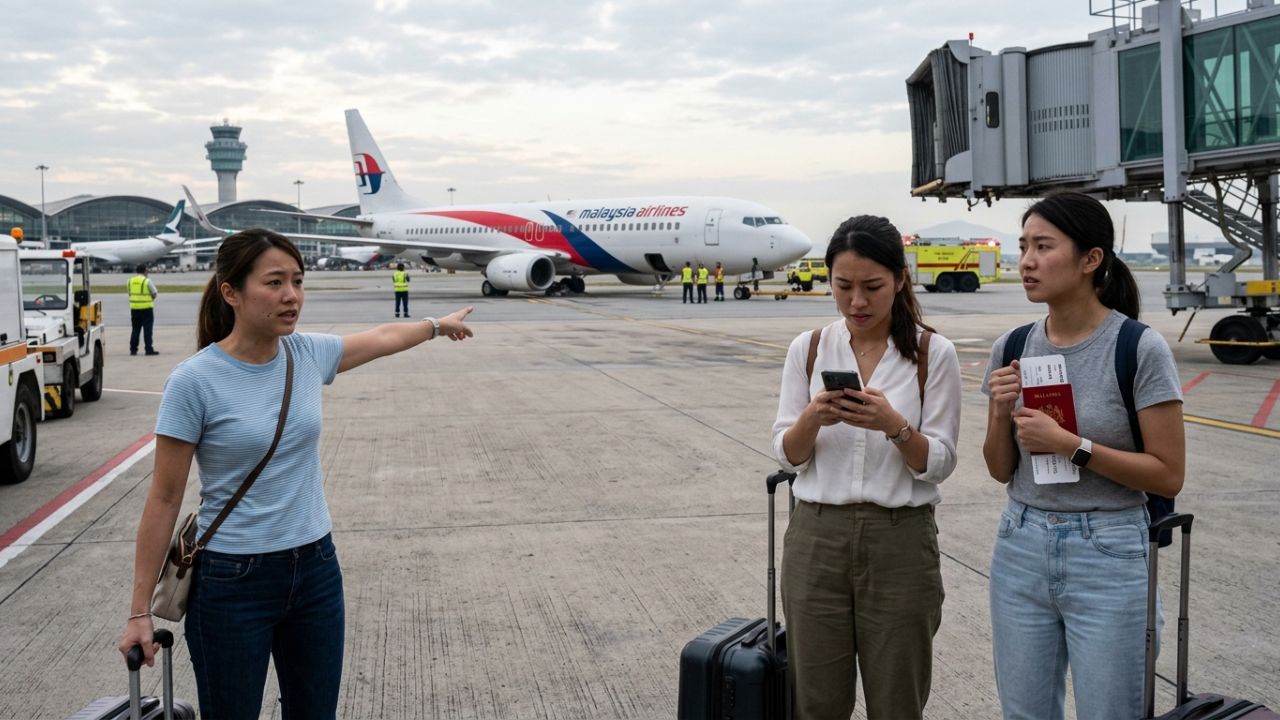
Image generated by AI
Malaysia Airlines Flight MH079 Boeing 737-800 Aborts Takeoff at Hong Kong International Airport After Crew Detect Unusual Vibration and Loud Mechanical Sound During Kuala Lumpur Departure — Tyre Bursts on Braking, All Passengers Safe
Published on May 13, 2026
At 8:45 AM local time on May 11, 2026, the morning departure sequence at Hong Kong International Airport — one of Asia's most extraordinary and operationally intensive aviation gateways — was interrupted by the kind of incident that tests every layer of commercial aviation's extraordinary safety architecture simultaneously. Malaysia Airlines Flight MH079, a Boeing 737-800 operating the scheduled Hong Kong (HKG) to Kuala Lumpur (KUL) service, began its takeoff roll from Hong Kong's south runway and was accelerating normally when the flight crew detected an unusual vibration accompanied by a loud mechanical sound from the aircraft — an alert combination that triggered the immediate execution of a Rejected Takeoff (RTO) procedure. The crew brought the aircraft to a controlled stop using emergency braking systems. During the deceleration sequence, one of the main landing gear tyres burst under the extraordinary thermal and mechanical stress of high-speed emergency braking — a consequence of the braking physics, not the original triggering abnormality. All passengers and crew exited the aircraft without injuries. The south runway was temporarily closed for emergency vehicle access and inspection. The Boeing 737-800 was immediately withdrawn from service for comprehensive engineering review. And Hong Kong's airport emergency systems worked exactly as designed. This is what aviation safety, executing under pressure, looks like.
Quick Summary:
- Malaysia Airlines Flight MH079 (Boeing 737-800, Hong Kong HKG → Kuala Lumpur KUL) performed a Rejected Takeoff (RTO) at Hong Kong International Airport at approximately 8:45 AM on May 11, 2026.
- The flight crew detected an unusual vibration and loud mechanical sound during takeoff acceleration — triggering the RTO procedure before reaching the critical V1 decision speed.
- During the emergency braking sequence, one main landing gear tyre burst under the heat and friction stress of high-speed deceleration — early indications suggest the tyre failure was a consequence of braking physics rather than the original abnormality.
- All passengers and crew safely evacuated the aircraft — no injuries were reported. Airport emergency vehicles were dispatched immediately to the runway.
- Hong Kong International Airport's south runway was temporarily closed for runway clearance procedures — causing limited but real disruption to arriving and departing flights during the morning peak departure window.
- Hong Kong International Airport handled over 53 million passengers in 2025 and processed 4.9 million tonnes of cargo — making even short runway closures operationally significant for the regional schedule.
- The Boeing 737-800 (Flight MH079) was removed from service for full engineering inspection of landing gear systems, wheel assembly, braking components, and structural stress analysis.
What Happened on Hong Kong's South Runway: The MH079 Rejected Takeoff Explained
The sequence of events on Hong Kong's south runway at 8:45 AM on May 11 unfolded in a matter of seconds — as all runway-phase aviation events do — and its resolution without injury reflects both the crew's training and the remarkable effectiveness of the safety systems built into the Boeing 737-800.
The takeoff roll began normally, with the aircraft accelerating through the standard power application sequence. As the 737-800 gathered speed toward rotation velocity, the flight crew detected an unusual vibration — a sensation abnormal enough to register as distinctly different from the normal aerodynamic vibration of an accelerating aircraft — simultaneously accompanied by a loud mechanical sound.
The critical pilot decision in this moment is governed by the concept of V1 speed — the takeoff decision speed beyond which a rejected takeoff becomes more dangerous than continuing the departure regardless of the abnormality. Below V1, a rejected takeoff can be executed safely on the remaining runway. Above V1, the aircraft must depart even with the identified problem, because stopping at that speed on the remaining runway distance is no longer safe.
The MH079 crew executed the RTO below V1 — meaning they had sufficient runway remaining for the deceleration — and immediately applied maximum braking force while retarding the throttles to idle. The aircraft's anti-skid braking system — standard on the Boeing 737 — modulated brake pressure to prevent wheel lockup and maximize controlled deceleration.
At the speeds involved in a pre-rotation RTO on a major international airport runway, the thermal energy generated by emergency braking is extraordinary. The friction between the brakes and wheels, multiplied by the aircraft's weight and velocity, creates heat sufficient to cause wheel and tyre damage even when the braking systems are functioning correctly. The main gear tyre burst during the MH079 deceleration is a known consequence of high-energy RTO events — not a braking system failure, but a physical limit of the rubber and wheel assembly under extreme thermodynamic stress.
The Boeing 737-800: Understanding the Aircraft Involved
The Boeing 737-800 — the specific variant involved in Flight MH079 — is the most commercially successful variant of the most commercially successful commercial aircraft family in aviation history. Over 5,000 Boeing 737-800s were delivered to airlines worldwide between 1998 and 2023, accumulating an extraordinary total of operational flight hours across virtually every airline and aviation environment on Earth.
Malaysia Airlines operates the Boeing 737-800 on regional and medium-haul routes across the Asia-Pacific corridor — including the Hong Kong–Kuala Lumpur route operated as MH079. The aircraft's twin CFM International CFM56-7B engines, glass cockpit EFIS displays, and modern fly-by-wire-influenced control systems make it one of the best-understood and most thoroughly analyzed commercial aircraft types in operation.
The rejected takeoff performance of the Boeing 737-800 is documented extensively in the aircraft's Aircraft Flight Manual (AFM) — including the maximum energy RTO limits, brake heat absorption data, and post-RTO inspection requirements that Malaysia Airlines' engineering team will now execute methodically following the MH079 event.
Post-RTO engineering inspection for a Boeing 737-800 typically encompasses: complete brake assembly removal and inspection, wheel bearing examination, landing gear structural stress analysis, tyre replacement on all main gear positions, hydraulic system inspection, anti-skid system functional testing, and structural frame inspection at the gear attachment points. This process typically grounds the specific aircraft for a minimum of 24–72 hours depending on findings, and potentially significantly longer if damage beyond the expected RTO limits is identified.
Hong Kong International Airport: The Hub Whose Runway You Cannot Close
Hong Kong International Airport's status as one of Asia's most extraordinarily concentrated aviation gateways means that even a temporary south runway closure carries operational implications beyond the immediate runway vicinity.
The airport handled over 53 million passengers in 2025 — approximately 145,000 passengers per day — and processed 4.9 million tonnes of air cargo, reinforcing its position as both the world's busiest international air cargo hub and one of Asia's most critical passenger transit gateways.
Hong Kong International's two-runway configuration (north and south runways operating in parallel) means that a south runway closure for runway clearance does not ground the airport — but it reduces arrival and departure capacity by approximately 50%, creating cascading delays in the morning departure bank when the airport operates at its highest intensity.
The morning departure window in which MH079's RTO occurred is typically the airport's most congested operational period — with regional departures to Kuala Lumpur, Singapore, Bangkok, Taipei, Seoul, Tokyo, and Shanghai all concentrating in the same 6–10 AM window. Short runway closures during this period produce the most immediate schedule impact.
Airport emergency vehicles — including Rapid Intervention Vehicles (RIVs) from Hong Kong Fire Services Department's airport deployment — responded immediately to the MH079 RTO, providing fire suppression capability at the aircraft's braking-heated wheel assemblies (hot brakes following high-energy RTOs require monitoring for potential wheel fire) and establishing the runway safety perimeter for engineering assessment.
What the MH079 RTO Means for Kuala Lumpur Route Travelers
The Malaysia Airlines Hong Kong–Kuala Lumpur corridor is one of the most commercially important regional routes in Southeast Asia aviation — carrying business travelers, leisure tourists, Malaysian diaspora in Hong Kong, and connecting passengers routing through Kuala Lumpur International Airport (KLIA) to domestic Malaysian destinations and onward international connections.
Malaysia Airlines has been actively rebuilding its international network following years of restructuring — expanding its regional connectivity between Malaysia and key Asian destinations including Hong Kong, Singapore, Bangkok, Tokyo, Seoul, and beyond. The carrier's strategy has focused on re-establishing market credibility and service quality on exactly the kind of high-frequency regional routes that the MH079 event temporarily disrupts.
For passengers aboard MH079 on May 11, Malaysia Airlines' standard operating procedure following an RTO and aircraft withdrawal from service involves:
- Immediate passenger disembarkation via passenger boarding bridges or airstairs with airport emergency vehicle support
- Passenger rebooking onto the next available Malaysia Airlines Hong Kong–Kuala Lumpur departure or alternative carrier services on the same route
- Accommodation and meal support for passengers facing extended delays during the engineering and rebooking process
- Communication of the aircraft status and rebooking options through gate staff, the MH mobile app, and direct customer service channels
Malaysia Airlines' Hong Kong–Kuala Lumpur schedule operates multiple daily services — meaning affected MH079 passengers would typically have been rebooked onto subsequent day departures without requiring overnight hotel accommodation at Hong Kong International.
Guide for Travelers:
- If you were on MH079 on May 11: Malaysia Airlines' customer service line for Hong Kong is +852 2868 2380. If you incurred hotel, meal, or alternative transport costs following the RTO delay, Malaysia Airlines is required under Hong Kong Consumer Council guidelines and Malaysia Airlines' own Conditions of Carriage to provide reasonable care during the delay.
- Travel insurance for technical disruptions: A comprehensive travel insurance policy covering trip interruption due to mechanical or technical aircraft incidents is the essential protection for any Asia-Pacific traveler. Ensure your policy explicitly covers missed connections resulting from aircraft technical events at transit airports.
- The Hong Kong–Kuala Lumpur corridor: Malaysia Airlines operates multiple daily HKG–KUL services — if your MH079 departure was disrupted, check real-time availability on the MH app (Malaysia Airlines' mobile app) for the next available departure. Cathay Pacific also operates this route and may have availability.
- V1 and aviation safety reassurance: The MH079 RTO is a demonstration of aviation safety systems functioning correctly — not a system failure. The crew identified an abnormality and executed the trained response in the time window available. No one was harmed. The aircraft was inspected. This is aviation safety working as designed.
- Hong Kong layover planning: If you're transiting through Hong Kong International Airport, build at least 90-minute connection windows for domestic/regional connections and 2-hour windows for long-haul connections during peak morning periods. Even brief runway closures can affect gate assignments and arrival sequencing.
- Kuala Lumpur from Hong Kong alternatives: If Malaysia Airlines MH079 or other HKG–KUL services are delayed for technical reasons, Cathay Pacific (CX) operates CX–HKG–KUL services with comparable frequency. Air Hong Kong also operates the corridor.
- Best time to visit Kuala Lumpur: April–August and November–December — between Malaysia's two monsoon seasons — offer the most consistently favorable weather for exploring the city's extraordinary street food scene, Petronas Twin Towers, Batu Caves, and the extraordinary Chinatown of Petaling Street.
Related Travel Guides
- British Airways, Lufthansa, and Singapore Airlines Navigate Middle East Aviation Crisis as Dubai and Doha Routes Face Suspensions
- KLM Flight KL643 Boeing 787 U-Turns Over Ireland After Engine Valve Failure
- British Airways BA1458 Declares Squawk 7700 Emergency at Edinburgh After Co-Pilot Falls Ill
Malaysia Airlines Flight MH079 will be remembered — by its passengers, by Hong Kong aviation authorities, and by the engineering teams who will study the event's technical data — not as a near-disaster but as a demonstration of aviation's extraordinary safety layering executing precisely as designed. The crew detected the abnormality. The RTO was executed. The aircraft stopped. The tyre burst — as physics dictates it might in a high-energy RTO — but the aircraft was stopped and the passengers were safe. Hong Kong International Airport's emergency systems responded. The south runway was cleared. Operations resumed. And a Boeing 737-800 that has spent its career as one of aviation's most reliable workhorses is now receiving the thorough inspection that the event demands before it carries passengers again. Hong Kong, Kuala Lumpur, and Malaysia Airlines will continue connecting the extraordinary cities and cultures of the Asia-Pacific corridor — and they will do so with the safety systems that made May 11 a story about what worked, not about what went wrong.
Disclaimer
This article is for informational and educational purposes only. It does not constitute legal, financial, or professional advice. While we strive to provide accurate and up-to-date information, travel policies, regulations, and conditions change rapidly. Always verify information with official sources before making travel decisions. Nomad Lawyer makes no representations about the accuracy, reliability, completeness, or suitability of the information provided. Readers should consult qualified professionals for advice specific to their circumstances. The views expressed in this article are those of the author and do not necessarily reflect the views of Nomad Lawyer.
Kunal K Choudhary
Co-Founder & Contributor
A passionate traveller and tech enthusiast. Kunal contributes to the vision and growth of Nomad Lawyer, bringing fresh perspectives and driving the community forward.
Learn more about our team →