
M23 Van Fire Causes Severe Traffic Delays and Lane Closures Near Gatwick Airport in August 2026
A vehicle fire on the M23 southbound caused four miles of congestion and significant delays for passengers accessing Gatwick Airport on August 25, 2026.

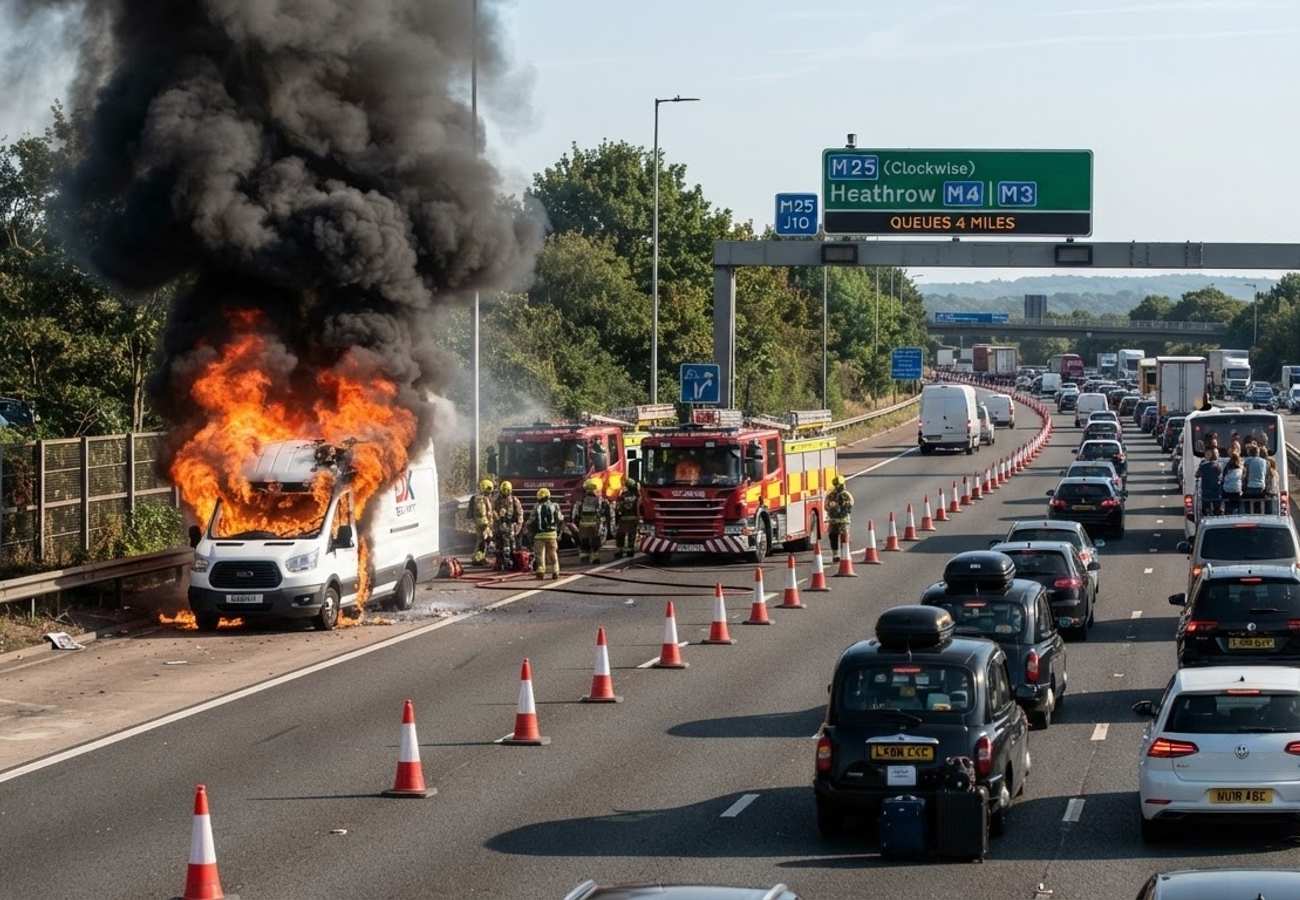
Image generated by AI
A van fire on the M23 southbound triggered immediate lane closures and four miles of congestion on August 25, 2026, adding over 30 minutes to journey times for Gatwick Airport passengers.
M23 Southbound Transit Disruption
On Tuesday morning, August 25, 2026, a vehicle fire on the M23 motorway caused significant operational delays for motorists traveling toward Gatwick Airport. The incident occurred on the southbound carriageway between Junction 8 (the M25 interchange) and Junction 9 (Gatwick Airport), a critical artery for airport access.
The vehicle, identified as a van, became fully engulfed in flames in a live lane, producing thick black smoke visible from several miles away. This necessitated an immediate emergency response from the Surrey Fire and Rescue Service and National Highways.
To facilitate firefighting efforts and ensure the safety of other motorists, National Highways initially closed two of the four southbound lanes. While these closures were gradually reduced as the blaze was extinguished, residual restrictions remained in place to allow for debris removal and safety inspections of the road surface.
Traffic Impact and Route Specifications
The reduction in lane capacity led to rapid congestion, with queues extending approximately four miles back toward the M25 interchange. Motorists reported stop-start conditions and near-standstill traffic, particularly impacting those heading toward the Gatwick terminals and those continuing south toward Crawley and the A23 corridor.
| Parameter | Detail |
|---|---|
| Incident Date | August 25, 2026 |
| Location | M23 Southbound (Junction 8 to Junction 9) |
| Primary Cause | Van Fire |
| Lane Closures | 2 of 4 Southbound Lanes (Initial) |
| Congestion Length | 4 Miles |
| Estimated Delay | 30+ Minutes |
| Responding Agencies | Surrey Fire and Rescue Service, National Highways |
Traveler Logistics Guide: Navigating Gatwick Access
From a ground-level perspective, the M23 is a high-sensitivity corridor. Because it funnels a vast majority of airport-bound traffic between the M25 and the terminals, any incident between Junctions 8 and 10 can cause a systemic failure in arrival timelines.
Optimal Connection Strategies:
- Contingency Timing: During peak late-summer travel windows, travelers should add a minimum of 60 minutes to their estimated arrival time when relying on the M23.
- Real-Time Monitoring: Use National Highways live feeds or GPS-based traffic apps before departing the M25. If congestion is reported at Junction 8, consider diverting through local A-roads toward Crawley, though these often saturate quickly during motorway closures.
- Intermodal Resilience: For those traveling from London or the South Coast, rail links to Gatwick remain the most resilient option during road-based crises. The airport's surface transport mix is designed for redundancy, and the train station provides direct access to the terminals, bypassing motorway bottlenecks.
Infrastructure Impact Assessment
This incident underscores the vulnerability of the Gatwick access corridor. Despite historical capacity improvements, the stretch between Junctions 8 and 10 remains susceptible to "shockwave" congestion, where a single vehicle breakdown or fire can paralyze the flow of passengers and airport staff.
While Gatwick’s runway and terminal operations remained unaffected, the "last mile" of the journey remains a primary point of failure for passenger experience. The rapid build-up of a four-mile queue from a single-vehicle incident highlights the lack of immediate high-capacity alternatives for motorists entering the airport from the north.
Transit flow returned to normal by midday following the full reopening of all lanes.
Related Travel Guides
Disclaimer
This article is for informational and educational purposes only. It does not constitute legal, financial, or professional advice. While we strive to provide accurate and up-to-date information, travel policies, regulations, and conditions change rapidly. Always verify information with official sources before making travel decisions. Nomad Lawyer makes no representations about the accuracy, reliability, completeness, or suitability of the information provided. Readers should consult qualified professionals for advice specific to their circumstances. The views expressed in this article are those of the author and do not necessarily reflect the views of Nomad Lawyer.
Preeti Gunjan
Contributor & Community Manager
A passionate traveller and community builder. Preeti helps grow the Nomad Lawyer community, fostering engagement and bringing the reader experience to life.
Learn more about our team →