
Chatsworth Helicopter Crash Shakes Los Angeles Airspace: What Travelers Need to Know About Rotorcraft Safety and Valley Mobility
A fatal news helicopter crash in Chatsworth kills three, prompting FAA and NTSB investigations into urban rotorcraft safety across the San Fernando Valley.

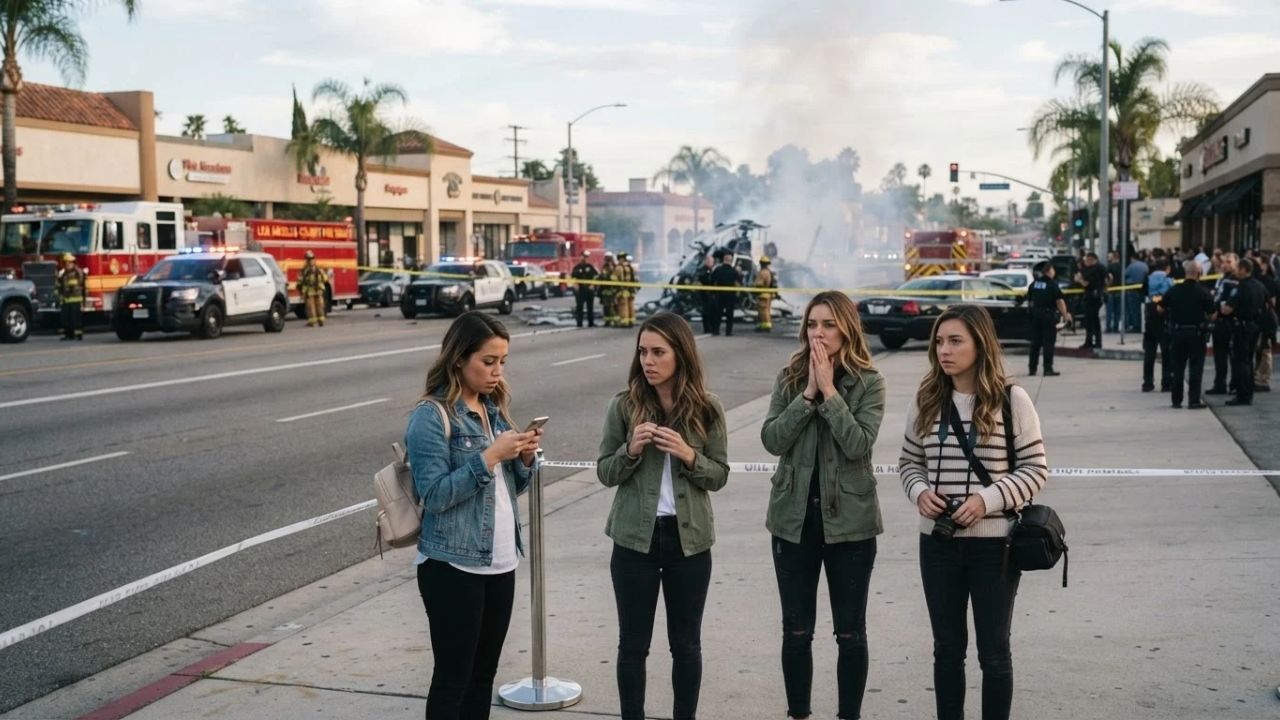
Image generated by AI
Across the sprawling five-hundred-square-mile basin of Los Angeles County, low-altitude urban airspace ranks among the most congested in the world, with law enforcement helicopters, medical evacuation flights, news crews, and aerial tour operators routinely circling within hundreds of feet of one another over dense suburban neighborhoods. That delicate aerial choreography turned tragic shortly before 7:00 pm on Tuesday evening, September 15, 2026, when an electronic news-gathering helicopter crashed in the 9100 block of North Mason Avenue in Chatsworth, an established community in the northwestern San Fernando Valley. Coming down between two commercial buildings, the aircraft struck several parked vehicles and storage containers, claiming at least three lives—including a pedestrian walking on the ground—and sending another person to the hospital in unknown condition. With more than fifty Los Angeles Fire Department (LAFD) firefighters rushing to extinguish the resulting fireball, the disaster occurred only hours after and blocks away from an earlier fatal collision at Nordhoff Street and De Soto Avenue where an SUV struck a Metro bus, leaving two dead and several injured. For the 49.5 million travelers who navigate Southern California each year, the incident provides a sobering reminder of how localized emergencies interact with aviation oversight, ground transit, and neighborhood safety across the greater metropolitan area.
The Chatsworth Incident: Airspace Density and Emergency Operations in the Valley
The chain of events leading to the Chatsworth crash illustrates the intense operational pressures placed on urban flight crews during breaking-news coverage. Earlier on Tuesday, emergency teams converged on the intersection of Nordhoff Street and De Soto Avenue following a violent crash between an SUV and an LA Metro transit bus that claimed two lives. The ensuing emergency response attracted multiple television news helicopters to the western San Fernando Valley to broadcast live aerial footage of the scene. Operating news helicopters in close proximity to active emergency sites requires continuous communication, sharp visual scanning for utility poles and nearby aircraft, and intense concentration amidst changing dusk lighting conditions.
Shortly before 7:00 pm, one of the news helicopters went down along the 9100 block of North Mason Avenue. The impact zone triggered an intense post-crash fire that damaged four parked vehicles and two commercial storage containers. More than fifty LAFD firefighters responded, extinguishing the flames and securing the site for federal investigators. Tragically, the incident produced a ground casualty when a pedestrian was struck and killed, emphasizing the severe secondary risks that urban aviation accidents pose to populated commercial and industrial zones.
Formal inquiries have been launched by the Federal Aviation Administration and the National Transportation Safety Board. Federal investigators will examine aircraft maintenance logs, pilot flight hours, air traffic communications, mechanical systems, and the operational protocols governing news-gathering flights operating near emergency cordons. Crucially for regional visitors, commercial airline operations at Los Angeles International Airport (LAX) and Hollywood Burbank Airport (BUR) experienced zero disruption, though local street closures and emergency vehicle activity caused significant surface delays across the western Valley.
What Makes the San Fernando Valley Different: Beyond the Hollywood Glitz
For international travelers whose perceptions of Los Angeles are shaped by the beachfront boardwalks of Venice or the celebrity enclaves of Beverly Hills, the San Fernando Valley reveals an entirely different cultural and geographic reality. Located nearly thirty miles northwest of Downtown Los Angeles and twenty-five miles north of LAX, Chatsworth sits in the shadow of the dramatic Santa Susana Mountains and the Simi Hills.
Historically, Chatsworth was defined by cattle ranches, citrus groves, and rugged sandstone geology that captured the imagination of Hollywood's golden age. Historic properties like the Iverson Movie Ranch served as the outdoor filming location for hundreds of classic Western films and television serials, providing the backdrop for stars like John Wayne, Roy Rogers, and Gary Cooper.
Just north of the crash corridor stands Stoney Point Park, an iconic municipal park featuring massive sandstone outcroppings, caves, and alcoves that have served as a historic training ground for generations of world-class rock climbers, boulderers, and equestrians. Cultural destination guides from Discover Los Angeles emphasize that while the northern Valley remains an integral part of the city's commercial and residential backbone, its rugged terrain and equestrian trails offer a distinct window into California’s frontier history that feels worlds away from the urban coastal core.
Visitor Insider Tips: Navigating LA Travel, Airspace Tours, and Valley Corridors
Traveling across Los Angeles while remaining mindful of regional transportation realities and aerial safety requires practical knowledge and seasoned advice:
Vetting Aerial Tour Operators: Aerial sightseeing remains one of the most popular ways to view the Hollywood Sign, downtown skyscrapers, and the Malibu coastline. When booking a helicopter tour, always verify that the flight provider operates under FAA Part 135 commercial certification rather than less regulated general aviation rules. Inquire about the operator's maintenance audit history, pilot flight-hour thresholds, and whether twin-engine aircraft are available for extended over-city flights.
Valley Surface Transit Alternatives: When severe accidents close major surface streets like Mason Avenue, Nordhoff Street, or De Soto Avenue, regional highway travel can quickly snarl. To bypass surface congestion in the San Fernando Valley, utilize the Metro G Line (formerly the Orange Line), a dedicated bus rapid transit corridor running on its own private roadway from Chatsworth Station through the heart of the Valley to the North Hollywood B Line (Red Line) subway station.
Historic Valley Dining Stops: If you find yourself in the northwest Valley, avoid chain fast-food outlets along commercial strips. Stop at the Munch Box on Kirkpatrick Street, an open-air burger stand operating since 1956, designated as a Los Angeles Historic-Cultural Monument for its classic root beer floats and chili dogs. For authentic regional cuisine, venture slightly south to Ventura Boulevard in Encino or Tarzana to experience the city's celebrated Persian and Middle Eastern dining rooms, renowned for wood-grilled kebabs and fresh saffron rice.
Travel Insurance Aviation Riders: If your California itinerary includes scenic helicopter flights, hot air ballooning, or chartered aerial excursions, carefully inspect your travel insurance policy wording. Many standard leisure policies contain specific exclusions for non-scheduled rotary-wing flights; ensure you carry an adventure sports or general aviation rider that covers emergency medical evacuation and trip cancellation.
Strategic Valley Bases: If your Southern California vacation combines theme parks with film history, staying along Ventura Boulevard in Studio City or Sherman Oaks provides a central base with excellent walkability, boutique coffee shops, and quick access to Universal Studios Hollywood and Warner Bros. Studios, while insulating you from outer industrial transit corridors.
Cultural and Environmental Context: Balancing Urban Growth and Aviation Safety
The Chatsworth accident brings renewed attention to the broader framework of urban aviation safety across Southern California. Los Angeles County sustains an immense visitor economy, welcoming 49.5 million visitors in 2025—comprising 43.1 million domestic travelers and 6.4 million international visitors—which generated $42.6 billion in business sales and supported over 530,000 tourism-related jobs. International visitors from top source markets including Mexico, China, Canada, Japan, the United Kingdom, Australia, and South Korea rely on the city’s vast transportation infrastructure to explore regional attractions.
From an aviation safety perspective, the tragedy occurs against a backdrop of steady long-term progress. According to FAA data, 2024 logged the lowest fatal helicopter accident rate in twenty-five years at 0.45 fatal accidents per 100,000 flight hours, with overall fatal accidents dropping by more than thirty-five percent since the formation of the United States Helicopter Safety Team (USHST) in 2013. Yet, as demonstrated by the safety restrictions introduced following the January 2025 collision near Reagan National Airport in Washington, operating rotary aircraft in dense metropolitan airspace demands constant regulatory refinement.
In an urban environment where first-responder aircraft, electronic news gathering, and tourist charters share the skies above dense residential valleys, maintaining stringent altitude separation, dedicated flight lanes, and strict buffer zones around emergency incidents is essential to safeguarding both flight crews and the diverse communities living on the ground below.
FAQ: Navigating Los Angeles Travel and Airspace Safety in 2026
Did the Chatsworth helicopter crash disrupt flights at LAX or Burbank? No. Commercial airline operations at Los Angeles International Airport and Hollywood Burbank Airport continued normally. The incident was isolated to the northwest San Fernando Valley and affected only local surface streets.
Are helicopter sightseeing flights over Los Angeles safe? Yes. Rotorcraft safety has improved significantly, with 2024 marking the lowest fatal accident rate in 25 years. However, travelers should always verify that their tour operator holds an active FAA Part 135 commercial certificate.
How can travelers navigate around traffic disruptions in the San Fernando Valley? Travelers can utilize the Metro G Line dedicated bus rapid transit route, which runs on its own private busway from the Chatsworth Transportation Center to North Hollywood, bypassing street congestion completely.
What cultural attractions are located in Chatsworth? Chatsworth is celebrated for its historic Hollywood Western film ranches, scenic equestrian trails, and world-class bouldering among the massive sandstone formations of Stoney Point Park in the Santa Susana Mountains.
Above the sprawling freeways and sandstone ridges of Southern California, vigilance in the skies safeguards the countless journeys unfolding below.
Related Travel Guides
- Delta Air Lines Expands Domestic Network: Nonstop Monterey Return, Transcontinental Hawaii Routes, and New LAX Links
- Car-Free on the Pacific Shore: How Santa Monica’s Big Blue Bus Revolutionizes Southern California Travel
- The Insider Guide to the San Fernando Valley: Film Ranches, Stoney Point, and Classic Diners
Disclaimer
This article is for informational and educational purposes only. It does not constitute legal, financial, or professional advice. While we strive to provide accurate and up-to-date information, travel policies, regulations, and conditions change rapidly. Always verify information with official sources before making travel decisions. Nomad Lawyer makes no representations about the accuracy, reliability, completeness, or suitability of the information provided. Readers should consult qualified professionals for advice specific to their circumstances. The views expressed in this article are those of the author and do not necessarily reflect the views of Nomad Lawyer.
Raushan Kumar
Founder & Lead Developer
Full-stack developer with 11+ years of experience and a passionate traveller. Raushan built Nomad Lawyer from the ground up with a vision to create the best travel and law experience on the web.
Learn more about our team →