
Aviation Updates: Over 900 Flights Grounded as Violent Summer Storms Unleash Travel Chaos Across London Heathrow and Gatwick
A violent atmospheric collision over southern England triggers massive flight cancellations and absolute travel chaos at London's two busiest airport hubs.

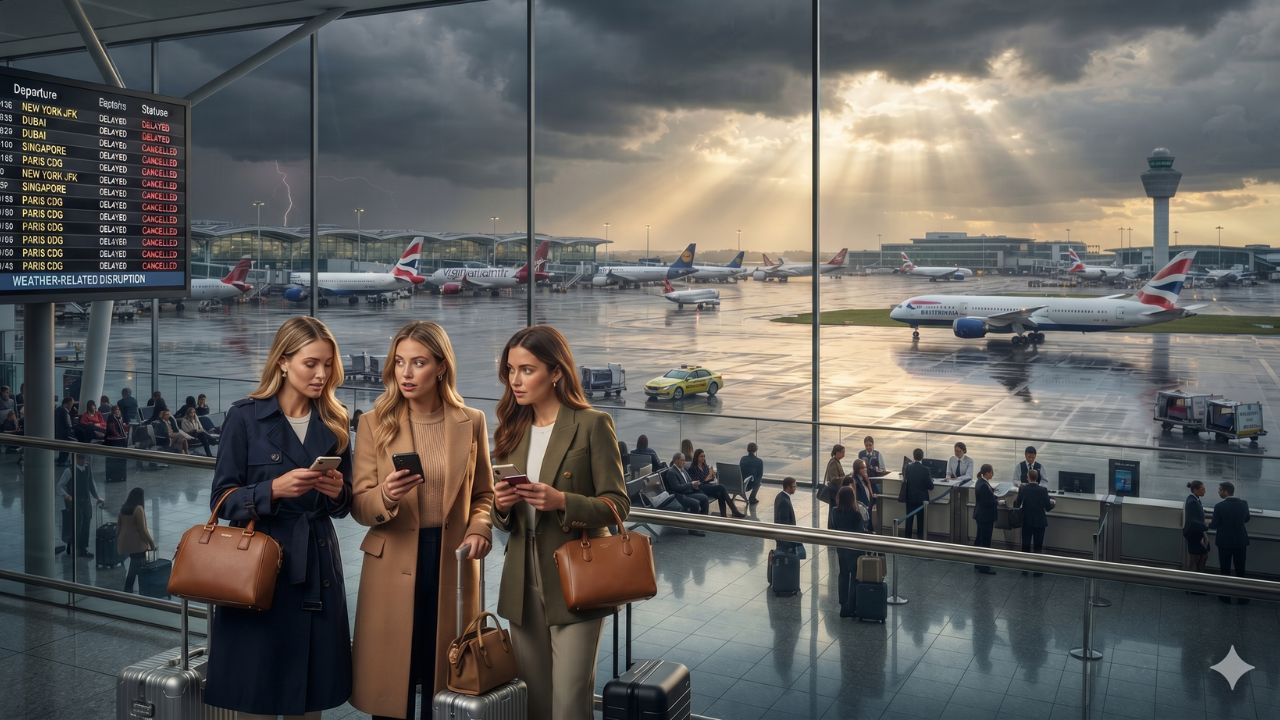
Image generated by AI
Aviation Updates: Over 900 Flights Grounded as Violent Summer Storms Unleash Travel Chaos Across London Heathrow and Gatwick
As a massive, highly volatile atmospheric shift violently collides with peak summer travel demand, London's two busiest aviation gateways have been plunged into absolute travel chaos, triggering over 900 flight delays and shattering the European air traffic control network.
Image generated by AI
As urgent airline news platforms and highly critical aviation updates continuously document the terrifying vulnerability of Europe's airspace, a massive operational collapse is currently unfolding across the United Kingdom. A violent, rapid atmospheric transition from extreme summer heat directly into severe, highly unstable thunderstorms has completely fractured the sky over southern England. This catastrophic weather event has instantly triggered widespread, unmitigated travel chaos, severely paralyzing London's two primary international gateways. With over 900 flights already confirmed as delayed or outright cancelled, this terrifying disruption has triggered a massive, cascading network failure that is violently rippling across northwestern Europe. Tens of thousands of passengers are currently trapped inside highly congested terminals, facing brutal, multi-hour airport disruptions and the terrifying reality of sudden flight cancellations with zero immediate rebooking options.
Expanded Overview: The Capacity Compression Effect
When analyzing the massive macroeconomic and operational forces driving European aviation, the structural fragility of shared airspace is glaringly obvious.
This is not a localized weather event; it is a massive systemic breakdown driven by highly restrictive safety protocols. According to urgent operational advisories from NATS (the UK’s air traffic authority) and Eurocontrol, the massive storm cells have forced air traffic controllers to aggressively increase the physical spacing between arrivals and departures. This safety maneuver instantly triggered what aviation planners officially describe as a “capacity compression effect.” While the airports remain technically open, their functional throughput capacity has been violently slashed. Holding patterns are saturating the skies, completely strangling the flow of inbound aircraft and ensuring that delays stretch well beyond a half-day.
Section-Wise Breakdown: The Heathrow Meltdown
The operational collapse at the UK's flagship gateway is nothing short of devastating.
London Heathrow Airport (LHR), operating at absolute maximum capacity even on clear days, simply cannot absorb this level of atmospheric disruption. As storm cells engulfed the approach corridors, controllers forcefully slowed operations, instantly affecting 474 flights. Aircraft rotations were immediately destroyed. Widebody jets slated for international long-haul departures were trapped on the tarmac, while inbound feeder flights from across Europe were forced into endless holding patterns or diverted entirely. The resulting backlog has completely overwhelmed ground handling crews and terminal gate availability, creating an operational nightmare that will require days to fully unwind.
Section-Wise Breakdown: The Gatwick Gridlock
Simultaneously, the exact same atmospheric violence paralyzed the UK's second-busiest hub.
London Gatwick Airport (LGW), highly dependent on rapid, high-frequency European leisure traffic, suffered a catastrophic disruption, with 439 flights directly affected. Because Gatwick operates the busiest single-runway system in the world, any mandatory increase in aircraft spacing immediately triggers massive ground delays. Passengers have reported agonizing waiting times exceeding four hours, with many facing outright cancellations. As crew duty times legally expire due to the prolonged delays, airlines at Gatwick are facing severe staffing shortages, permanently destroying their ability to execute recovery schedules.
Flight Details: London Aviation Storm Disruption Matrix
The exact operational telemetry outlining this highly terrifying airspace breakdown, detailing the staggering volume of affected flights across London's dual-airport system, has been consolidated into the mandatory matrix below.
London Aviation Storm Disruption Matrix (2026)
| Operational Hub | Flights Affected | Primary Impact |
|---|---|---|
| London Heathrow (LHR) | 474 flights | Severe terminal congestion and cascading delays |
| London Gatwick (LGW) | 439 flights | Multi-hour delays and immediate aircraft shortages |
| Total Regional Disruption | Over 900 flights | Widespread European network slowdown |
| Primary Cause | Rapid atmospheric shift (Heatwave to severe thunderstorms) | Mandatory ATC spacing increases reducing capacity |
| Passenger Rights (EU261) | Compensation Exempt | Disruption classified as "extraordinary circumstances" |
Passenger Impact: The EU261 Legal Confusion
For the thousands of travelers trapped in this logistical nightmare, the operational chaos is heavily compounded by a massive legal misconception.
Furious passengers trapped in terminals for over four hours frequently demand immediate financial compensation, mistakenly assuming that all massive delays trigger EU261 payouts. However, because this specific disruption is driven directly by severe weather and mandatory air traffic control restrictions, it is legally classified as "extraordinary circumstances." Consequently, airlines are absolutely not legally required to financially compensate passengers for these delays. While carriers must provide basic care, they are entirely exempt from liability when safety spacing rules dictate network capacity, forcing frustrated travelers to personally absorb the massive financial costs of missed connections and ruined holidays.
Industry Analysis: The Climate-ATC Compression Corridor
Aviation economists explicitly warn that this massive London disruption is a terrifying preview of the newly emerging “Climate-ATC Compression Corridor.”
This massive structural risk stretches violently from southern Europe all the way into Scandinavia. As intense regional heatwaves increasingly collide with volatile storm systems, traditional airline scheduling models are completely breaking down. Multiple European countries are now frequently forced to simultaneously manage rerouted flights, drastically increasing congestion across shared international corridors. When the atmosphere shifts violently within a matter of hours, air traffic control networks rapidly saturate, transforming hubs like Heathrow and Gatwick into paralyzed nodes inside a severely stressed continental aviation grid.
Conclusion: Surviving the European Summer Gridlock
Ultimately, the catastrophic disruption of over 900 flights across London Heathrow and Gatwick is a terrifying, highly visible consequence of climate volatility violently intersecting with air traffic control limits. As airlines desperately deploy contingency schedules to absorb the massive backlog, full operational recovery remains highly contingent on aircraft repositioning and crew duty resets. For passengers attempting to navigate European airspace this summer, extreme flexibility is absolutely mandatory. The systemic travel chaos triggered by these rapid atmospheric shifts guarantees that flight schedules are no longer predictable—they are entirely conditional based on the immediate survival capacity of the European ATC network.
Key Takeaways
- Massive Network Collapse: Severe thunderstorms over southern England triggered a catastrophic airspace breakdown, disrupting over 900 flights across London.
- The Heathrow and Gatwick Toll: London Heathrow (LHR) saw 474 flights affected, while London Gatwick (LGW) suffered disruptions to 439 flights, resulting in delays extending up to half a day.
- ATC Capacity Compression: The disruption was driven by mandatory air traffic control safety protocols requiring increased spacing between aircraft, violently slashing runway throughput.
- EU261 Compensation Exemption: Because the delays were caused by severe weather and ATC restrictions (extraordinary circumstances), airlines are legally exempt from providing financial compensation to delayed passengers.
- Climate Volatility Risk: The event highlights a growing structural risk across Europe, where rapid transitions from heatwaves to storms consistently overwhelm traditional airline scheduling models.
FAQ: London Heathrow and Gatwick Storm Disruptions 2026
How many flights were disrupted by the severe storms over London? The violent atmospheric shift triggered massive travel chaos, directly affecting over 900 flights, with 474 flights disrupted at London Heathrow and 439 flights disrupted at London Gatwick.
Why did thunderstorms cause such massive delays across the UK? To guarantee passenger safety, UK air traffic authority NATS and Eurocontrol were forced to increase the physical spacing between aircraft to avoid storm cells, triggering a "capacity compression effect" that slashed runway throughput.
Am I entitled to EU261 compensation for these London flight delays? No. Because the massive delays and cancellations were explicitly caused by severe weather and mandatory air traffic control restrictions, the event is classified as "extraordinary circumstances," rendering airlines legally exempt from financial compensation payouts.
Related Travel Guides
Africa Caribbean Aviation Fuel Crisis Travel Chaos 2026
Eurowings Mallorca Winter Expansion Travel Chaos 2026
Europe Regional Flight Disruption Survival Guide 2026
Disclaimer: This article is strictly for informational purposes. The aviation operational data, specific flight disruption metrics (including the 474 affected flights at Heathrow and 439 at Gatwick), and the interpretation of EU261 passenger compensation exemptions regarding "extraordinary circumstances" are based on official NATS air traffic advisories and Eurocontrol network data available at the time of publication. Severe weather patterns, mandatory air traffic control spacing restrictions, and airline recovery schedules are highly dynamic and subject to immediate, unannounced modification. Passengers must explicitly verify exact flight statuses, individual airline rebooking policies, and personal travel insurance coverage directly with their operating carrier prior to navigating through London or European airspace during severe storm events.
Disclaimer
This article is for informational and educational purposes only. It does not constitute legal, financial, or professional advice. While we strive to provide accurate and up-to-date information, travel policies, regulations, and conditions change rapidly. Always verify information with official sources before making travel decisions. Nomad Lawyer makes no representations about the accuracy, reliability, completeness, or suitability of the information provided. Readers should consult qualified professionals for advice specific to their circumstances. The views expressed in this article are those of the author and do not necessarily reflect the views of Nomad Lawyer.
Preeti Gunjan
Contributor & Community Manager
A passionate traveller and community builder. Preeti helps grow the Nomad Lawyer community, fostering engagement and bringing the reader experience to life.
Learn more about our team →