
Lewes Derailment Investigation Widens: East Sussex Rail Travel Disrupted in 2026
The RAIB has expanded its probe into the Lewes derailment, examining track geometry and extreme heat as London-Eastbourne rail travel faces significant delays.

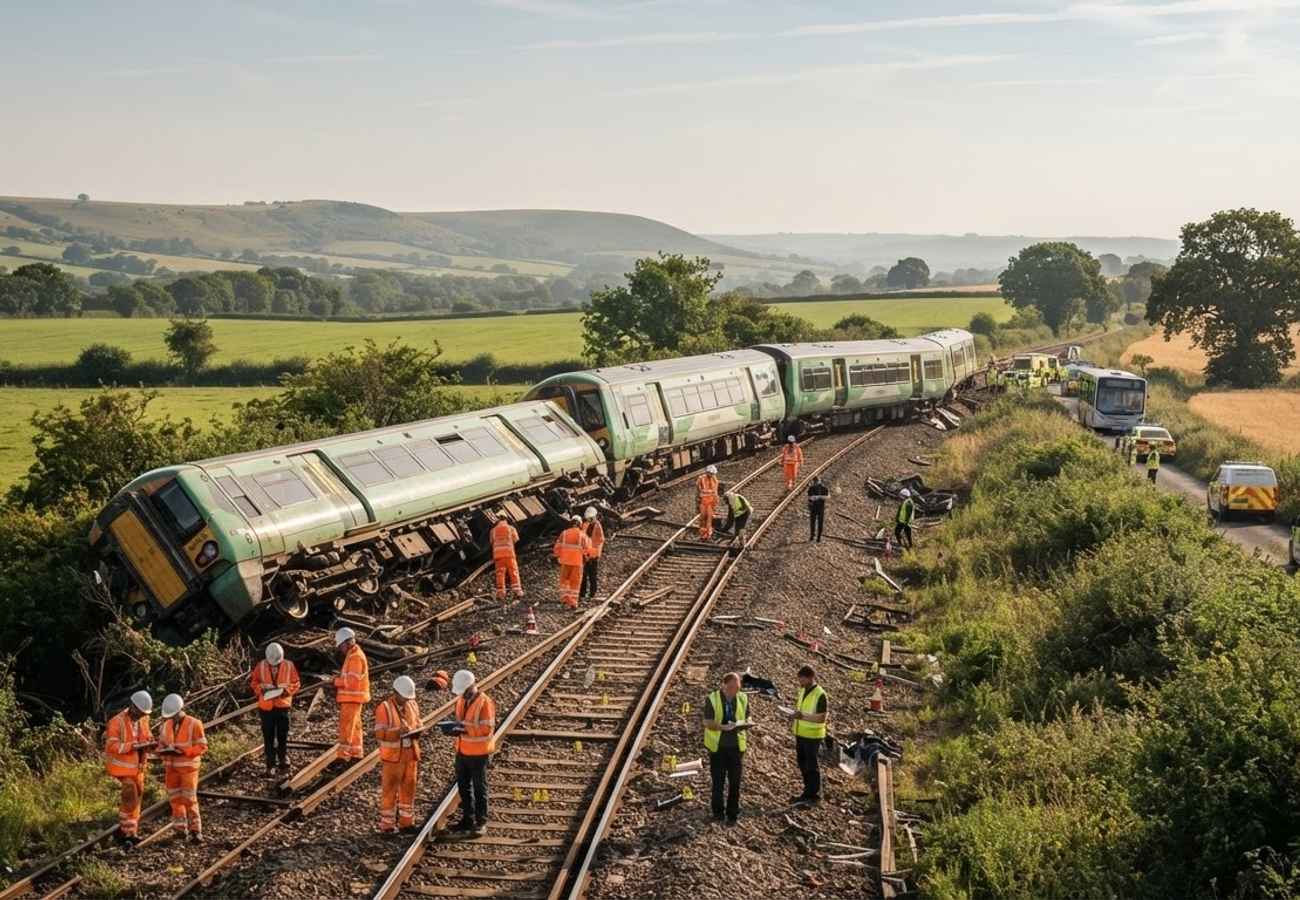
Image generated by AI
The Rail Accident Investigation Branch (RAIB) has expanded its inquiry into the August 13 derailment near Lewes, citing potential track geometry failures and extreme weather as key variables. Passengers on the London-Eastbourne corridor face prolonged journey times and mandatory diversions as critical sections of the network remain closed.
The investigation centers on train 1F34, which derailed on August 13, resulting in three of its eight vehicles overturning. The incident caused 30 injuries, with 20 passengers requiring hospitalization. As officials widen the scope of the probe to include embankment stability and maintenance logs, the operational impact on East Sussex connectivity has intensified.
Current Service Disruptions and Routing
Southern has confirmed that direct rail services between London and Eastbourne or Hastings are currently suspended. The railway segment between Haywards Heath and Lewes remains closed to facilitate recovery and forensic evidence gathering.
Logistical adjustments for passengers include:
- Mandatory Diversions: Travelers from London to Eastbourne must now route through Brighton and change trains.
- Rail Replacement: Bus services are operating between Haywards Heath and Lewes.
- Increased Capacity: Extra carriages have been deployed on the Brighton to Eastbourne leg to manage displaced passenger volumes.
- Journey Buffers: Passengers are advised to allow a minimum of 60 additional minutes for travel.
Technical Findings and Investigation Scope
The RAIB is analyzing a combination of environmental and mechanical factors to determine the exact derailment mechanism.
Speed and Track Geometry Preliminary data indicates the train was traveling at approximately 65 mph in a zone where the maximum permitted speed is 70 mph. However, investigators identified a track geometry irregularity immediately preceding the derailment point. Notably, the RAIB is reviewing reports from passengers on earlier services who described "rough riding" at this specific location.
Environmental Factors Weather conditions at the time of the accident were recorded as hot, sunny, and dry. The nearest weather station reported an air temperature of approximately 27°C. While the RAIB has not concluded that heat caused the derailment, they are assessing the effectiveness of current risk-control measures for high-temperature operations.
Incident Data Summary
| Metric | Detail |
|---|---|
| Train ID | 1F34 |
| Date of Incident | August 13, 2026 |
| Train Configuration | 8 vehicles (3 overturned) |
| Passenger Count | Approximately 150 |
| Casualties | 30 injured (20 hospitalized) |
| Recorded Speed | 65 mph (Limit: 70 mph) |
| Ambient Temperature | 27°C |
Why This Matters: Industry Analysis
From a logistical perspective, this incident exposes a critical vulnerability in the South Coast's rail resilience. The reliance on a single primary artery between Haywards Heath and Lewes means that any failure in this sector effectively severs the direct link between the capital and Eastbourne.
Our analysis of the RAIB's focus on "rough riding" reports suggests a potential failure in the feedback loop between passenger experience and maintenance triggers. If passengers were reporting instability prior to the crash, the investigation will likely pivot toward whether maintenance schedules were sufficient to address geometry irregularities before they became catastrophic. Furthermore, the mention of 27°C heat highlights a growing industry concern: the susceptibility of aging UK rail infrastructure to thermal expansion and track buckling during increasingly frequent summer heatwaves.
Forward Outlook
The immediate priority remains the restoration of the Haywards Heath to Lewes line. However, the wider impact will be felt in the form of stricter speed restrictions across the East Sussex network until the RAIB clears the track geometry as safe.
Passengers should expect continued volatility in schedules. The industry will be watching for the RAIB's final report to see if this triggers a nationwide audit of "rough riding" reports and a revision of heat-related speed protocols for the 2027 season.
The balance between maintaining high-frequency summer tourism and infrastructure safety is now under extreme scrutiny.
Related Travel Guides
Disclaimer
This article is for informational and educational purposes only. It does not constitute legal, financial, or professional advice. While we strive to provide accurate and up-to-date information, travel policies, regulations, and conditions change rapidly. Always verify information with official sources before making travel decisions. Nomad Lawyer makes no representations about the accuracy, reliability, completeness, or suitability of the information provided. Readers should consult qualified professionals for advice specific to their circumstances. The views expressed in this article are those of the author and do not necessarily reflect the views of Nomad Lawyer.
Preeti Gunjan
Contributor & Community Manager
A passionate traveller and community builder. Preeti helps grow the Nomad Lawyer community, fostering engagement and bringing the reader experience to life.
Learn more about our team →