
LATAM Boeing 777 Pilot Aborts High-Speed Takeoff at São Paulo–Guarulhos in Dramatic Close Call
A LATAM Boeing 777 narrowly avoided a disaster at São Paulo–Guarulhos International Airport after pilots executed a high-speed rejected takeoff just as the aircraft began to rotate.

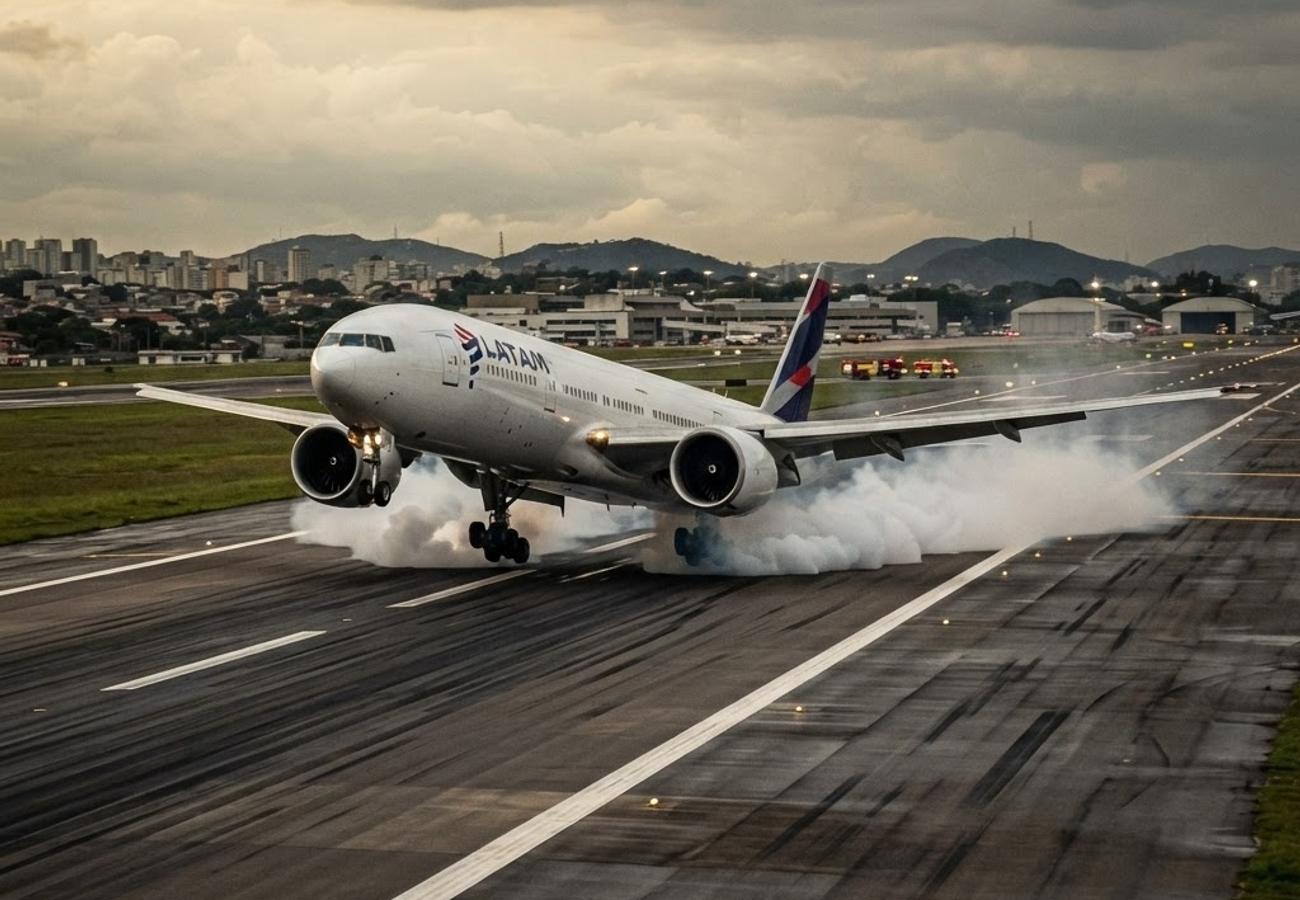
Image generated by AI
[São Paulo, August 17, 2026] — A LATAM Airlines Boeing 777 narrowly avoided a potential catastrophe at São Paulo–Guarulhos International Airport after the flight crew aborted a long-haul departure at high speed, slamming on the brakes just as the aircraft's nose lifted off the runway.
The incident, captured in dramatic footage now circulating on aviation forums, involved a widebody jet that had reached its rotation speed before the pilots made the split-second decision to stop. While the maneuver left passengers shaken and caused significant wear to the aircraft's landing gear, no injuries were reported among the crew or those on board.
High-Speed Deceleration Captured on Video at Guarulhos
Visual evidence from social media and aviation enthusiasts shows the Boeing 777 accelerating rapidly down the runway. The footage indicates the aircraft had reached the point of rotation, with the nose gear visibly lifting into the air. However, within seconds, the nose dropped back to the tarmac, and the jet underwent a violent deceleration.
Thick clouds of smoke erupted from the main landing gear area, a clear indicator of maximum braking effort and the immediate deployment of thrust reversers to kill the aircraft's forward momentum. Flight-tracking data suggests the jet was traveling at a ground speed consistent with the "decision speed" (V1) for a fully loaded Boeing 777 preparing for a long-haul flight.
Industry observers have noted that this was an exceptionally late rejected takeoff. Standard aviation protocol dictates that once an aircraft passes V1, the crew should continue the takeoff regardless of most malfunctions, as there is typically insufficient runway remaining to stop safely. A decision to abort after rotation has begun is rare and generally reserved for catastrophic failures that would make flight impossible.
Operational Pressures at São Paulo–Guarulhos International Airport
The incident took place at Brazil's busiest aviation hub, where LATAM maintains a significant base for its long-haul network. While São Paulo–Guarulhos is equipped with expansive runways designed to accommodate heavy aircraft, the physics of a high-speed abort place immense stress on the airframe.
When a fully loaded widebody jet is brought to a halt from near-takeoff speeds, the kinetic energy is converted into heat through the brakes. This often results in:
- Extreme brake temperature spikes
- Tire blowouts or deflations due to friction
- Potential for runway overruns if the stop is not perfectly executed
Aviation specialists indicate that while the airport's infrastructure provides a safety margin, the intensity of this specific maneuver likely pushed the aircraft's braking systems to their absolute limits.
Formal Investigation into Boeing 777 Systems and Crew Logic
Civil aviation authorities in Brazil are expected to launch a comprehensive probe into the event. Investigators will focus on the Flight Data Recorder (FDR) and Cockpit Voice Recorder (CVR) to determine exactly what prompted the crew to abort the takeoff after the aircraft had already begun to rotate.
Key areas of the investigation will include:
- Cockpit Warnings: Whether any critical system alerts or "master cautions" appeared on the flight deck.
- Aircraft Configuration: Verification that the flaps, slats, and trim were set correctly for departure.
- Weight and Balance: Ensuring the aircraft was loaded within safe center-of-gravity limits.
- Mechanical Integrity: Reviewing maintenance logs for any recent anomalies in the braking or engine control systems.
Preliminary reports and images showed the aircraft immobilized on a taxiway with deflated tires, confirming the severity of the braking force. Experts warn that until the official report is released, any claims regarding specific mechanical failures remain speculative.
Passenger Impact and Terminal Disruptions
Passengers on the flight described a terrifying experience characterized by a sudden, powerful jolt and the sound of screeching brakes. Some travelers reported a pungent burning smell filling the cabin, which is typical when brake discs reach extreme temperatures.
Following the stop, the aircraft remained on the runway for an extended period while emergency services conducted precautionary checks. Once cleared, the jet was towed to a secure area, and passengers were escorted back to the terminal.
The event caused a ripple effect across the airport's operations. The temporary closure of a primary runway led to:
- Delayed departures for multiple airlines
- Diversions of incoming long-haul flights
- Scheduling conflicts for LATAM’s high-utilization widebody fleet
For the airline, the grounding of a Boeing 777 for technical inspection creates a logistical gap in their long-haul schedule, often requiring the deployment of reserve aircraft or the rebooking of hundreds of passengers.
The Evolution of Aviation Safety in Brazil
This incident occurs against a backdrop of continuous safety upgrades within the Brazilian aviation sector. Over the last several decades, regulators have implemented stricter standards for runway maintenance and crew training at major hubs like Guarulhos and São Paulo–Congonhas.
Current data suggests that major Brazilian carriers now operate with safety benchmarks that align with global industry leaders. Analysts argue that while the imagery of smoke and deflated tires is unsettling, the successful stop proves that the "fail-safe" layers of modern aviation—trained pilots, robust braking systems, and rapid emergency response—worked as intended.
Why This Matters: The Traveler's Perspective
For the average passenger, this incident highlights the critical importance of "V1" (decision speed). While it may seem counterintuitive that a pilot would choose to take off with a known problem rather than stop, the risk of running off the end of the runway at 150+ mph is often far greater than the risk of managing a technical glitch in the air.
From a logistical standpoint, this event underscores why long-haul flights occasionally suffer "technical delays" without a detailed explanation. When a widebody aircraft undergoes a high-speed abort, it cannot simply be cleared for the next flight; it requires a rigorous inspection of the landing gear and brakes to ensure no structural fatigue occurred during the deceleration.
The incident serves as a stark reminder of the precision required in heavy-jet operations and the thin margin between a routine departure and a critical emergency.
Related Travel Guides
Disclaimer
This article is for informational and educational purposes only. It does not constitute legal, financial, or professional advice. While we strive to provide accurate and up-to-date information, travel policies, regulations, and conditions change rapidly. Always verify information with official sources before making travel decisions. Nomad Lawyer makes no representations about the accuracy, reliability, completeness, or suitability of the information provided. Readers should consult qualified professionals for advice specific to their circumstances. The views expressed in this article are those of the author and do not necessarily reflect the views of Nomad Lawyer.
Kunal K Choudhary
Co-Founder & Contributor
A passionate traveller and tech enthusiast. Kunal contributes to the vision and growth of Nomad Lawyer, bringing fresh perspectives and driving the community forward.
Learn more about our team →