
Las Vegas Teams Up with Nashville, Philadelphia, New Orleans and Other US States Shine from Tourism Faceloss with a Surge of Visitor Searches
Las Vegas Teams Up with Nashville, Philadelphia, New Orleans and Other US States Shine from Tourism Faceloss with a Surge of Visitor Searches

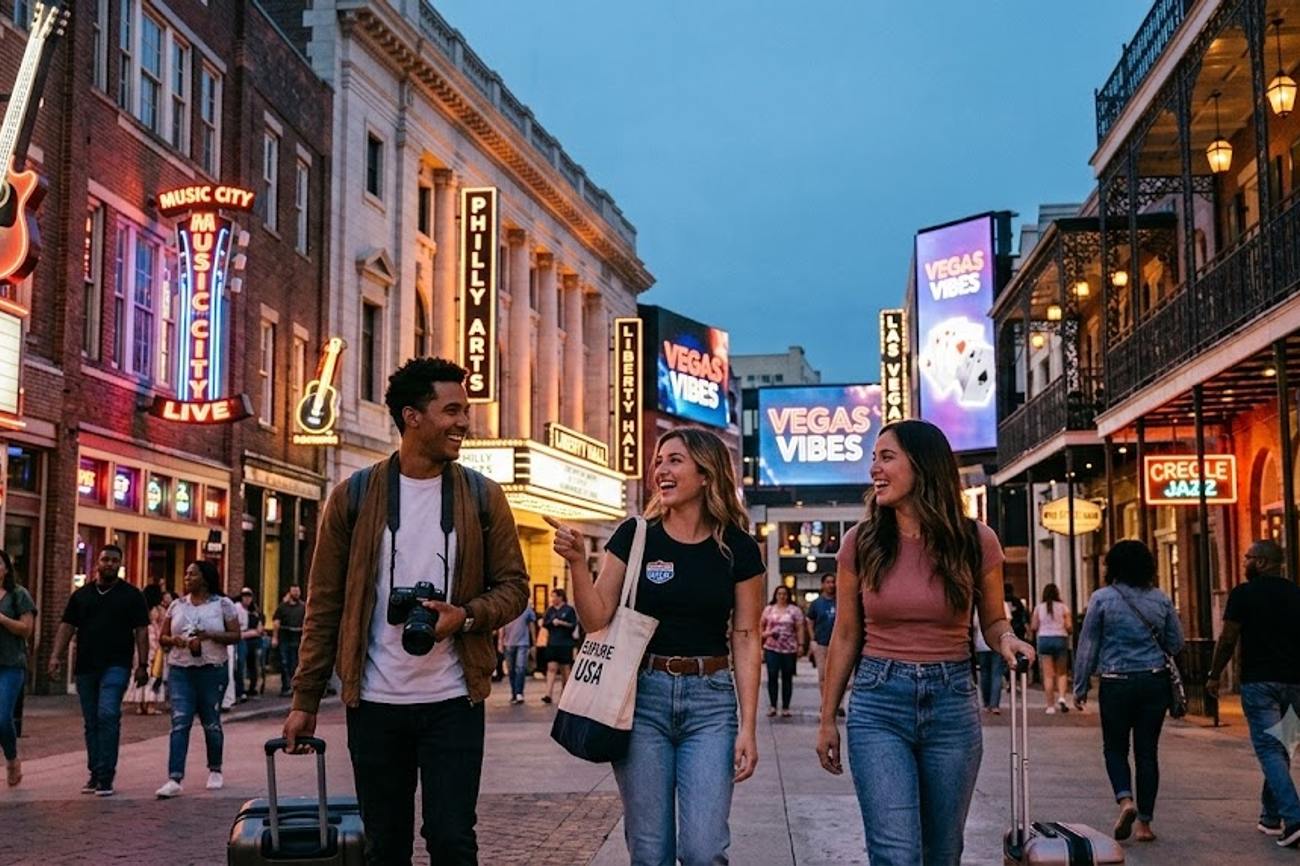
Image generated by AI
A 12% plunge in July 2025 visitation serves as the baseline for the current volatility in the Las Vegas tourism market, where a fragmented recovery is now taking hold. While September 2026 search data from Priceline indicates that Las Vegas is currently the most-searched US destination—surpassing both New York and Orlando—this digital interest masks a deeper structural instability. The US urban tourism sector is no longer recovering in a linear fashion; instead, it has splintered into a "multi-speed" recovery where specific cities are buoyed by niche drivers like convention records or international surges, while others struggle with inflationary pressures.
The Fragmentation of Urban Tourism
The recovery of the American city is no longer a tide that lifts all boats. According to recent government and public-sector data, the drivers of growth vary wildly by geography. For instance, San Diego is seeing a surge driven by the corporate sector, while Philadelphia and New Orleans are leaning heavily on a "calendar-event" strategy to pull in crowds.
This unevenness is most evident when comparing the "event-driven" cities to the "leisure-hub" cities. In Philadelphia and New Orleans, the influx of hundreds of thousands of visitors is tied directly to specific 2026 major events. Conversely, New York City is leveraging a broader base of 65 million visitors (as of 2025), with a sophisticated mix of 52.4 million domestic and 12.5 million international travelers.
The divergence is not just about who is visiting, but how they are spending. San Francisco has successfully pushed visitor spending to $14.2 billion in 2025, effectively eclipsing its pre-pandemic peaks. Meanwhile, Las Vegas is fighting a war of attrition against its own pricing models, attempting to lure back a demographic that has become increasingly sensitive to the cost of basic amenities.
Data Breakdown: US Urban Recovery Metrics (2025-2026)
The following data illustrates the disparity in recovery drivers across major US hubs:
Major U.S. hubs like Las Vegas and Nashville are experiencing a significant surge in visitor interest as domestic tourism rebounds. Travelers are increasingly utilizing the Visit Las Vegas official portal to coordinate stays and explore new entertainment districts.
| City | Primary Metric | Value/Status | Recovery Driver |
|---|---|---|---|
| New York City | 2025 Total Visitors | 65 Million | Mixed (Domestic/Intl) |
| San Francisco | 2025 Total Spending | $14.2 Billion | High-Value Spending |
| Washington, DC | 2025 Total Spending | $11.9 Billion (+4%) | Stable Growth |
| Nashville | 2025 Total Visitors | 17.39 Million (+2.7%) | General Visitor Growth |
| Miami Area | FY2025 Overnight Visitors | 20.2 Million (+0.7%) | Modest Recovery |
| San Diego | FY2025 Convention Impact | $1.57 Billion | Group/Event Demand |
| New Orleans | Airport Passenger Volume | ~12.5 Million | Connectivity/Events |
| Las Vegas | July 2026 Occupancy | 77.2% | Search-led Recovery |
Expert Analysis: The "Affordability Gap" and the Vegas Paradox
For travelers booking trips to the American Southwest, the direct consequence of the current market shift is a widening "affordability gap." Las Vegas presents a fascinating paradox: search demand is at a peak, yet the actual visitation numbers remain roughly 10% below the 42.5 million mark recorded in 2019.
The data suggests that while the desire to visit Las Vegas remains high (as evidenced by the September 2026 search surge), the ability to visit is being throttled by two primary factors: airfare inflation and "nickel-and-diming" at the destination. With airfares to and from the city climbing by more than 20% in recent months, the barrier to entry has risen significantly.
When this is coupled with destination-side inflation—exemplified by the viral backlash over a $26 bottle of water at the Aria—the result is a psychological shift in the leisure traveler. We are seeing a transition where Las Vegas is moving from a "mass-market" destination to a "premium-tier" destination. This explains why hotel occupancy rose slightly to 77.2% in July 2026, but convention attendance actually dropped by 5.6% in the same period. The business traveler is more sensitive to the total cost of the trip than the luxury leisure traveler.
To accommodate this rise in traffic, regional airports are optimizing passenger logistics and flight schedules. Travelers can monitor real-time arrivals and terminal updates via the Philadelphia International Airport official website to ensure seamless transit.
The pricing pressure creates a dangerous feedback loop. To recover the $4.3 billion in spending lost between 2024 ($55.1 billion) and 2025 ($50.8 billion), operators are raising prices. However, these price hikes are exactly what is deterring the volume of visitors needed to reach 2019 levels. For the nomad or the budget-conscious traveler, the "Vegas Value Proposition" has eroded, pushing them toward alternative hubs like Nashville, which saw a 2.7% increase in visitors in 2025.
Key Takeaways
- Search vs. Reality: High search volume for Las Vegas in late 2026 does not equate to a full recovery, as total visitation remains 10% below 2019 levels.
- The Cost Barrier: A 20% increase in airfares and rising on-site costs (hotel/dining) are creating a significant deterrent for price-sensitive domestic travelers.
- Divergent Drivers: Recovery is no longer uniform; San Diego is winning on convention spend ($1.57B), while New York is winning on sheer volume (65M visitors).
- International Lag: While New York's international arrivals have hit 92.6% of 2019 levels, other cities are still struggling to regain their global footprint.
- Spending Volatility: Las Vegas experienced a sharp spending drop of $4.3 billion in a single year (2024 to 2025), highlighting the fragility of leisure-dependent economies.
FAQ: US Urban Tourism 2026
Is Las Vegas becoming too expensive for average tourists? Yes. With airfares up over 20% and high-profile price hikes for basic amenities in resorts, many leisure travelers are reporting that the city is less accessible than it was pre-pandemic, leading to a 7.5% drop in visitors in 2025.
Which US cities are currently seeing the strongest tourism recovery? New York City and San Francisco are leading. New York maintains massive volume with 65 million visitors, while San Francisco has pushed visitor spending to $14.2 billion, surpassing its pre-pandemic levels.
New Orleans continues to attract global tourists through its unique cultural heritage and seasonal festivals. Detailed visitor guidelines and city-wide event calendars are maintained by New Orleans & Company to streamline the tourist experience.
Why is convention travel declining in some cities while rising in others? It depends on the city's value proposition. San Diego hit a record $1.57 billion convention impact, whereas Las Vegas saw a 5.6% dip in July 2026, suggesting a shift in where corporate planners find the best value.
How has international travel recovered in major US hubs? Recovery is uneven. New York City has nearly returned to normal, with international arrivals at 92.6% of 2019 levels. Other cities, like Seattle, are only now forecasting a 15% increase in international overnight visitors for 2026.
The American city is no longer a monolith; it is a collection of fragmented markets where the cost of a bottle of water can signal a macroeconomic shift.
Tags: Las Vegas Convention and Visitors Authority, New York City Comptroller, 2026 US Tourism Trends, LVCVA, US Urban Recovery 2026, San Francisco Tourism Spending
Related Travel Guides
- United Teams Up With American and More As Airlines Cut Flights And Prepare Travellers For Higher Holiday Airfares
- Los Angeles Holds The Top Position Followed by Atlanta, Detroit and More As Delta’s Biggest Hubs Drive Global Connectivity
- El Valle de Antón Follows Santa Fe and More as Hidden Panama Adventures Beckon Travellers Worldwide
Disclaimer
This article is for informational and educational purposes only. It does not constitute legal, financial, or professional advice. While we strive to provide accurate and up-to-date information, travel policies, regulations, and conditions change rapidly. Always verify information with official sources before making travel decisions. Nomad Lawyer makes no representations about the accuracy, reliability, completeness, or suitability of the information provided. Readers should consult qualified professionals for advice specific to their circumstances. The views expressed in this article are those of the author and do not necessarily reflect the views of Nomad Lawyer.
Kunal K Choudhary
Co-Founder & Contributor
A passionate traveller and tech enthusiast. Kunal contributes to the vision and growth of Nomad Lawyer, bringing fresh perspectives and driving the community forward.
Learn more about our team →