
Japan–Thailand Keeps Pace With Asia’s Expanding Travel Corridors as Air Connectivity Shapes Longer Stays
Japan–Thailand Keeps Pace With Asia’s Expanding Travel Corridors as Air Connectivity Shapes Longer Stays

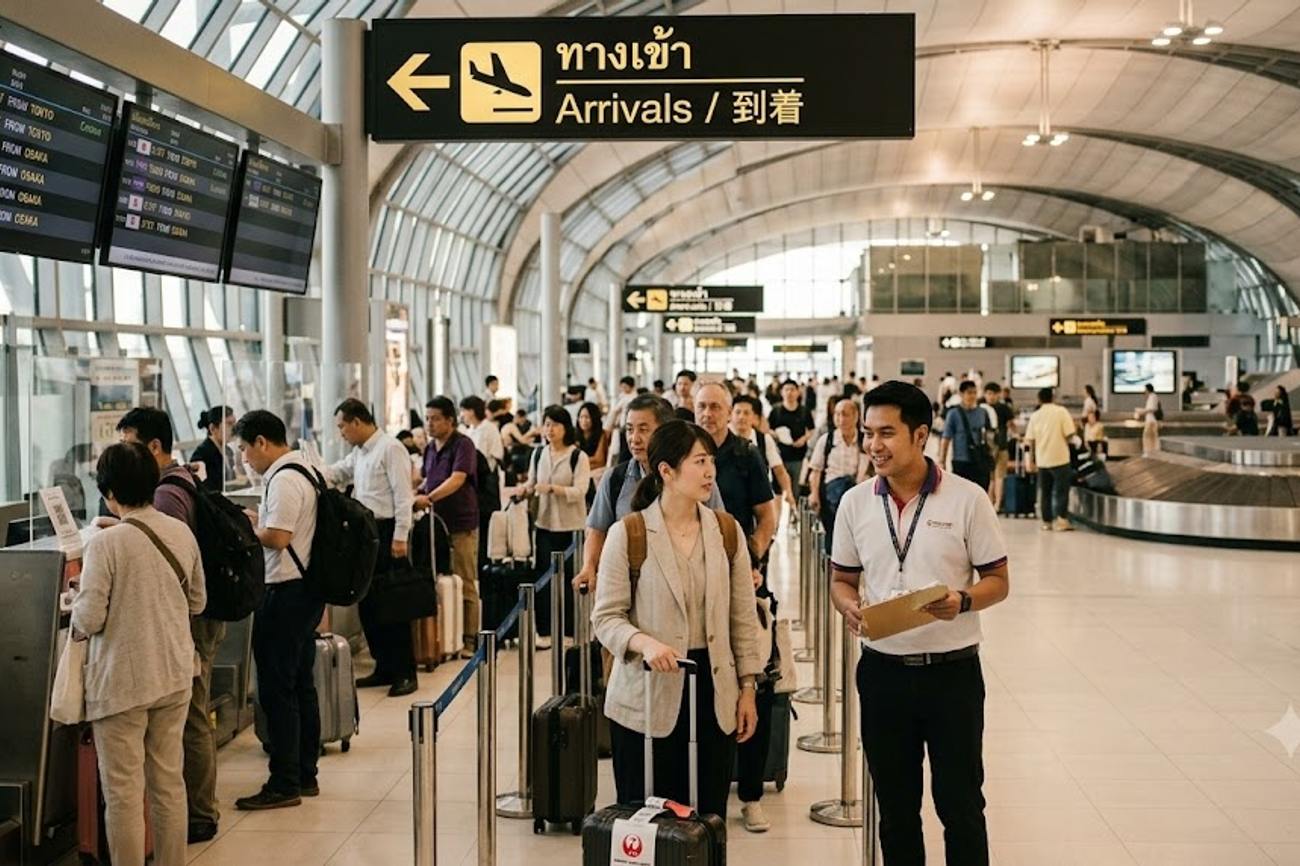
Image generated by AI
985,612 Japanese nationals visited Thailand between January and November 2025, marking a 4.16 per cent year-on-year increase. This surge in arrivals coincides with a strategic expansion of direct air corridors across Southeast Asia, as Thailand, Vietnam, and Japan attempt to solve a fundamental paradox of aviation economics: does increased connectivity encourage deeper, longer-term exploration, or does it simply facilitate a rise in high-frequency, short-duration "micro-trips"?
The Japanese Connectivity Pivot in Thailand
The Thai tourism sector is currently utilizing its robust data architecture to determine if removing friction from the travel process alters visitor behavior. The Tourism Authority of Thailand (TAT) has shifted its strategy toward airline partnerships to decentralize tourism, moving visitors away from saturated hubs and into regional provinces.
This strategy materialized in December 2025 with the launch of three critical direct services. Thai AirAsia X introduced four weekly flights connecting Sendai to Bangkok, while Thai Lion Air established three weekly flights from Hokkaido to Bangkok and four weekly flights from Osaka to Bangkok. These seven additional weekly services are designed to cater to independent travelers who prioritize scheduling flexibility over traditional tour packages.
For the Japanese market, the baseline for travel depth is already established. Data from the first eleven months of 2025 shows that Japanese visitors averaged a stay of 6.04 days, with a mean expenditure of 39,000 baht per trip. The preference for independent travel is evident in the geographic distribution of these visitors, who frequently bypassed traditional hubs to visit Chon Buri, Phuket, Ayutthaya, and Chiang Mai.
Vietnam's High-Volume Recovery Model
While Thailand focuses on stay duration, Vietnam is managing an aggressive volume recovery. In 2025, Vietnam welcomed nearly 21.2 million international visitors, a 20.4 per cent increase over 2024 and a 17.8 per cent jump compared to 2019 levels. The reliance on aviation is absolute, with air arrivals totaling 17.8 million, representing 84.3 per cent of all international entries.
The Japan-Vietnam corridor is a primary engine of this growth. In 2025, approximately 814,000 Japanese citizens visited Vietnam, contributing to a bilateral goal of two million combined annual visits by 2030. Unlike Thailand's recent route additions, Vietnam Airlines maintains a comprehensive, high-frequency grid.
The current network density between the two nations is substantial:
| Route | Weekly Frequency |
|---|---|
| Tokyo Haneda $\rightarrow$ Hanoi | 7 |
| Tokyo Narita $\rightarrow$ Hanoi | 7 |
| Tokyo Narita $\rightarrow$ Ho Chi Minh City | 7 |
| Tokyo Narita $\rightarrow$ Da Nang | 7 |
| Osaka $\rightarrow$ Hanoi | 7 |
| Osaka $\rightarrow$ Ho Chi Minh City | 7 |
| Osaka $\rightarrow$ Da Nang | 4 |
| Nagoya $\rightarrow$ Hanoi | 7 |
| Nagoya $\rightarrow$ Ho Chi Minh City | 5 |
| Fukuoka $\rightarrow$ Hanoi | 5 |
Vietnam is further intensifying this capacity. Between 26 October and 30 November 2026, the Osaka to Hanoi frequency will rise from seven to 11 weekly flights, eventually scaling to 14 weekly services starting 1 December.
The Phuket Experiment: Bypassing the Hub
The most significant shift in regional logistics is the emergence of the Vietnam-Thailand leisure corridor. On 2 July 2026, Vietnam Airlines launched a direct service from Ho Chi Minh City to Phuket. The inaugural flight, operated by an Airbus A321, carried 152 passengers. This service now operates four times weekly on Tuesdays, Thursdays, Saturdays, and Sundays.
This route represents a fundamental change in travel geography. By eliminating the mandatory transfer through Bangkok, Vietnamese travelers can access southern Thai resorts directly. This creates a "natural experiment" for aviation analysts: does the removal of a domestic transfer encourage a longer, more relaxed stay, or does it make a two-night "weekend getaway" so convenient that it actually reduces the average length of stay?
Thailand is betting on the former. The TAT has set an ambitious target of 689,000 Vietnamese arrivals for 2026. Progress toward this goal is already evident, with 219,986 arrivals recorded between 1 January and 25 May.
Expert Analysis: The Connectivity Paradox
For the modern traveler, the expansion of direct routes from cities like Sendai, Hokkaido, and Ho Chi Minh City suggests a more convenient journey, but the economic reality for the destination is more complex. As a senior analyst, I view these developments through the lens of the "Connectivity Paradox": as the cost and time of access decrease, the perceived value of a "long trip" often diminishes.
For travelers booking the new Ho Chi Minh City–Phuket route, the direct consequence is a reduction in travel fatigue. However, the pricing pressure created by higher frequency often leads to lower average ticket costs. When flights become "commoditized" and frequent, travelers are more likely to book short, impulsive trips rather than planned, multi-week itineraries.
The data from Japan indicates a resilience against this trend. An average stay of 6.04 days suggests that Japanese travelers view Thailand as a primary destination rather than a stopover. However, the risk for Thailand and Vietnam is that by optimizing for "passenger throughput" (the total number of arrivals), they may inadvertently sacrifice "visitor nights" (the total time spent in-country).
The real metric of success for these new routes is not the 20.4 per cent surge in arrivals seen in Vietnam, but whether those arrivals translate into diversified spending across secondary cities. If a traveler uses a direct flight to Phuket to spend 48 hours in a resort and then leaves, the net economic benefit to the local ecosystem is significantly lower than a traveler who enters via Bangkok and spends ten days traversing the north.
Key Takeaways
- Japanese Market Stability: Japanese visitors to Thailand averaged 6.04 days per trip in 2025, spending an average of 39,000 baht.
- Network Expansion: Seven new weekly services from Sendai, Hokkaido, and Osaka to Bangkok were launched in December 2025 to support independent travel.
- Vietnam's Volume Surge: Vietnam saw a 20.4 per cent increase in international arrivals in 2025, reaching nearly 21.2 million visitors.
- Strategic Bypass: The new Ho Chi Minh City–Phuket route (launched July 2026) allows travelers to skip Bangkok, testing whether direct resort access increases or decreases stay duration.
- Capacity Growth: Vietnam Airlines is scaling Osaka–Hanoi flights to 14 weekly services by December 2026.
FAQ: Southeast Asia Aviation 2026
Are there direct flights from Japan to Thailand besides Bangkok? While most new services from Sendai, Hokkaido, and Osaka terminate in Bangkok, the International Air Transport Association (IATA) tracks a growing trend of regional connectivity that encourages travelers to use Bangkok as a gateway to Phuket and Chiang Mai.
How long do Japanese tourists typically stay in Thailand? Based on data from January to November 2025, the average length of stay for Japanese visitors was 6.04 days.
Can I fly directly from Vietnam to Phuket? Yes, Vietnam Airlines launched a direct service from Ho Chi Minh City to Phuket on 2 July 2026, operating four times per week.
Which airline operates the most flights between Japan and Vietnam? Vietnam Airlines maintains the most extensive network, providing high-frequency daily services from Tokyo (Haneda and Narita), Osaka, Nagoya, and Fukuoka.
The map of Asia is shrinking, but the depth of the journey remains a variable of economics, not just aviation.
Tags: Thai AirAsia X, Vietnam Airlines, Japan-Thailand Air Routes, Ho Chi Minh City-Phuket Flight, TAT 2026 Targets, Osaka-Hanoi Connectivity
Related Travel Guides
- UK Holidaymakers Face New TUI Warning As Airport Currency Exchange Mistakes Could Raise Travel Costs Abroad
- Minneapolis Saint Paul International Airport Prepares for 2026 MEA Travel Rush Amid Reduced Airline Seat Capacity
- Middle East Airports Face Massive Travel Disruptions as 895 Flight Delays and 67 Cancellations Impact Dubai, Doha, and Regional Hubs
Disclaimer
This article is for informational and educational purposes only. It does not constitute legal, financial, or professional advice. While we strive to provide accurate and up-to-date information, travel policies, regulations, and conditions change rapidly. Always verify information with official sources before making travel decisions. Nomad Lawyer makes no representations about the accuracy, reliability, completeness, or suitability of the information provided. Readers should consult qualified professionals for advice specific to their circumstances. The views expressed in this article are those of the author and do not necessarily reflect the views of Nomad Lawyer.
Raushan Kumar
Founder & Lead Developer
Full-stack developer with 11+ years of experience and a passionate traveller. Raushan built Nomad Lawyer from the ground up with a vision to create the best travel and law experience on the web.
Learn more about our team →