
Anak Krakatau Eruption Shuts 8 Indonesian Airports: Travel Chaos Hits 170,000 Passengers in 2026
A major eruption of Anak Krakatau has paralyzed western Indonesia's aviation network, forcing 170,000 stranded travelers onto grueling overland journeys via trains and ferries.

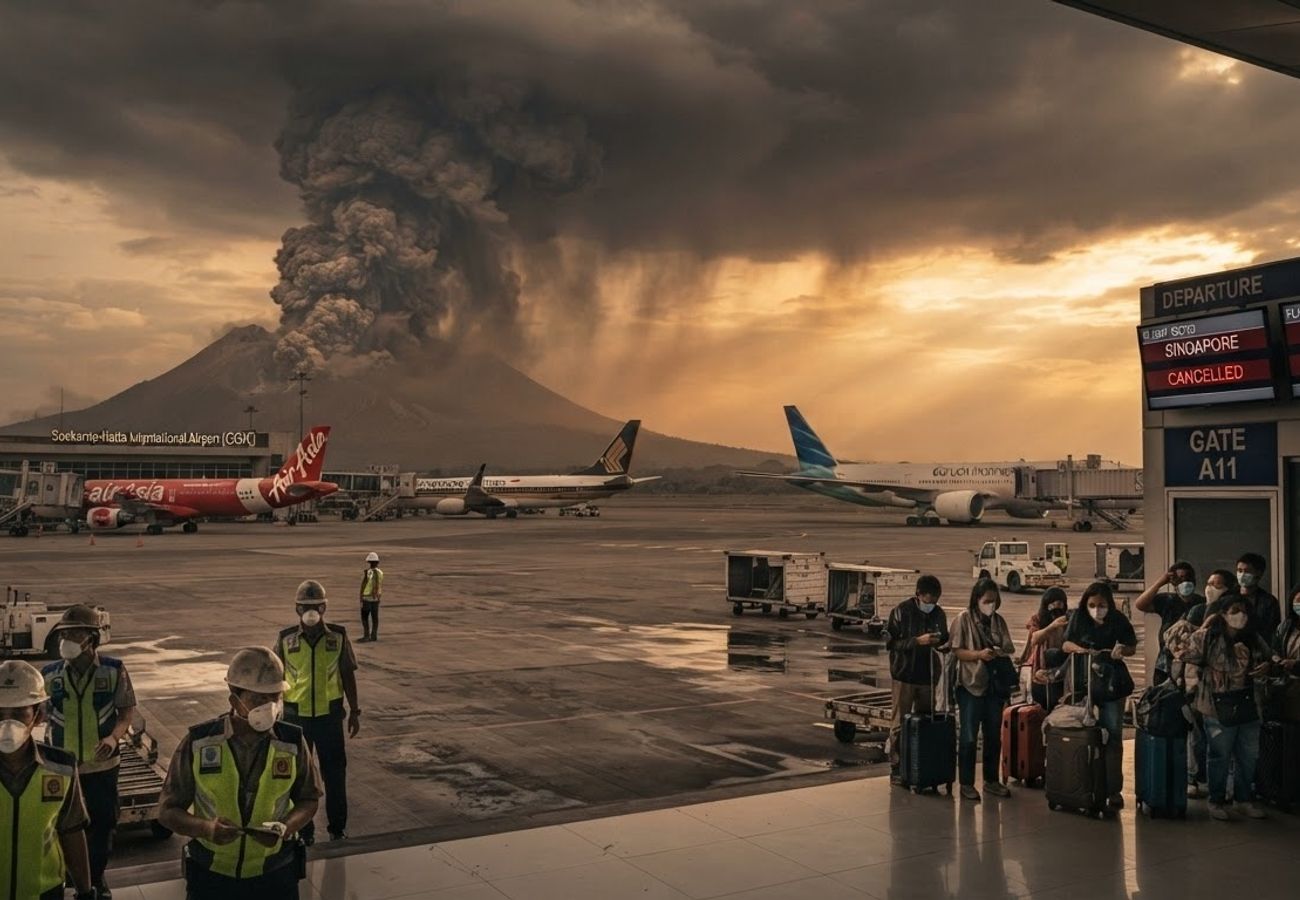
Image generated by AI
Over 170,000 passengers are stranded across western Indonesia after the Anak Krakatau volcano shuttered eight key airports. Travel times that typically take two hours by air have transformed into 27-hour overland odysseys.
The sudden eruption of Mount Anak Krakatau in the Sunda Strait has triggered a systemic collapse of aviation logistics across Java and Sumatra. Between 5 and 6 September 2026, a massive ash column drifted into prevailing wind patterns, contaminating the airspace of Indonesia's most critical hubs. This has forced a mass migration of travelers from the skies to the rails and roads, creating a logistical bottleneck in one of the world's most populous regions.
The Aviation Gridlock: Hubs and Disruptions
The scale of the disruption is centered on the capital's primary gateways. Both Soekarno Hatta and Halim Perdanakusuma in Jakarta have faced temporary closures, alongside Husein Sastranegara in Bandung and Radin Inten in Lampung. In total, eight airports have been affected by the ash cloud, which poses a severe risk to jet engines.
The impact on regional and international connectivity has been immediate:
- Passenger Impact: 170,000+ travelers affected nationwide.
- Key Carriers: Singapore Airlines, Scoot, and AirAsia have reported widespread cancellations and schedule shifts.
- Critical Routes: Jakarta to Singapore and other Southeast Asian hubs remain the most volatile.
For the traveler, the experience has been one of extreme uncertainty. Airport operators have been forced into a "stop-start" pattern, reopening runways briefly only to close them again as ash concentrations shift, leaving thousands in a state of limbo.
The Shift to "Marathon Journeys"
With flights cancelled, the demand for ground and sea transport has spiked violently. Travelers are now attempting to bridge the gap between cities like Bali, Yogyakarta, and Jakarta using a patchwork of available services.
Reports indicate a surge in demand for the Java rail corridor. Premium train classes are entirely sold out, pushing travelers into economy carriages or overnight sleeper buses. In one documented case, a flight from Bali to Jakarta was replaced by a 27-hour journey involving multiple trains, local buses, and a cross-Java ferry.
This shift has created a secondary economic ripple:
- Fare Spikes: Same-day tickets for trains between Jakarta, Bandung, Yogyakarta, and Surabaya have climbed significantly above standard weekday rates.
- Hospitality Surge: Last-minute hotel bookings have spiked near Jakarta’s Gambir and Pasar Senen stations as passengers pause between connections.
- Alternative Gateways: International arrivals are increasingly diverting to Surabaya or Yogyakarta to avoid the Jakarta ash zone, then completing their journeys by road.
Cultural & Environmental Value: Navigating the Volcanic Arc
For those navigating this crisis, the experience offers a raw look at the "Ring of Fire" dynamics that shape Indonesian life. The current disruption highlights the fragility of modern aviation when faced with the geological power of the Sunda Strait.
The real impact for the visitor is a forced deceleration. While frustrating, this shift encourages direct engagement with local transport economies. By utilizing the rail and ferry networks, travelers are inadvertently supporting regional transit operators and small-scale vendors in transit cities along Java’s north coast, moving away from the sterile environment of airport terminals into the heart of Indonesian communal travel.
Visitor Insider Tips
Navigating Indonesia during volcanic activity requires flexibility and local knowledge. If you are currently stranded or planning a trip to the region:
- The "Secondary City" Strategy: If Jakarta is closed, check flight availability into Surabaya (SUB) or Yogyakarta (YIA). From there, the rail network is the most reliable way to move westward.
- Rail Booking Hacks: Use the official KAI (Kereta Api Indonesia) app for real-time seat availability. If premium classes are full, look for "Ekonomi" seats—they are basic but move you toward your destination.
- Cultural Etiquette in Transit: During crises, transit hubs become incredibly crowded. Patience is paramount. A few words of Bahasa Indonesia (e.g., "Permisi" for "Excuse me") go a long way in crowded train stations.
- Health Precautions: Volcanic ash is abrasive. If traveling overland through affected zones, carry an N95 mask to protect your lungs from fine particulate matter.
- Off-Peak Windows: While this is an emergency, typically, early September is a shoulder season. Use this to your advantage by negotiating rates with local transport providers who may have lower baseline demand.
Tourism Outlook
The Indonesian Transportation Ministry has attempted to mitigate the chaos by switching five airports in Java and Sumatra to 24-hour operations. While this eases some pressure, the long-term outlook depends entirely on wind patterns and the stability of Anak Krakatau.
This event underscores the necessity for "disruption-proof" itineraries in Indonesia. Future travel trends will likely see an increase in multi-modal bookings—where travelers secure backup rail or ferry options alongside their flights—to avoid the "marathon journey" scenario.
Stay flexible, stay masked, and keep your itinerary fluid.
Related Travel Guides
Disclaimer
This article is for informational and educational purposes only. It does not constitute legal, financial, or professional advice. While we strive to provide accurate and up-to-date information, travel policies, regulations, and conditions change rapidly. Always verify information with official sources before making travel decisions. Nomad Lawyer makes no representations about the accuracy, reliability, completeness, or suitability of the information provided. Readers should consult qualified professionals for advice specific to their circumstances. The views expressed in this article are those of the author and do not necessarily reflect the views of Nomad Lawyer.
Raushan Kumar
Founder & Lead Developer
Full-stack developer with 11+ years of experience and a passionate traveller. Raushan built Nomad Lawyer from the ground up with a vision to create the best travel and law experience on the web.
Learn more about our team →