
India's 350 Kmph Bullet Train Frontier: Inside the B35 Project and Mumbai–Ahmedabad High-Speed Rail Corridor

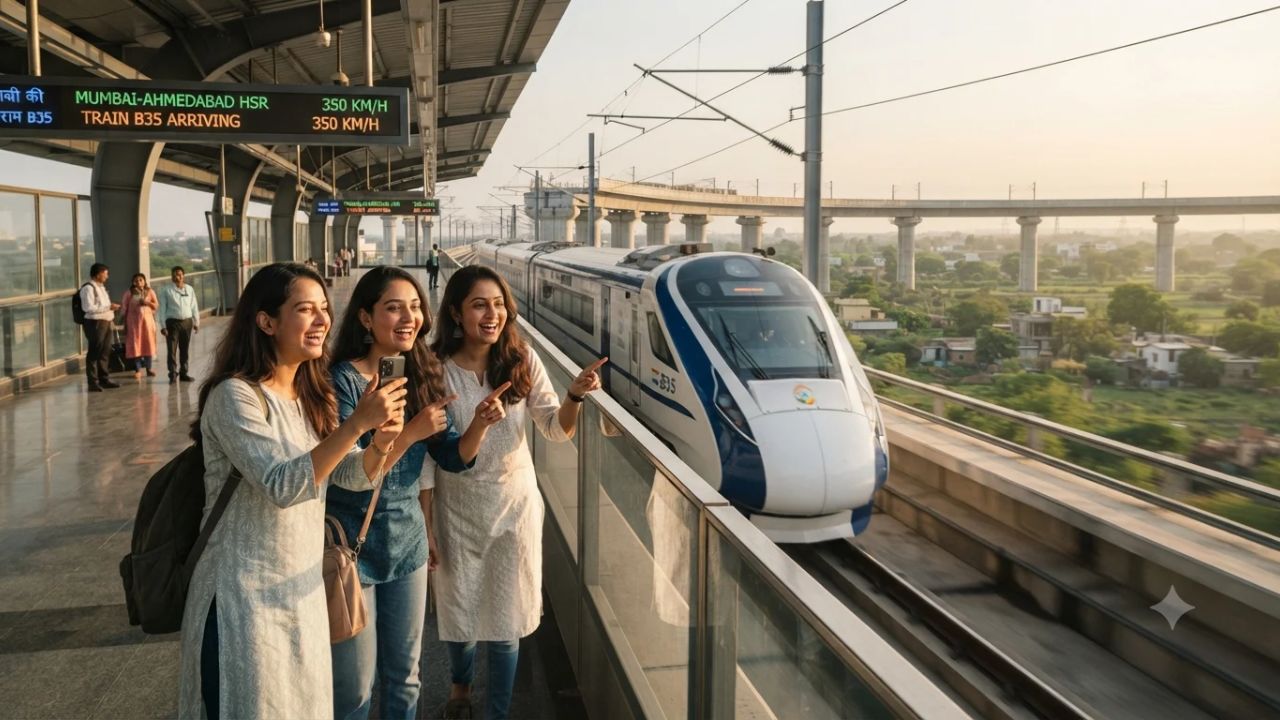
Traveling between the financial capital of Mumbai and the textile hub of Ahmedabad will soon take barely two hours, slashing overland journey times by more than sixty percent. Indian Railways has commenced development of the B35 platform, an indigenously engineered bullet train capable of reaching a design speed of 350 kmph by 2030. Progressing alongside the flagship Mumbai–Ahmedabad High-Speed Rail (MAHSR) project, this engineering initiative signals India's decisive transition from importing foreign rolling stock toward manufacturing homegrown ultra-high-speed trains.
The revised investment requirement for the pioneering 508-kilometer corridor has crossed Rs 2 lakh crore, driven by dedicated undersea tunneling, viaduct construction, and modern elevated terminal stations. As domestic production accelerates, travelers across western India are preparing for a new era of clean, rapid intercity mobility.
Technical Architecture, Phased Trainsets, and Capital Investment
Constructing India's premier high-speed rail corridor represents one of the most complex infrastructure undertakings in South Asian history, overseen by the National High Speed Rail Corporation Limited. The revised expenditure exceeding Rs 2 lakh crore represents a significant update from initial 2015 projections, reflecting specialized engineering requirements across Maharashtra and Gujarat:
- Union Budget Backing: Approximately Rs 1 lakh crore of the total investment is supported directly through the Union Budget.
- Infrastructure and Viaduct Civil Works: Construction costs for viaducts, river bridges, and undersea tunnels have grown to more than Rs 1 lakh crore.
- Land Acquisition: Dedicated right-of-way acquisition across dense agricultural and urban parcels totaled approximately Rs 19,700 crore.
- Corridor Cost per Kilometer: The structural build cost stands at approximately Rs 399 crore per kilometer, excluding future next-generation rolling stock additions.
To inaugurate high-speed services ahead of the 350 kmph B35 rollout, Indian Railways will deploy first-generation B28 high-speed trainsets. Designed to achieve maximum test speeds of 280 kmph and maintain regular passenger operating speeds of 249 kmph, manufacturing of the B28 trainsets is underway, with prototype units scheduled to commence physical track testing during the first quarter of 2027.
Simultaneously, India is deploying the Bharat Train Control System (BTCS), a proprietary signalling and automatic train protection architecture. BTCS continuously calculates safe braking curves, monitors inter-train headway spacing, and manages traction power, reducing reliance on imported electronic control systems.
Globally, this development places India in direct technological company with advanced railway powers, mirroring Japan's concurrent development of next-generation E10 Shinkansen trainsets scheduled for production around 2030.
What Makes the Mumbai–Ahmedabad Corridor Geographically Unique
The high-speed alignment traverses one of the country's most densely populated economic corridors, linking twelve newly designed stations across Maharashtra, Gujarat, and the Union Territory of Dadra and Nagar Haveli:
- Undersea Tunnel Engineering in Thane Creek: A 21-kilometer tunnel section, including a seven-kilometer undersea stretch beneath the Arabian Sea tidal flats near Mumbai, protects coastal mangrove ecosystems while granting high-speed trains entry into the subterranean Mumbai BKC terminus.
- Elevated Viaduct Design: Over 90% of the route is elevated on massive concrete viaducts, eliminating level crossings, preventing wildlife track incursions, and preserving regional agricultural land beneath the tracks.
- Strategic City Center Stations: Terminals in Surat, Vadodara, Anand, and Ahmedabad place travelers within minutes of major commercial districts, bypassing congested highway ring roads.
Visitor Insider Tips for Future Western India High-Speed Travel
As the high-speed rail corridor approaches commercial operational phases, business commuters and cultural travelers can optimize their journeys with key transit advice:
- Connect to Business Hubs via BKC Underground Terminus: The Mumbai terminal is located directly within the Bandra Kurla Complex (BKC), allowing corporate travelers to step directly off the train and walk to financial headquarters, international consulates, and premium hotels.
- Use High-Speed Rail for UNESCO Heritage Excursions in Gujarat: High-speed stops at Vadodara and Ahmedabad provide rapid access to the historic stepwells of Adalaj, the Sun Temple at Modhera, and the Champaner-Pavagadh Archaeological Park promoted by Gujarat Tourism.
- Pair Rapid Rail with Vande Bharat Express Options: During early operational phases starting with B28 trainsets in 2027, synchronize travel between standard broad-gauge Vande Bharat trains and standard-gauge bullet train links for seamless connectivity across western rail networks.
- Utilize Integrated Digital Smart Ticketing: MAHSR ticketing systems will feature dynamic biometric fare collection and synchronized QR codes, enabling commuters to book combined Metro and bullet train transfers in a single smartphone transaction.
- Experience the Sabarmati Multi-Modal Hub: The northern terminus at Sabarmati in Ahmedabad integrates bullet train platforms with Indian Railways broad-gauge lines, the Ahmedabad Metro, and regional bus rapid transit corridors under a single roof.
Environmental Sustainability and Regional Economic Impact
High-speed electric rail delivers significant environmental benefits compared to short-haul commercial aviation and private highway commuting. Running entirely on dedicated high-voltage overhead electrification, bullet trains produce up to 80% fewer carbon emissions per passenger-kilometer than equivalent domestic air travel between Mumbai and Ahmedabad.
Furthermore, the domestic development of B35 and B28 trainsets stimulates thousands of advanced manufacturing jobs across India's domestic industrial belt. By fostering local capabilities in precision traction motors, lightweight aluminum coach fabrication, and computerized signaling, India is laying the technological foundation for planned bullet train corridors linking Delhi, Varanasi, Chennai, and Bengaluru.
FAQ: India High-Speed Rail 2026
What is the difference between the B28 and B35 bullet trains?
The B28 is India's first-generation bullet train with an operational speed of 249 kmph and design speed of 280 kmph. The B35 is a next-generation train designed to operate at 350 kmph by 2030.
When will testing for the Mumbai–Ahmedabad bullet train begin?
Prototype B28 high-speed trainsets are scheduled to begin comprehensive field track testing by the first quarter of 2027.
What is the total project cost of the Mumbai–Ahmedabad High-Speed Rail corridor?
The revised total estimated cost of the 508-kilometer corridor exceeds Rs 2 lakh crore, with roughly Rs 1 lakh crore funded through the Union Budget.
How fast will the bullet train travel between Mumbai and Ahmedabad?
Operational B28 trains will run at 249 kmph, reducing the current five-hour journey to roughly two hours, with future B35 trains operating up to 350 kmph.
India's leap into 350 kmph indigenous rail technology transforms travel across western corridors, establishing high-speed rail as the sustainable foundation of modern mobility.
Related Travel Guides
Disclaimer
This article is for informational and educational purposes only. It does not constitute legal, financial, or professional advice. While we strive to provide accurate and up-to-date information, travel policies, regulations, and conditions change rapidly. Always verify information with official sources before making travel decisions. Nomad Lawyer makes no representations about the accuracy, reliability, completeness, or suitability of the information provided. Readers should consult qualified professionals for advice specific to their circumstances. The views expressed in this article are those of the author and do not necessarily reflect the views of Nomad Lawyer.
Raushan Kumar
Founder & Lead Developer
Full-stack developer with 11+ years of experience and a passionate traveller. Raushan built Nomad Lawyer from the ground up with a vision to create the best travel and law experience on the web.
Learn more about our team →