
Hobart Airport Opens Expanded Arrivals Hall with Eighty-Five Meter Baggage Carousel Under Two Hundred Million Dollar Development
Hobart Airport opens a new arrivals hall with an 85-meter baggage carousel under a A$200 million terminal expansion.

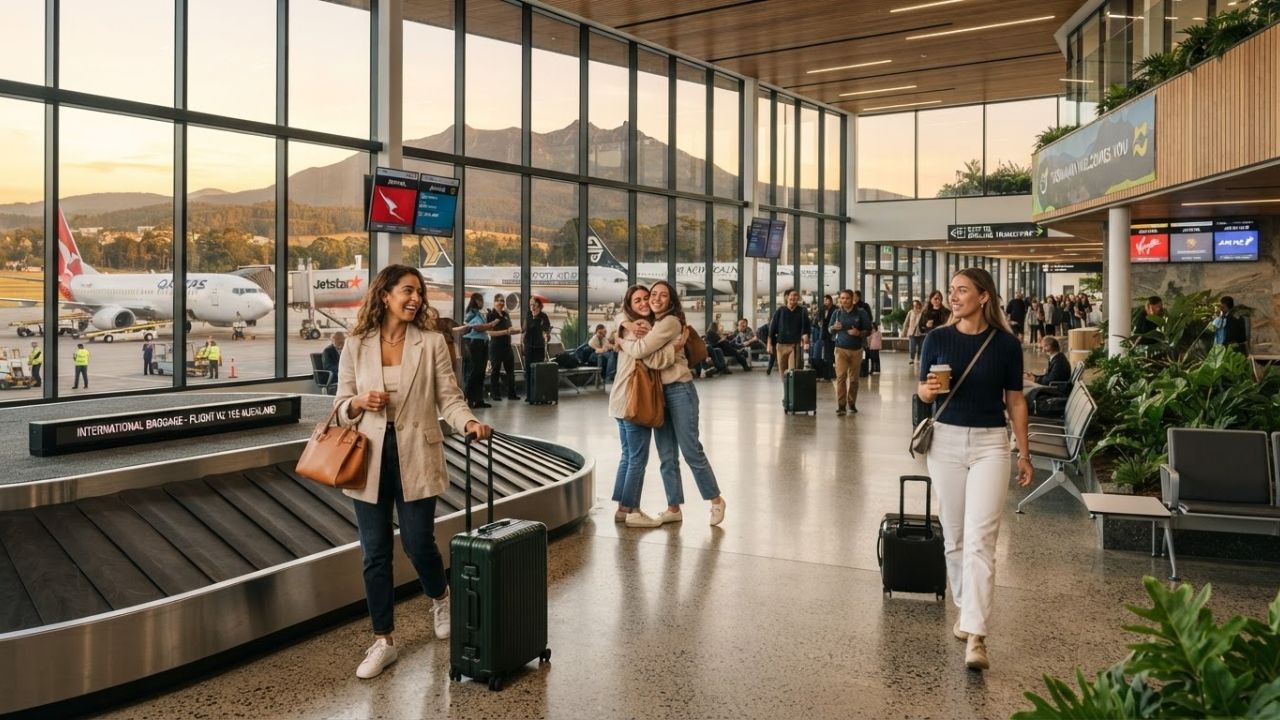
Image generated by AI
Hobart Airport has opened its newly expanded arrivals hall, introducing an eighty-five meter baggage carousel and redesigned passenger exits. The project forms part of a A$200 million terminal redevelopment program designed to double the terminal footprint by 2027.
The Core Transit Update
Hobart Airport has completed the latest phase of its terminal expansion, opening a reconfigured arrivals hall in July 2026. The new facility adds approximately 800 square meters of passenger space and features an 85-meter U-shaped baggage reclaim carousel. A second, older baggage carousel is currently undergoing upgrades to increase baggage handling capacity. Flight schedules and terminal directories are hosted on the Hobart Airport official site.
The arrivals hall features a dedicated corridor connecting aircraft directly with the baggage claim zone to separate arriving and departing passenger flows. The project also introduces a redesigned arrivals forecourt and reconfigured exit pathways that improve pedestrian transit to car rental counters and ground transport services. The changes are part of a A$200 million modernization plan that is two-thirds complete.
Transit Schedule & Route Specifications
The arrivals hall expansion is designed to manage high passenger volumes, particularly during the winter school holiday peak when over 135,000 travelers are forecast. The table below outlines the primary features of the newly opened arrivals hall and compares the project's parameters with wider Australian aviation trends.
Table 1: Key Features of the New Hobart Airport Arrivals Hall
| Feature Parameter | Hall Implementation | Operational Advantage |
|---|---|---|
| Baggage Carousel | 85-meter U-shaped configuration | Accelerates baggage distribution for simultaneous arrivals |
| Additional Floor Space | Approximately 800 square meters | Reduces terminal passenger crowding during peak periods |
| Arrivals Corridor | Dedicated walkway to baggage claim | Streamlines passenger flow and isolates departures |
| Redesigned Forecourt | Tasmanian-themed landscaping | Enhances passenger welcome experience |
| Exit Pathways | Reconfigured terminal exit routes | Faster transit to car rental desks and shuttles |
| Passenger Forecast | 135,000 travelers in July 2026 | Eases winter school holiday terminal bottlenecks |
Table 2: Comparison of Hobart Airport Project with Industry Trends
| Aviation Development Area | Hobart Airport Implementation | Broader Australian Industry Trend |
|---|---|---|
| Terminal Capacity | Doubling current terminal footprint | Larger terminals to handle long-term demand |
| Baggage Reclaim | High-capacity U-shaped carousel | Automated baggage distribution systems |
| Passenger Flow | Segregated arrivals corridor | Redesigned terminal routing to cut bottlenecks |
| Commercial Space | Planned retail and dining expansion | Increasing non-aeronautical revenue per passenger |
| Local Branding | Tasmanian wilderness themes | Destination-themed public terminal spaces |
| Operational Control | Staged construction delivery | Integrated queue-reduction technologies |
Traveler Logistics Guide
Travelers departing from or arriving at Hobart Airport during the ongoing terminal expansion should allow extra time to navigate the airport. Because construction continues across other terminal sectors, temporary signage and shifted passenger lanes may still be encountered. It is recommended to arrive at least 90 minutes before domestic flights and check with individual airlines for check-in windows.
Ground transport options, including taxi ranks, rideshare pick-up zones, and local bus connections, are accessible via the newly reconfigured arrivals forecourt. Arriving passengers can find local transportation links and tour booking details on the Tourism Tasmania official portal. Digital boarding passes and airline mobile check-in are recommended to bypass ticketing queues.
Infrastructure Impact Assessment
The A$200 million redevelopment program represents a major upgrade to Tasmania's regional transport infrastructure. The project aligns with airport planning guidelines monitored by the Australian Department of Infrastructure. Doubling the terminal's physical footprint by 2027 will allow the airport to handle projected growth in domestic and international travelers.
Expanding terminal capacity is essential for supporting Tasmania's tourism economy, which relies heavily on air access for both leisure and business visitor traffic. Staging the construction in phases allows daily flight schedules to remain active while upgrades progress. The modernized gateway improves regional connectivity, positioning Hobart to attract additional domestic services and future direct international routes.
Key Takeaways
- Arrivals Precinct Launch: Hobart Airport has opened its expanded arrivals hall, adding 800 square meters of passenger space.
- Baggage Improvements: The facility features an 85-meter U-shaped baggage carousel to handle high-volume arrivals.
- Redevelopment Funding: The upgrades are part of a A$200 million terminal expansion project scheduled for completion in 2027.
- Aviation Capacity: The expansion will double the terminal footprint, helping accommodate over 135,000 forecast passengers during July peaks.
FAQ
How large is the new baggage carousel at Hobart Airport?
The newly opened arrivals hall features a modern 85-meter U-shaped baggage carousel, designed to speed up luggage reclaim for passengers.
When will the entire Hobart Airport terminal expansion be completed?
The broader A$200 million redevelopment program is currently two-thirds complete, with final construction phases slated for completion by 2027.
Why is Hobart Airport expanding its terminal footprint?
The project is doubling the terminal size to manage long-term passenger growth, expand retail options, and improve security screening efficiency.
Related Travel Guides
- Kansai International Airport Introduces Gate-Controlled Terminal One Pickup Rules and Tolls to Ease Vehicle Congestion in Osaka
- South Korea and China Expand Bilateral Air Traffic Rights for the First Time in Seven Years Adding Seventy Weekly Flights
- Perth Airport Unveils Major Terminal One International Retail Upgrade Adding Fourteen Outlets Ahead of Peak Travel Season
Disclaimer
This article is for informational and educational purposes only. It does not constitute legal, financial, or professional advice. While we strive to provide accurate and up-to-date information, travel policies, regulations, and conditions change rapidly. Always verify information with official sources before making travel decisions. Nomad Lawyer makes no representations about the accuracy, reliability, completeness, or suitability of the information provided. Readers should consult qualified professionals for advice specific to their circumstances. The views expressed in this article are those of the author and do not necessarily reflect the views of Nomad Lawyer.
Kunal K Choudhary
Co-Founder & Contributor
A passionate traveller and tech enthusiast. Kunal contributes to the vision and growth of Nomad Lawyer, bringing fresh perspectives and driving the community forward.
Learn more about our team →