
Middle East Airspace Strain: 1,424 Delays and 34 Cancellations Hit Dubai, Istanbul, Cairo, and Riyadh Gateways
Flight tracking data records 1,424 delays and 34 cancellations across Middle East aviation hubs, impacting Dubai, Istanbul, Cairo, Riyadh, and regional carriers.

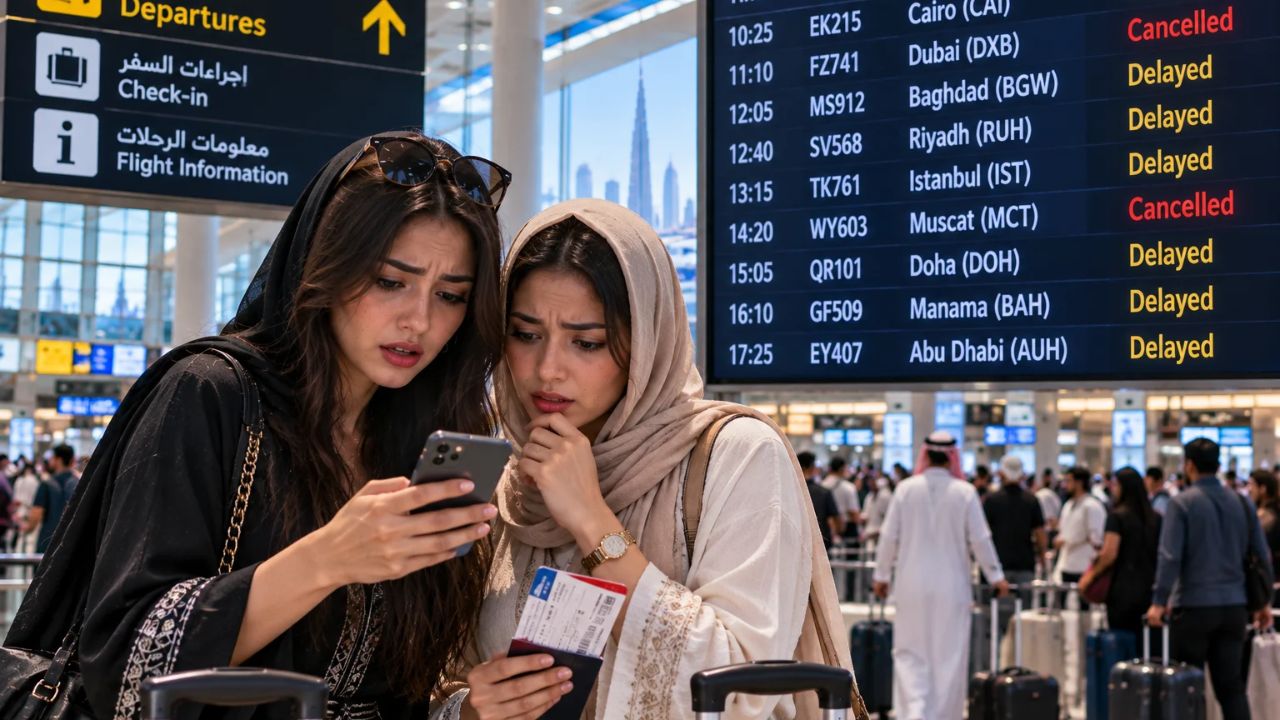
Image generated by AI
More than 42 percent of FlyDubai flights and 47 percent of Israir scheduled operations suffered cascading delays in a single operational window, while Istanbul Airport logged nearly 400 delayed departures and arrivals. Regional air traffic flow controls, peak gate congestion, and connecting corridor bottlenecks resulted in 1,424 flight delays and 34 cancellations across primary transit hubs connecting Europe, Africa, South Asia, and the Gulf.
Transit Hub Bottlenecks Across the Middle East and Eastern Mediterranean
Aviation tracking logs recorded on 27 September 2026 confirm significant schedule friction across major transfer airports. Istanbul Airport in Türkiye recorded the highest raw delay volume among all regional gateways, handling 391 delays and 9 cancellations as intercontinental connection banks backed up across its concourses. Detailed flight status and terminal updates are accessible via Istanbul Airport Operations.
In the United Arab Emirates, Dubai International Airport reported 279 delays and 11 cancellations, the highest cancellation total in the region. Satellite facilities in the UAE absorbed parallel pressure, with Sharjah International documenting 113 delays and 2 cancellations, while Abu Dhabi International logged 111 delays and 1 cancellation.
Across Saudi Arabia, King Khalid International Airport in Riyadh recorded 88 delays and 3 cancellations, while Abha Regional Airport logged 10 delays and 2 cancellations. Beyond the Arabian Peninsula, Cairo International Airport in Egypt handled 169 delays and 2 cancellations, Ben Gurion International Airport recorded 256 delays alongside 3 cancellations, and Baghdad International Airport documented 7 delays and 1 cancellation.
Carrier Breakdown and Operational Metrics
Regional airlines experienced varying levels of operational disruption across domestic and international route networks:
- Turkish Airlines: Logged the highest delay volume with 355 delayed flights, impacting 21 percent of its scheduled network, alongside 7 cancellations.
- FlyDubai: Handled 124 delays representing a 42 percent delay rate, along with 3 cancellations.
- Egypt Air: Recorded 79 delays (29 percent of operations) and 2 cancellations.
- Saudia: Documented 76 delayed flights (14 percent of operations) and 5 cancellations.
- Israir: Experienced schedule slippage across 45 flights, representing a 47 percent delay rate, with 1 cancellation.
Passenger Transit Strategies for Gulf Gateways
- Layover Buffer Recommendations: If connecting between long-haul flights through Dubai International (DXB) or Istanbul Airport (IST), maintain layover buffers of at least 3 to 4 hours. With concourses spanning several kilometers, short 60-minute connections leave passengers vulnerable to missed boarding calls when inbound aircraft hold on the taxiway.
- Airside Transit Facilities: If your flight faces an extended delay at Dubai or Abu Dhabi, avoid exiting immigration unless you hold clear entry visas and confirmed hotel vouchers. Both airports feature airside transit sleeping pods, hourly lounges, and shower facilities in departure concourses.
- Rebooking Protocols for Low-Cost Carriers: If flying regional low-cost carriers like FlyDubai or Israir, use airline mobile applications to select automated rebooking options. Airport service desks often face lengthy queues during widespread bank delays.
- Luggage Interlining Confirmation: When booking separate tickets on different carriers across Gulf hubs, verify whether your baggage is checked through to your final destination. Unlinked tickets require clearing customs, retrieving bags, and re-checking at the main departures hall.
Regulatory Framework and Consumer Rights
Aviation operations throughout the Gulf operate under regional oversight guidelines coordinated with the General Civil Aviation Authority (GCAA) and global safety standards outlined by the International Air Transport Association (IATA).
Under international carriage conditions, airlines must provide passengers delayed beyond four hours with meal vouchers, refreshment access, and necessary communication facilities. For overnight delays resulting from controllable airline scheduling or equipment issues, carriers are obligated to arrange complimentary hotel lodging and round-trip airport ground transportation.
FAQ: Navigating Middle East Airport Delays in 2026
Which Middle East airport experienced the highest number of flight delays?
Istanbul Airport (IST) recorded the highest delay count in the region with 391 flights disrupted, followed by Dubai International (DXB) with 279 delays.
What should passengers do if their connecting flight in Dubai is missed?
Proceed immediately to the nearest Emirates or FlyDubai connection desk in your terminal concourse to receive an updated boarding pass and hotel accommodation vouchers if onward travel is delayed overnight.
Are transit visas required for long airport layovers in the UAE?
Passengers remaining inside the secure international airside transit area do not need a transit visa. If leaving the airport during layovers over 8 to 24 hours, eligible nationalities can obtain a visa on arrival or apply for a 48-to-96-hour transit visa.
How can travelers check real-time gate changes at Cairo or Riyadh airports?
Monitor terminal display boards and download the official carrier mobile application, which pushes immediate push notifications regarding gate assignments and departure adjustments.
Securing generous connection times and tracking flight alerts through official airline apps ensures smooth travel across dynamic Middle Eastern transit hubs.
Disclaimer
This article is for informational and educational purposes only. It does not constitute legal, financial, or professional advice. While we strive to provide accurate and up-to-date information, travel policies, regulations, and conditions change rapidly. Always verify information with official sources before making travel decisions. Nomad Lawyer makes no representations about the accuracy, reliability, completeness, or suitability of the information provided. Readers should consult qualified professionals for advice specific to their circumstances. The views expressed in this article are those of the author and do not necessarily reflect the views of Nomad Lawyer.
Raushan Kumar
Founder & Lead Developer
Full-stack developer with 11+ years of experience and a passionate traveller. Raushan built Nomad Lawyer from the ground up with a vision to create the best travel and law experience on the web.
Learn more about our team →