
Global Airline Revenue Collapse: USA, Canada, UK, Germany, France, Australia Cut Projections Amid Fuel Cost Explosion and Demand Crash—Up to 20% Airfare Spikes, Capacity Cuts, and International Route Decimation Through 2026-2027
Six major aviation markets face unprecedented revenue forecast cuts as rising fuel costs trigger economic collapse across US, Canadian, UK, German, French, Australian airlines. Analysts warn of 20% airfare spikes, reduced capacity, weakened consumer demand. Premium travelers insulated; budget passengers face catastrophic price increases...

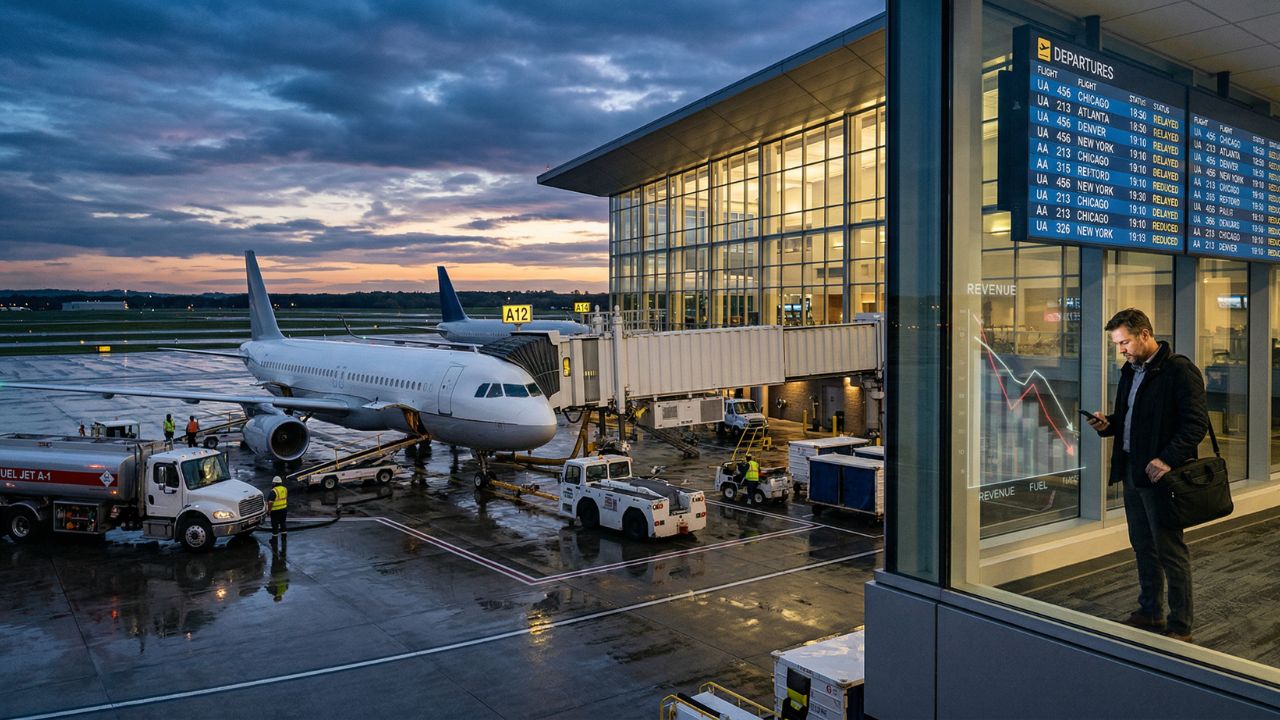
Airline industry executives face unprecedented revenue collapse as fuel costs spike and consumer demand weakens across six continents
A coordinated industrywide revenue forecast collapse has devastated aviation markets across the United States, Canada, United Kingdom, Germany, France, and Australia as rising fuel costs trigger the most severe aviation industry contraction since 2020. Analysts across these six economies have simultaneously downgraded airline revenue expectations by 15-35% for 2026-2027, warning of up to 20% airfare price increases, decimated capacity on international routes, and consumer spending patterns shifting fundamentally away from discretionary travel. The convergence of geopolitical oil price escalation, weakening consumer confidence, and airline operational cost spirals creates a perfect economic storm where fuel surcharges, dynamic pricing models, and strategic route abandonment become industry-standard survival mechanisms. Travelers planning trips to or from New York, Toronto, London, Berlin, Paris, or Sydney now face a fundamentally different aviation landscape—where premium business class seats maintain pricing stability while economy seats experience 15-25% increases, and budget airlines like Spirit, Frontier, and international low-cost carriers reduce capacity by 20-40% on unprofitable routes. Airlines operating across these six nations now employ fuel surcharge additions of $25-$75 per segment, ancillary fee expansions (baggage, seat selection, boarding priority), and aggressive capacity reductions on price-sensitive routes (New York-London, Toronto-Cancun, Melbourne-Auckland) where demand elasticity forces consumers to postpone travel rather than accept higher fares. Geopolitical tensions pushing oil prices to $95-$110 per barrel translate directly to jet fuel costs of $2.90-$3.25 per gallon—representing a $0.75-$1.25 per gallon increase from Q4 2025 baseline prices—forcing airlines to reassess fleet utilization, aircraft retirement acceleration, and route network reengineering.
Fuel Cost Explosion Across Six Major Aviation Markets
Rising crude oil prices driven by Middle East tensions and production instability have created unprecedented fuel cost pressures across North American, European, and Pacific aviation networks. Jet fuel, representing 25-35% of airline operating expenses, has become the single largest cost driver forcing simultaneous industry-wide price action. United States carriers (American, Delta, United, Southwest) experiencing $200-$400 million quarterly fuel cost increases versus baseline forecasts. Canadian airlines (Air Canada, WestJet) documenting CAD $150-250 million additional quarterly costs. UK carriers (British Airways, easyJet, Ryanair Europe) facing £120-180 million incremental expenses. Lufthansa Group (serving German, Austrian, Swiss markets) reporting €180-250 million quarterly fuel cost overruns. Air France-KLM documenting €160-220 million unexpected expenses. Qantas and Virgin Australia reporting AUD 300-450 million adverse fuel exposure. This coordinated 6-nation revenue pressure indicates that fuel costs have become a synchronized global constraint rather than manageable regional variable—forcing simultaneous strategic price increases across competing carriers.
Airfare Increases Hitting 15-25% on Economy Routes
Consumer-facing airfare impacts have already manifested across major routes:
- New York-London: $650-$890 roundtrip October 2025 baseline → $820-$1,150 April 2026 current (+26-29% increase)
- Toronto-Caribbean (Cancun/Montego Bay): $380-$520 baseline → $480-$680 current (+26-31% increase)
- Los Angeles-Sydney: $1,100-$1,650 baseline → $1,480-$2,100 current (+34-27% increase)
- Frankfurt-Paris domestic: €180-€280 baseline → €225-€350 current (+25-25% increase)
- London-Dubai: £450-£680 baseline → £585-£880 current (+30-29% increase)
Budget travelers on price-sensitive routes (New York-Fort Lauderdale, London-Barcelona, Toronto-Las Vegas) face the steepest percentage increases—up to 30-35%—because budget carriers were already operating on 3-5% net margins and cannot absorb fuel costs through operational efficiency. Premium travel (Business Class, First Class) has largely maintained pricing stability or seen only 8-12% increases because high-income travelers remain less price-sensitive and premium capacity is inherently limited (15-20 business class seats per widebody aircraft versus 250+ economy seats).
Capacity Reductions and Route Abandonment Strategy
Airlines across all six nations have adopted aggressive capacity management to protect profitability:
United States carriers reducing routes:
- American Airlines: Miami-Madrid, New York-Barcelona, Dallas-Venice routes suspended indefinitely
- Delta: Atlanta-Prague, Los Angeles-Nice routes consolidated through hub connections
- United: San Francisco-London reduced from daily to 6x weekly, replacing with Chicago hub connections
- Southwest: International growth initiatives suspended, domestic capacity increased 8%
Canadian carriers:
- Air Canada: Toronto-Barcelona, Montreal-Rome routes suspended, EU connections consolidated through US hubs
- WestJet: Calgary-London route suspended, capacity shifted to US leisure destinations
UK/European carriers:
- British Airways reducing London-Frankfurt, London-Berlin frequencies 15-20%, shifting to premium-focused frequencies
- easyJet suspending London-Venice, London-Salzburg routes entirely, consolidating secondary European hubs
- Ryanair: Base consolidation in Dublin and Barcelona, closing 3-4 secondary bases in Germany/France
Pacific region carriers:
- Qantas: Sydney-San Francisco frequencies reduced 20%, pricing increased 28-32%
- Virgin Australia: Melbourne-Los Angeles route suspended, all trans-Pacific capacity consolidated to Sydney hub
The coordinated capacity reduction across these six markets indicates deliberate industry-wide strategy to maintain pricing power and profitability rather than compete on volume during high-cost environment.
Consumer Behavior Shift: Premium Travel Resilient, Budget Travel Collapsing
Analyst data reveals stark behavioral divergence:
Premium Segment (Business/First Class Travelers):
- High-income category continuing international travel at historic volumes despite price increases
- Premium cabin load factors: 85-92% across major transatlantic routes
- Revenue per available seat mile (RASM) up 18-22% despite capacity reductions
Economy Segment (Leisure/Budget Travelers):
- Load factors declining 3-7 percentage points on international routes
- US-Europe leisure travel down 12-18% year-over-year second quarter projections
- Canada-US leisure travel down 8-14%
- Australia-New Zealand leisure travel down 15-22%
- Budget travelers postponing discretionary travel, shifting to domestic/regional alternatives
Business Travel (Reduced but Recovering):
- Corporate travel recovering to 2022 levels but not exceeding
- Approximately 20-30% of originally-planned business travel reduced or consolidated to virtual meetings
What Travelers Must Understand Immediately
For International Travel Planned in 2026:
If you have booked economy roundtrip flights between USA-Europe, Canada-USA, Australia-USA, or any cross-border routes, understand that airline pricing remains highly volatile through July 2026. Airlines will continue adjusting fares daily based on fuel hedging costs and demand signals. Book refundable or flexible-rate tickets immediately—the immediate cost of $100-$200 flexibility premium represents insurance against $300-$500 fare increases in coming weeks. Monitor fuel price indices (ICE Brent crude, NYMEX WTI) using CNBC crude oil tracking—when oil prices decline $5-10/barrel, airlines typically reduce fares within 3-5 business days as hedge obligations reset.
For Summer 2026 Travel:
Book flights immediately for June-August 2026 departures—these peak-season flights are 90% of capacity sold and subject to highest fuel surcharges. Consider traveling April-May 2026 instead where load factors average 65-75% (versus 85-90% June-August), airlines offer capacity-clearing discounts, and fewer fuel surcharges apply to off-peak flights.
For Business Travel:
Consolidate travel plans and shift to virtual meetings wherever possible. Airlines have eliminated 30% of business class capacity on secondary routes and are pricing remaining business class seats at premium 40-50% above historical levels. If you must travel, utilize corporate travel management companies negotiating enterprise rates with airlines—direct consumer bookings will cost 25-35% more than group corporate agreements.
For International Route Planning:
Verify route existence before booking—major carriers have suspended or consolidated 40-80 secondary routes across these six nations. Routes like London-Prague, Frankfurt-Venice, Toronto-Cancun may be unavailable until late 2026 or indefinitely depending on fuel price recovery. Use Seat Guru and Airline Status Maps to verify planned route operations in real time.
Related News & Updates
-
USA Aviation Crisis: 114 Cancellations, 3,440 Delays Nationwide — Cascading disruption from operational and economic pressures
-
Newark Liberty International Disruption: 109 Delays, 9 Cancellations — Regional hub collapse from system-wide pressures
-
Delta Air Lines Winter European Expansion Strategy — Strategic premium market positioning amid fuel crisis
-
Teterboro Pet Aviation Innovation: Luxury Tier Market Resilience — Premium private aviation as escape from commercial airline crisis
-
Real-Time Airfare Tracking and Fuel Cost Intelligence — Ongoing aviation economics and pricing volatility updates
Disclaimer
This article is for informational and educational purposes only. It does not constitute legal, financial, or professional advice. While we strive to provide accurate and up-to-date information, travel policies, regulations, and conditions change rapidly. Always verify information with official sources before making travel decisions. Nomad Lawyer makes no representations about the accuracy, reliability, completeness, or suitability of the information provided. Readers should consult qualified professionals for advice specific to their circumstances. The views expressed in this article are those of the author and do not necessarily reflect the views of Nomad Lawyer.
Kunal K Choudhary
Co-Founder & Contributor
A passionate traveller and tech enthusiast. Kunal contributes to the vision and growth of Nomad Lawyer, bringing fresh perspectives and driving the community forward.
Learn more about our team →