
Germany Adopts Sustainable Slow Rail Model as European Travelers Abandon Short-Haul Flights in 2026
Germany aligns with Switzerland and France in a systemic shift toward slow rail and overnight low-carbon travel as 41% of European travelers prioritize regional exploration over short-haul aviation — now joined by sleeper coach operators like Twiliner.

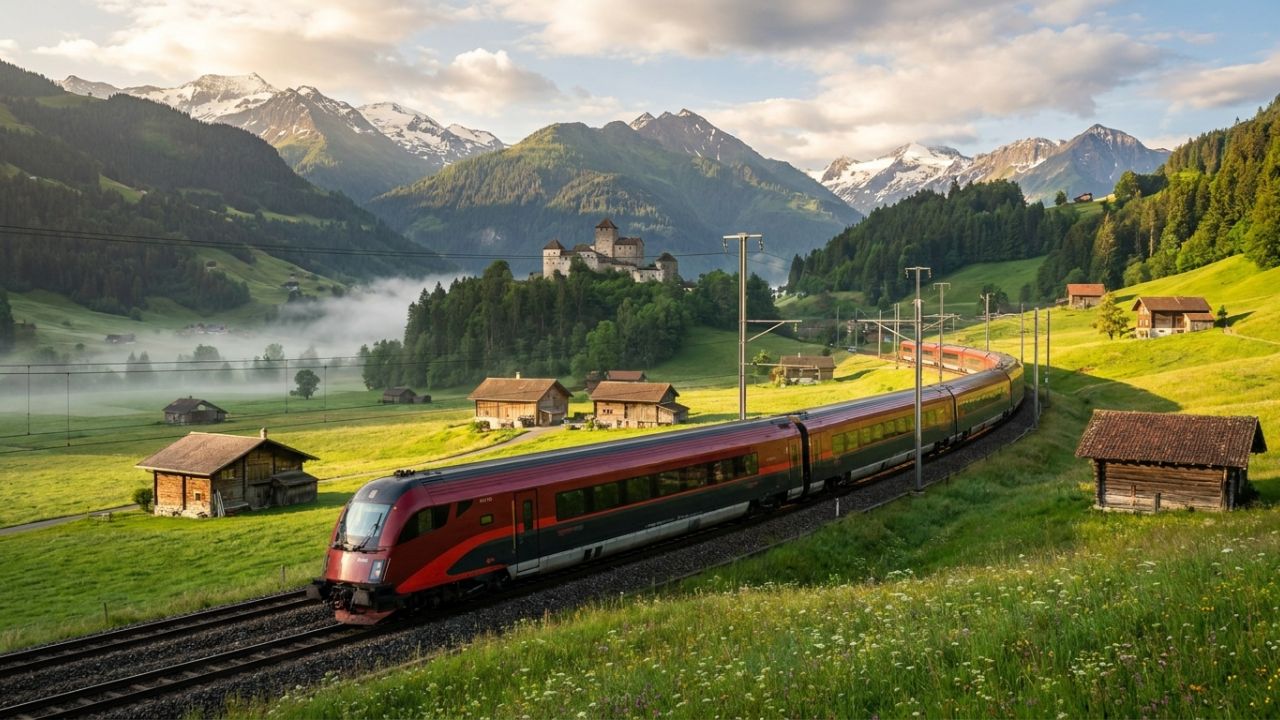
Image generated by AI
The European aviation landscape is undergoing a structural pivot as Germany integrates into a high-efficiency, low-carbon transit model pioneered by Switzerland and France. Rising airfare surcharges and the expansion of cross-border sleeper networks are driving a mass migration of passengers from short-haul flights to multi-destination rail itineraries.
The Shift to Slow Rail: Operational Drivers
Our analysis of continental passenger flows indicates that the transition away from point-to-point regional aviation is fueled by three primary structural dynamics. First, predictable budget management has become a priority; escalating baggage fees and peak-season aviation surcharges have made flat-rate rail passes a more stable option for household planning.
Second, aggressive decarbonization mandates are influencing consumer behavior. Electric rail travel generates up to 80% fewer greenhouse gas emissions per passenger-kilometer than equivalent regional flights. Finally, the "experiential" component of travel has evolved, with vacationers now viewing the transit through alpine and coastal landscapes as a core part of the holiday rather than lost time.
Regional Impact and Network Performance
Flight tracking and transit data from Eurostat, the Swiss Federal Statistical Office (FSO), and Deutsche Bahn (DB) reveal a massive scale of rail adoption. EU national rail systems now carry over 8.7 billion passengers annually.
Switzerland: The Integration Benchmark
Switzerland continues to set the global standard for integrated scenic rail. Data from LITRA and the FSO shows rail passenger travel reached a record 6.30 billion passenger-kilometers in Q2, representing a 5.2% year-over-year increase. This is driven by the Swiss Travel System's unified pass, allowing seamless transfers between mainline rail, funiculars, and lake steamers.
Germany: The Central Transit Hub
Germany is aggressively capturing the slow-travel demographic. Mid-year metrics from Deutsche Bahn (DB) and Destatis show that over 960 million passengers utilized regional and long-distance services in H1 2026. The expansion of flat-rate regional transit passes has significantly lowered financial barriers, positioning hubs like Munich, Berlin, Frankfurt, and Hamburg as primary gateways to Scandinavia and Eastern Europe.
Austria and France: Infrastructure and Legislation
Austria’s ÖBB has spearheaded the sleeper rail renaissance via the Nightjet fleet. A critical infrastructure milestone is the 33 km Koralm Tunnel, which has reduced travel time between Graz and Klagenfurt from 3 hours to 45 minutes.
In France, the shift is reinforced by legislation. The government has implemented bans on domestic short-haul flights where direct rail alternatives exist under two and a half hours, permanently redirecting traffic to the TGV InOui and Ouigo networks.
European Rail Performance Metrics 2026
| Country | Primary Rail Role | Official Passenger Data & Benchmarks | Primary Strategic Focus |
|---|---|---|---|
| Switzerland | Scenic Benchmark | 6.30 Billion Pass-Km (Record Q2) | Synchronized timetabling |
| Germany | Interconnecting Hub | 960 Million Passengers (H1 Baseline) | Deutschlandticket expansion |
| Austria | Night Rail Pioneer | ÖBB Nightjet Network Expansion | Overnight cross-border routes |
| France | High-Speed Synergy | TGV InOui & TER Network Growth | Regulatory flight bans |
| Italy | Heritage Transit | FS Treni Turistici Italiani Deployment | Historic tourist fleets |
Passenger Rights & Advisory: Rail vs. Aviation
For the affected traveler, the shift from air to rail is often a financial decision based on "hidden" costs. While budget airlines offer low base fares, our analysis of the total cost of transit suggests rail is increasingly more economical.
Financial Implications for Passengers:
- Baggage Costs: Rail ticketing typically includes full luggage allowances (2-3 bags) with zero weight-check fines. In contrast, short-haul flights often levy €35–€80 per checked bag.
- Last-Mile Logistics: Rail passengers arrive at city centers (e.g., Zürich HB, München Hbf), eliminating the €30–€60 expense typical of airport-to-city express transfers.
- Lodging Substitution: Utilizing an ÖBB Nightjet sleeper route combines transit with accommodation, potentially saving passengers between €120 and €250 per night on hotel costs.
Rebooking and Compensation Rights: Passengers utilizing EU rail networks should be aware that while rail does not fall under EU261/2004 (which governs aviation), many national operators have adopted similar passenger charters. For those switching from flights to rail due to disruptions, we recommend documenting all "hidden" aviation fees to claim full refunds if a flight is cancelled and a rail alternative is provided.
Industry Analyst View
The data suggests that the "speed" of regional air travel is now an illusion when factoring in airport friction, security queues, and transit to out-of-town terminals. With 41% of European travelers now favoring off-the-beaten-path regional exploration, the industry is seeing a permanent decoupling of "travel" from "aviation." The integration of high-speed corridors with historic heritage routes—particularly in Italy and Austria—indicates that rail is no longer just a utility, but a primary tourism product. And as the Twiliner model demonstrates, the overnight low-carbon revolution is not limited to rail infrastructure at all.
The era of the short-haul flight is being replaced by the era of the overnight journey.
Beyond Rail: The Rise of the Sleeper Coach — Twiliner as a Swiss Case Study
While the sleeper rail renaissance dominates headlines, a parallel and equally significant shift is occurring on European roads. Twiliner, a Swiss independent operator, has commercialized the "sleep through the journey, wake up at your destination" model using a premium overnight coach format — directly challenging both short-haul aviation and overbooked night trains.
What Is Twiliner?
Founded and headquartered in Switzerland, Twiliner operates double-decker coaches with fully lie-flat sleeper seats. Each bus carries a maximum of 21 passengers, a deliberately small capacity designed to replicate the privacy and comfort of a premium rail sleeper rather than the high-density economy of a standard coach. Each seat converts into a flat bed with personal bedding, and onboard amenities include free Wi-Fi, a snack bar, and a restroom with a changing area.
Current Routes and Frequency
Twiliner currently operates two primary international routes with near-daily departures from Zürich:
| Route | Key Stops | Departure Hub |
|---|---|---|
| Northern Route | Zürich → Basel → Luxembourg → Brussels → Rotterdam → Amsterdam | Zürich |
| Iberian Route | Zürich → Bern → Girona → Barcelona | Zürich |
Both routes are designed to depart in the evening and arrive at the destination the following morning — eliminating the need for a hotel night and enabling travelers to begin their day immediately upon arrival, a value proposition directly analogous to the ÖBB Nightjet model.
The Sustainability Argument
Twiliner's buses operate primarily on HVO (Hydrotreated Vegetable Oil) renewable diesel, a drop-in biofuel that the company reports delivers significantly lower lifecycle CO₂ emissions than conventional diesel and far lower than short-haul aviation. While precise per-passenger-kilometer figures require independent certification, the direction of the reduction is structurally sound: a 21-seat sleeper coach operating at high occupancy generates a fraction of the emissions of an equivalent number of passengers on regional flights.
This positions Twiliner within the same decarbonization narrative as the ÖBB Nightjet and Deutsche Bahn's regional rail expansion — without requiring fixed rail infrastructure, which gives it far greater route flexibility.
Why This Matters for the Broader Trend
Twiliner's emergence as a commercially viable operator confirms that the shift away from short-haul aviation is not exclusively a rail story. It is a broader overnight mobility story. Where night trains require decades of infrastructure investment and international track-access negotiations, overnight coach operators can launch new city-pair routes within months. This flexibility makes them a critical "last-mile" solution for city pairs that are economically or geographically unsuitable for dedicated night train services.
For travelers, the practical implication is a widening menu of low-carbon, overnight options. The combination of expanding Nightjet routes, new European Sleeper services (including Brussels–Cologne–Zürich–Milan from September 2026), and operators like Twiliner creates a genuinely competitive overnight travel market for the first time in decades.
Related Travel Guides
Disclaimer
This article is for informational and educational purposes only. It does not constitute legal, financial, or professional advice. While we strive to provide accurate and up-to-date information, travel policies, regulations, and conditions change rapidly. Always verify information with official sources before making travel decisions. Nomad Lawyer makes no representations about the accuracy, reliability, completeness, or suitability of the information provided. Readers should consult qualified professionals for advice specific to their circumstances. The views expressed in this article are those of the author and do not necessarily reflect the views of Nomad Lawyer.
Raushan Kumar
Founder & Lead Developer
Full-stack developer with 11+ years of experience and a passionate traveller. Raushan built Nomad Lawyer from the ground up with a vision to create the best travel and law experience on the web.
Learn more about our team →