
French Authorities Clarify Misconceptions Over Grand Canyon Travel Warnings
French officials debunk claims of a Europe-wide travel warning for the Grand Canyon following flash floods, clarifying specific wildfire alerts in the US.

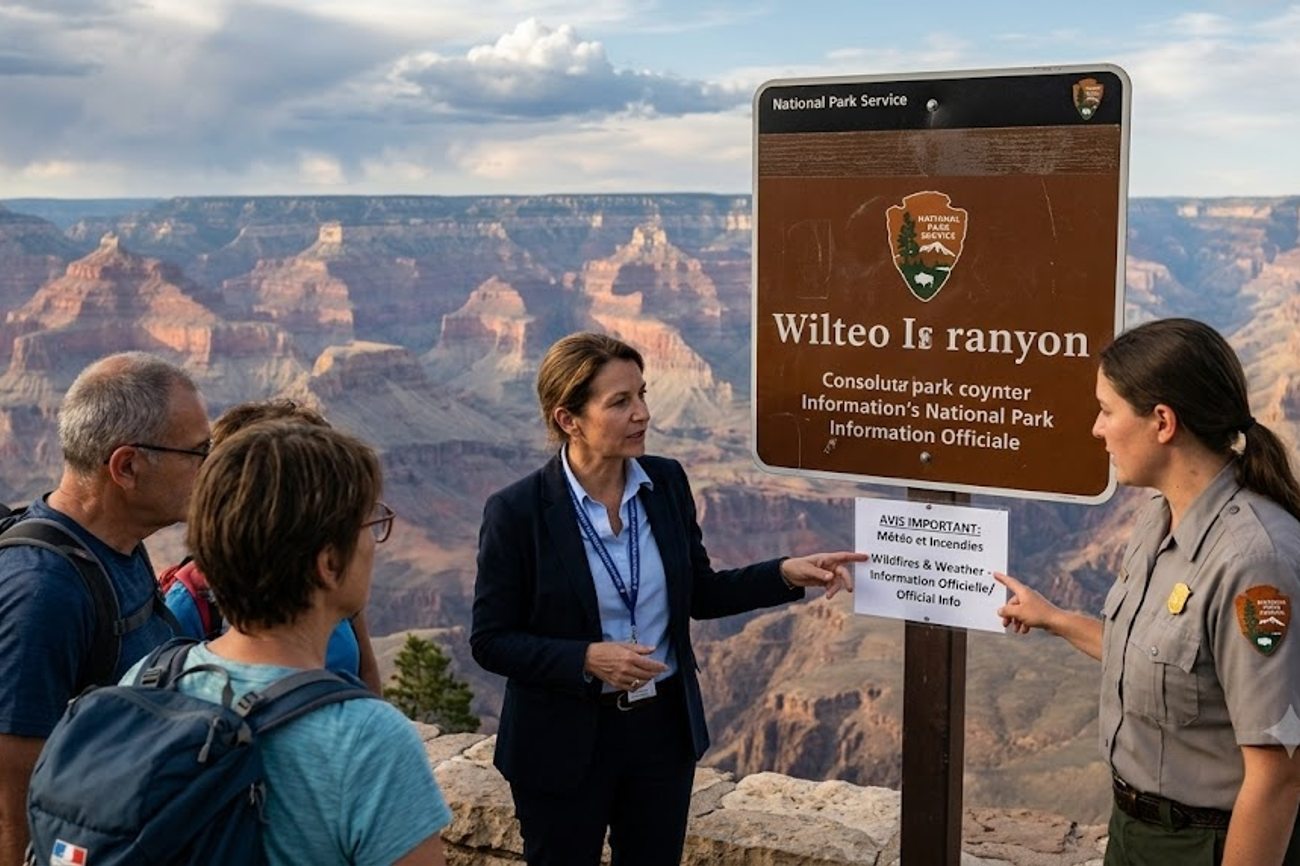
Image generated by AI
[Paris, September 4, 2026] — French government officials have conducted a comprehensive review of international travel advisories to address circulating claims regarding travel warnings for the Grand Canyon. The investigation confirms that while severe flash flooding has caused significant local disruptions within the park, these events have not triggered a unified European travel advisory. Instead, current warnings remain localized, with specific wildfire alerts limited to the states of Washington and Oregon.
The confusion stems from a misunderstanding of how government travel portals are updated. While several European nations have refreshed their US travel pages recently, these updates do not constitute a new, coordinated warning against visiting Arizona or the Grand Canyon. Officials urge travelers to distinguish between general safety guidance and specific emergency alerts.
National Park Service Reports Severe Infrastructure Damage
The catalyst for the recent alarm was a series of serious flash floods within Grand Canyon National Park. According to reports from the US National Park Service, the flooding was severe enough to necessitate the immediate closure of several key sites and transit routes.
Affected areas included:
- Phantom Ranch
- Bright Angel Campground
- The North Kaibab Trail
- Various bridges and critical infrastructure
The Park Service further alerted the public that subsequent thunderstorms could exacerbate the situation, increasing the risk of debris flows, additional flooding, and rockfalls. While these conditions created a localized emergency, they did not escalate into a diplomatic or international travel restriction.
European Governments Deny Coordinated Arizona Advisory
To verify the claims of a "shared Europe-wide warning," a detailed audit of official travel portals was conducted across multiple nations. The review covered the official US travel pages of France, Switzerland, the United Kingdom, Germany, Austria, the Netherlands, Belgium, Denmark, Norway, Sweden, Ireland, and Portugal.
The criteria for a qualifying advisory were strict: the notice had to be current for 2026, specifically address travel to the United States, and explicitly link the Grand Canyon or Arizona floods to a wider western-US hazard or wildfire danger for the autumn season. None of the reviewed government pages met these requirements.
Industry observers note that travelers often mistake general advice—such as "monitor local weather"—for a specific warning against a particular destination. The distinction is vital; a government may suggest caution regarding weather patterns without advising citizens to avoid Arizona entirely.
The Correlation Between Webpage Dates and Travel Alerts
A significant portion of the misinformation is attributed to the way government websites display "last updated" dates. When a ministry alters a single sentence, updates an entry requirement, or refreshes a broken link, the date at the top of the page changes. This does not necessarily indicate a new safety warning.
For example, Switzerland updated its US travel advice on August 31, shortly after the Grand Canyon floods. While the timing suggests a reaction, the actual text contains no mention of the August 29 flood, Phantom Ranch, or Bright Angel Canyon. The Swiss guidance remains broad, covering general risks such as landslides, heavy rain, and infrastructure damage.
Similarly, Austria's travel page showed a current date of September 4, with the last change occurring on September 3. However, the primary notices were unrelated to the Grand Canyon, and the wildfire information remained a general environmental warning rather than a response to the Arizona floods.
Germany provides a further example of this discrepancy. Its US advice was listed as current on September 4, but the content had remained unchanged since August 18. The update was purely editorial and occurred before the Grand Canyon incident, meaning it could not have been a response to the flooding.
French Wildfire Alerts Limited to Pacific Northwest
France possesses the most specific hazard notice among the reviewed nations, but it is geographically unrelated to the Grand Canyon. The Ministry for Europe and Foreign Affairs issued a wildfire notice on August 5, which was subsequently updated on August 7.
This specific alert focused exclusively on:
- Major wildfires in Washington State and Oregon.
- Evacuations and road closures in the Pacific Northwest.
- Poor air quality and smoke affecting the Seattle and Portland metropolitan areas.
While this is a critical warning for those visiting the Pacific Northwest, it does not apply to Arizona. Washington and Oregon are thousands of miles from the Grand Canyon. The French wildfire notice does not mention Arizona, nor does it advise against traveling to the United States as a whole.
France’s broader safety page, updated August 31, provides general guidance for road trips and national park visits. It advises travelers to:
- Check local weather forecasts and obey directions from rangers.
- Assess physical fitness before hiking in canyons or mountains.
- Carry appropriate gear and maintain valid insurance.
- Comply immediately with any compulsory evacuation orders.
UK Guidelines Emphasize Preparation Over Restriction
The UK Foreign, Commonwealth & Development Office (FCDO) maintains detailed safety protocols for US visitors, but these are presented as permanent safety guidelines rather than a reaction to recent events. The FCDO warns that wildfires are a persistent risk in dry regions, including forests and canyons, and urges travelers to monitor local news.
Regarding flash floods, the UK guidance warns that sudden flooding can destroy roads and disrupt travel. It explicitly directs visitors to consult the National Weather Service before embarking on canyon hikes or long-distance road trips.
For high-risk outdoor activities, the FCDO recommends:
- Avoiding solo hiking.
- Notifying a third party of planned itineraries.
- Utilizing official National Park Service data.
- Verifying that insurance policies cover helicopter evacuations and mountain rescue.
These guidelines were last updated on August 18, preceding the Grand Canyon flood. Consequently, the UK has not issued any special restrictions or cancellations for American holidays.
Why This Matters (Information Gain & Experience)
For the modern traveler, this situation highlights a dangerous gap between "digital signals" (like a webpage update date) and "actual intelligence" (the text of the warning). In an era of rapid information sharing, a simple date change on a government website can be misinterpreted as a red alert, leading to unnecessary trip cancellations or panic.
From a logistical standpoint, this underscores the necessity of reading the full text of an advisory rather than relying on headlines or metadata. For those planning a trip to the American West, the real takeaway is not a "ban" or a "warning," but a requirement for hyper-local awareness. The difference between a general "wildfire season" warning and a "mandatory evacuation" notice is the difference between packing a mask and cancelling a flight. Travelers should prioritize real-time data from the National Park Service and the National Weather Service over secondary interpretations of foreign government webpages.
Related Travel Guides
Disclaimer
This article is for informational and educational purposes only. It does not constitute legal, financial, or professional advice. While we strive to provide accurate and up-to-date information, travel policies, regulations, and conditions change rapidly. Always verify information with official sources before making travel decisions. Nomad Lawyer makes no representations about the accuracy, reliability, completeness, or suitability of the information provided. Readers should consult qualified professionals for advice specific to their circumstances. The views expressed in this article are those of the author and do not necessarily reflect the views of Nomad Lawyer.
Naina Thakur
Contributor & Travel Specialist
Travel enthusiast and legal writer covering visa regulations, responsible tourism, and cultural journeys across global destinations.
Learn more about our team →