
France CAF Tram-Train Expansion: €150 Million T13 Line Project to Transform Yvelines Travel by 2028
Île-de-France Mobilités has secured a €150 million contract with CAF for 15 new tram-trains to expand the T13 line toward Achères, enhancing regional connectivity in Yvelines.

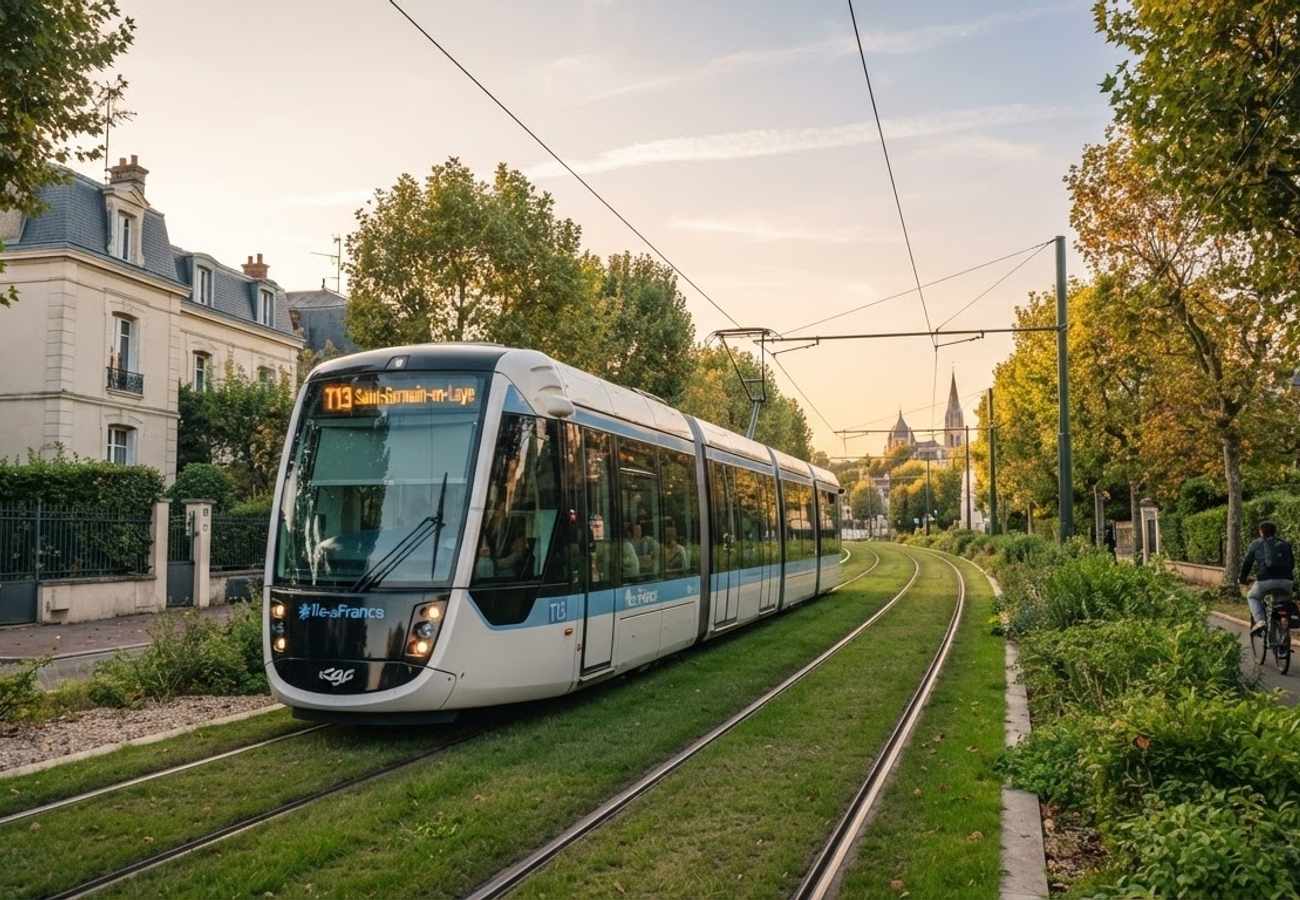
Image generated by AI
[Paris, August 27, 2026] — The Île-de-France regional transport authority has entered into a €150 million agreement with CAF to acquire 15 advanced tram-trains, a move designed to catalyze the expansion of the T13 line toward the suburban hub of Achères by 2028. This strategic investment marks the opening phase of a comprehensive modernization of the Paris region's transit network, aiming to bridge the gap between distant suburban communities and the urban core.
The initiative focuses on the Yvelines department, where the current T13 infrastructure serves as a vital artery for commuters and tourists alike. By integrating newer, high-capacity rolling stock, officials aim to diminish the reliance on private vehicles and streamline the movement of people across the Saint-Germain-en-Laye, Poissy, and Achères corridor.
€150 Million Investment in CAF URBOS Technology
The procurement contract centers on 15 tram-train units built on the specialized URBOS platform. To ensure the network can scale alongside growing population densities, the agreement includes flexible options for additional vehicles and a comprehensive supply of spare parts.
This capital injection is part of a wider mandate by Île-de-France Mobilités to decentralize transit. Rather than forcing all suburban passengers through congested central Paris interchanges, the new strategy emphasizes lateral connectivity, allowing travelers to move between outer-ring towns with greater efficiency.
The T13 line has already proven its utility since its 2022 debut, linking Saint-Cyr-l’École and Saint-Germain-en-Laye. Current service areas include Bailly, Versailles, Noisy-le-Roi, L’Étang-la-Ville, and Mareil-Marly. The upcoming extension to Achères is expected to significantly amplify this reach.
Technical Specifications of the T13 Fleet Expansion
| Project Element | Details |
|---|---|
| Location | Yvelines, Île-de-France, France |
| Operator Network | Île-de-France Mobilités regional transport system |
| Supplier | CAF |
| Investment Value | More than €150 million |
| Number of New Tram-Trains | 15 units |
| Vehicle Platform | CAF URBOS |
| Vehicle Length | 42 metres |
| Passenger Capacity | 86 seated and 170 standing passengers |
| Low-Floor Accessibility | Around 75% of vehicle area |
| Expected Extension Opening | 2028 |
Strategic Connectivity Shifts in Yvelines
The core of this transformation lies in the T13 extension from Saint-Germain-en-Laye to Achères via Poissy. This specific route is engineered to optimize north-south mobility within the Yvelines region, effectively creating a transit web that integrates with existing heavy rail.
Infrastructure reports indicate that the extension will add roughly 10 kilometres of tramway and four new stations. Once operational, the line is projected to support a daily ridership of approximately 17,000 passengers. During peak commuting hours, the frequency will increase to one tram every 10 minutes, offering a reliable alternative to road congestion.
The extension is not merely about new tracks; it is about multimodal integration. The T13 will provide seamless transfers to:
- RER A services at both Achères and Poissy.
- RER E connections located at Poissy.
- Transilien Line L and other regional rail services.
- Local bus networks that feed into the primary rail corridor.
The Hybrid Advantage of Modern Tram-Trains
While many urban planners prioritize raw speed, the T13 project utilizes the hybrid nature of tram-trains to solve a specific suburban problem. These vehicles are designed to operate on traditional city street tracks as trams and then transition onto heavy rail infrastructure as trains.
This flexibility is essential for the Yvelines region, where residential clusters are spread across a mix of dense town centers and open suburban landscapes. By removing the need for passengers to transfer between a tram and a train to reach their destination, the "one-seat ride" significantly reduces travel time and friction.
For the international visitor, this expansion unlocks the western periphery of Paris. Areas containing historic landmarks and green spaces, which were previously difficult to access without a car, will become viable day-trip destinations. For the local resident, the project translates to more predictable commutes and better access to essential healthcare and educational facilities.
Enhancing Passenger Experience and Industrial Localism
The CAF URBOS units are engineered for high-volume throughput and inclusivity. Each 42-metre vehicle consists of seven modules on five bogies, providing a total capacity of 256 passengers.
To meet modern accessibility standards, approximately 75% of the vehicle floor is designed at a low level. This ensures that travelers with luggage, families with strollers, and passengers with reduced mobility can board and alight without assistance. Interior upgrades include:
- Integrated air conditioning for climate control.
- Real-time dynamic passenger information displays.
- A modern interior aesthetic aligned with the Île-de-France Mobilités brand.
Furthermore, the project supports the French economy. The vehicles will be manufactured at the CAF facility in Bagnères-de-Bigorre, located in the Hautes-Pyrénées region, ensuring that the investment stimulates local industrial activity.
Economic and Tourism Implications for Western Paris
Beyond the logistics of commuting, the T13 extension acts as an economic catalyst. Improved transit accessibility typically correlates with increased foot traffic for local businesses and a diversification of tourism. By making smaller municipalities in Yvelines more accessible, the region can distribute tourist spending more evenly, moving visitors away from the saturated center of Paris.
From a regional development perspective, the project impacts a corridor that supports roughly 138,000 jobs and serves over 316,000 residents across nine municipalities. By linking these employment centers to residential zones via sustainable rail, the regional government is using infrastructure as a tool for sustainable urban growth.
Why This Matters: The Shift in Suburban Mobility
For the traveler and the daily commuter, this project represents a shift from "hub-and-spoke" transit (where everything leads to the center) to a "mesh" network. In the past, traveling between two suburban towns often required a detour into the city center and back out again. The T13 expansion eliminates this inefficiency.
From a logistical standpoint, the use of tram-trains reduces the need for massive, expensive new rail corridors while providing the capacity of a train. For the end-user, this means shorter wait times and a more comfortable environment. As European cities move toward "15-minute city" models, the T13 project provides the regional backbone necessary to make those local hubs viable.
The T13 expansion signals a future where the suburbs are no longer mere satellites of Paris, but connected economic centers in their own right.
Related Travel Guides
Disclaimer
This article is for informational and educational purposes only. It does not constitute legal, financial, or professional advice. While we strive to provide accurate and up-to-date information, travel policies, regulations, and conditions change rapidly. Always verify information with official sources before making travel decisions. Nomad Lawyer makes no representations about the accuracy, reliability, completeness, or suitability of the information provided. Readers should consult qualified professionals for advice specific to their circumstances. The views expressed in this article are those of the author and do not necessarily reflect the views of Nomad Lawyer.
Preeti Gunjan
Contributor & Community Manager
A passionate traveller and community builder. Preeti helps grow the Nomad Lawyer community, fostering engagement and bringing the reader experience to life.
Learn more about our team →