
Flights Cancelled Around Asia as Japan, India, Malaysia, Thailand, UAE Cancel 136 and Delay 5,846 Flights Impacting Japan Airlines, China Southern, ANA Wings, IndiGo, Batik, Lao, Emirates and More Airlines at Tokyo, New Delhi, Kuala Lumpur, Bangkok, Dubai and Others
Severe weather in Asia causes 5,846 flight delays and 136 cancellations. Japan Airlines, China Southern, and Emirates im

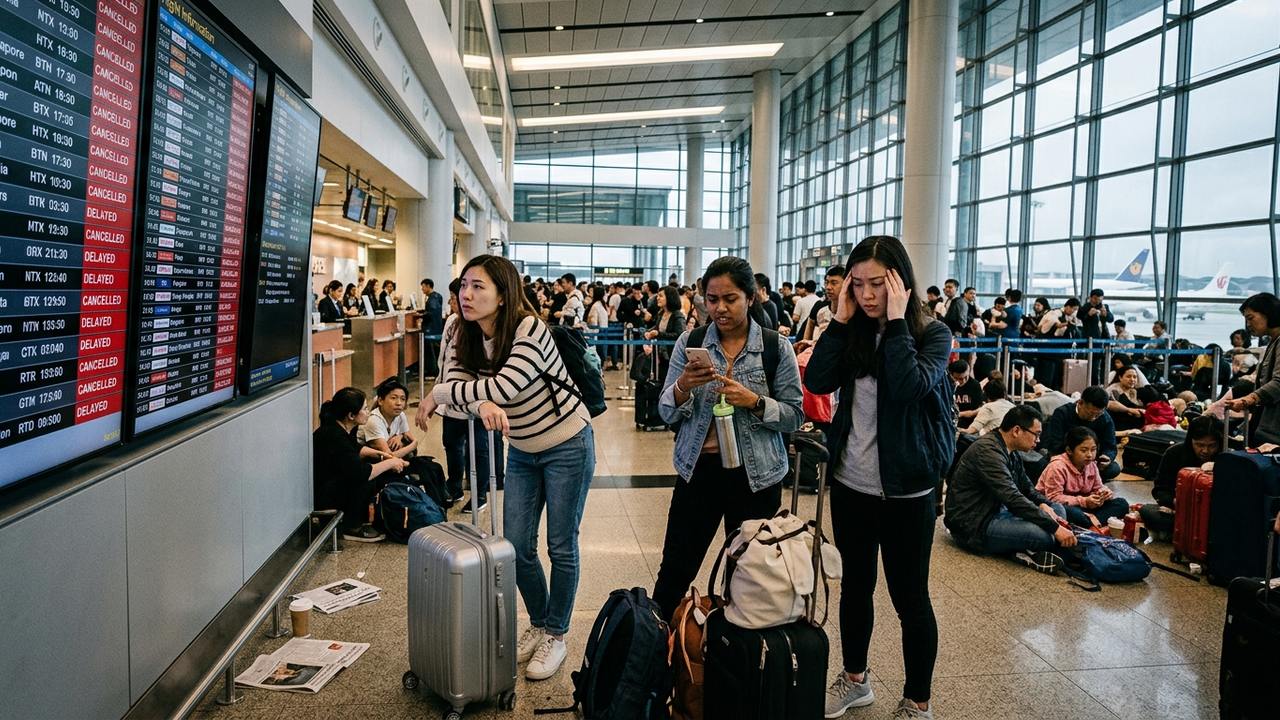
Image generated by AI
[Tokyo, June 27, 2026] — Severe weather systems across Asia have triggered massive aviation disruptions, resulting in 136 flight cancellations and 5,846 delays across five nations. The operational chaos, driven by intense typhoon activity and heavy monsoon rainfall, is currently impacting major carriers including Japan Airlines, China Southern, and Emirates at critical hubs such as Tokyo, New Delhi, and Dubai.
The instability is the result of a cascading effect where extreme weather in East Asia has created a ripple of scheduling conflicts across South Asia, Southeast Asia, and the Middle East. High-traffic corridors are experiencing significant congestion as airlines struggle to reroute aircraft around storm cells and manage reduced visibility on runways.
East Asia Faces Severe Operational Strain in Japan and China
The most acute disruptions are concentrated in East Asia, where Japan and China are battling severe meteorological conditions. Data indicates that Tokyo Haneda Airport has become a primary bottleneck, recording 759 delays. While cancellations at Haneda remained relatively low, the high volume of delays suggests that air traffic flow restrictions and congestion are the primary drivers of the instability.
In China, the impact is widespread across several metropolitan hubs. Guangzhou Baiyun International Airport reported 717 delays and 13 cancellations, marking it as one of the most stressed facilities in the region. Similarly, Shenzhen Bao’an Airport saw 660 delays and 7 cancellations, placing immense pressure on the Pearl River Delta's aviation infrastructure.
Other significant Chinese hubs reporting high levels of disruption include:
- Shanghai Hongqiao: 329 delays
- Beijing Capital: 291 delays
- Xiamen Gaoqi: 281 delays
- Kunming Changshui: 221 delays
- Shanghai Pudong: 183 delays
Japan's domestic network is also under pressure, with Narita Airport recording 103 delays and New Chitose recording 115 delays, confirming that the weather systems are affecting multiple regions of the Japanese archipelago.
Secondary Disruptions Across South and Southeast Asian Hubs
While the epicenter of the crisis is in the East, South and Southeast Asian airports are experiencing secondary operational stress. In India, Indira Gandhi International Airport in New Delhi reported 161 delays and 5 cancellations, attributed to weather-related congestion.
The Southeast Asian corridor is seeing similar instability, particularly in Indonesia and Malaysia. Jakarta Soekarno-Hatta recorded 258 delays and 3 cancellations, while Kuala Lumpur International reported 265 delays and a single cancellation. Bangkok Suvarnabhumi also faced pressure with 231 delays and one cancellation. These figures suggest that while the weather may be less severe in these locations than in Japan, the interconnected nature of Asian aviation means that delays in one hub inevitably bleed into others.
Middle East and South Asia Corridor Stability
The disruptions have extended into the Middle East and Western South Asia, though to a lesser degree. Dubai International Airport recorded 105 delays and 4 cancellations, while Istanbul Airport saw 83 delays and 2 cancellations. In Pakistan, the impact remained minimal, with Islamabad International Airport reporting only 6 delays and 2 cancellations, indicating a more stable operational environment in that specific sector.
Airline-Level Operational Breakdown
The operational burden has fallen heavily on major regional carriers, with Chinese airlines seeing the highest volume of schedule instability. China Eastern leads the disruption list with 757 delays and 19 cancellations, closely followed by China Southern Airlines, which recorded 750 delays and 5 cancellations.
Other airlines facing significant operational challenges include:
| Airline | Total Delays | Total Cancellations |
|---|---|---|
| China Eastern | 757 | 19 |
| China Southern | 750 | 5 |
| Japan Airlines | 391 | 3 |
| Air China | 334 | 8 |
| Hainan Airlines | 252 | 12 |
| XiamenAir | 251 | 2 |
| ANA Wings | 151 | 9 |
Budget and regional operators, including IndiGo, Batik Air, and AirAsia, have also reported moderate disruptions, proving that the weather event has affected all tiers of aviation, from full-service international carriers to low-cost regional players.
Primary Drivers of Aviation Network Failure
Industry observers attribute the current crisis to a powerful combination of typhoon activity and heavy monsoon rains. These systems have created a "perfect storm" of operational hurdles. Specifically, intense storm cells have forced widespread airspace rerouting, which increases flight times and fuel consumption.
Furthermore, low visibility at major airports has led to increased spacing between arriving and departing aircraft, effectively reducing runway capacity. When a primary hub like Tokyo Haneda or Guangzhou Baiyun experiences a slowdown, it creates a cascading effect, delaying aircraft that were scheduled for subsequent legs in Kuala Lumpur, Bangkok, or Dubai.
Passenger Guidance for Affected Travelers
With the aviation network under significant strain, travelers are urged to take proactive measures to avoid being stranded. Officials recommend that passengers closely monitor real-time notifications from their respective airlines for schedule changes.
Due to the high volume of delays, airports are experiencing increased congestion at check-in counters and security checkpoints. Travelers are advised to arrive at the airport earlier than usual. Additionally, those with flexible or refundable tickets are encouraged to rebook their travel to avoid peak storm periods, and passengers connecting through major hubs—particularly in Tokyo, Guangzhou, and Bangkok—should prepare for potential re-routing.
Why This Matters: The Fragility of Interconnected Hubs
The current crisis underscores a critical vulnerability in the modern Asian aviation model: the high level of interdependence between regional hubs. When a "super-hub" in East Asia faces weather-driven restrictions, the impact is not localized. Instead, it creates a systemic failure that propagates through the network, affecting flights thousands of miles away in the UAE or India.
This event demonstrates that aviation resilience in Asia is heavily dependent on the stability of a few key corridors. As extreme weather events become more frequent and intense, the reliance on a small number of mega-hubs may create a systemic risk. The fact that 5,846 delays occurred across just 136 cancellations indicates that the system is currently "clogged" rather than "broken," meaning the infrastructure is struggling to process the volume of traffic under restricted conditions. For the industry, this highlights an urgent need for more dynamic rerouting capabilities and increased buffer capacity in scheduling to absorb weather-related shocks.
Related Travel Guides
Disclaimer
This article is for informational and educational purposes only. It does not constitute legal, financial, or professional advice. While we strive to provide accurate and up-to-date information, travel policies, regulations, and conditions change rapidly. Always verify information with official sources before making travel decisions. Nomad Lawyer makes no representations about the accuracy, reliability, completeness, or suitability of the information provided. Readers should consult qualified professionals for advice specific to their circumstances. The views expressed in this article are those of the author and do not necessarily reflect the views of Nomad Lawyer.
Kunal K Choudhary
Co-Founder & Contributor
A passionate traveller and tech enthusiast. Kunal contributes to the vision and growth of Nomad Lawyer, bringing fresh perspectives and driving the community forward.
Learn more about our team →