
Toronto Flight Disruptions Hit Travellers Flying to Vancouver, Winnipeg, Ottawa, Montreal, Calgary and Several other Destinations as Air France, Jazz Aviation, Air Canada and others Face over a Dozen Flight Cancellations and Numerous Delays, New Update
Toronto Pearson Airport reports 16 flight cancellations and 127 delays on June 26, 2026, impacting Air Canada, WestJet,

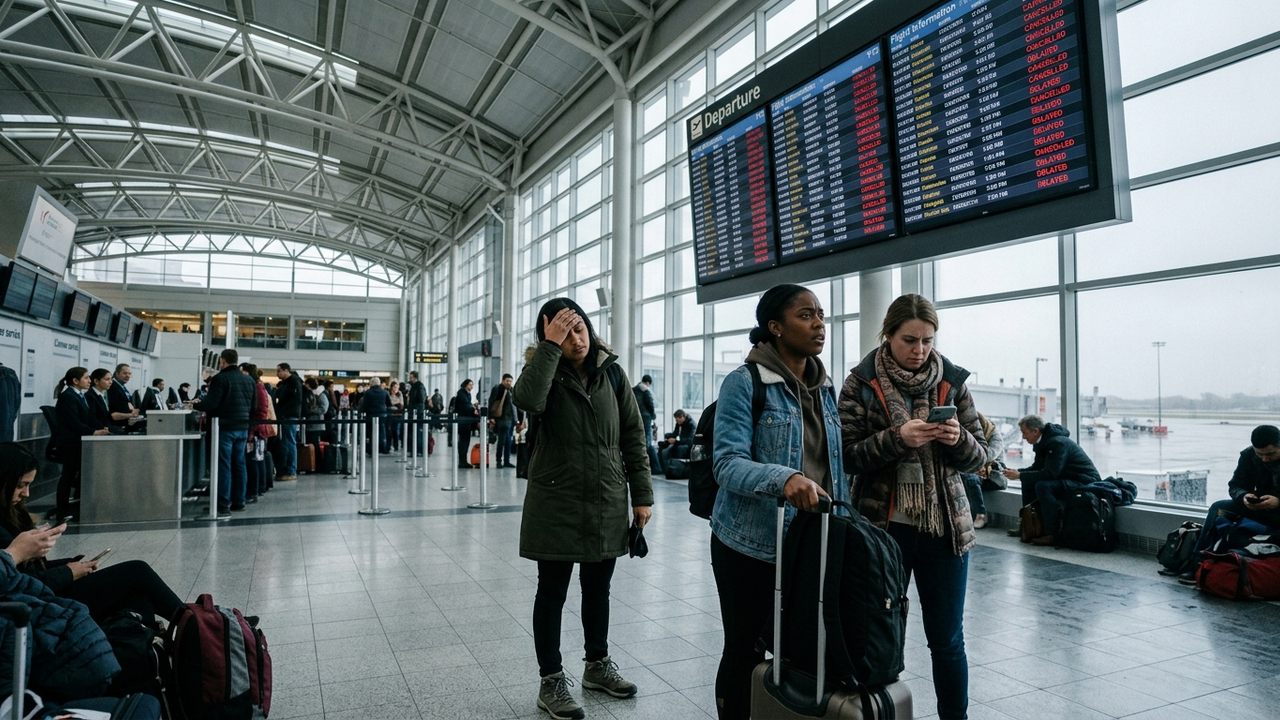
Image generated by AI
[Toronto, June 27, 2026] — Severe operational instability struck Toronto Pearson International Airport on June 26, 2026, resulting in 16 flight cancellations and 127 delays within a single 24-hour window. The disruptions heavily impacted travel flows to major Canadian hubs including Vancouver, Winnipeg, Ottawa, Montreal, and Calgary, while also triggering delays for international flights bound for the United States and Europe.
The sudden spike in scheduling irregularities created a ripple effect across the North American aviation network. Major carriers, including Air Canada and WestJet, along with international airlines like Air France and Lufthansa, faced significant logistical hurdles as the airport—one of Canada's primary aviation gateways—struggled to maintain standard operational efficiency.
Operational Breakdown at Toronto Pearson International Airport
Data from flight tracking sources indicate that the instability was concentrated at Toronto Pearson, where the volume of delays far outweighed the number of total cancellations. While 16 flights were completely scrubbed from the schedule, 127 flights experienced significant departures or arrival delays.
This imbalance suggests that while most aircraft remained in service, the airport's ability to process flights on time was severely compromised. The disruptions were not limited to a specific time of day but remained uneven throughout the reporting period, causing cascading delays for passengers relying on Toronto as a primary connection point for onward travel.
Affected Flight Paths and Global Destinations
The scheduling volatility impacted a diverse array of domestic and international routes. The instability was particularly acute for short-haul flights within Canada and long-haul connections to global financial and tourism hubs.
Routes experiencing total cancellations included:
- Domestic: Vancouver and Winnipeg.
- International: London, Paris, Vienna, Miami, Phoenix, and Raleigh/Durham.
Routes plagued by significant delays included:
- Canadian Cities: Ottawa, Montreal, Calgary, Saskatoon, Charlottetown, Victoria (North Saanich), Yellowknife, Edmonton, Kelowna, and Deer Lake.
- United States: Los Angeles, Orlando, Indianapolis, Boston, Denver, Dallas-Fort Worth, Newark, Chicago, San Diego, San Francisco, Austin, Nashville, and St. Louis.
- International: Frankfurt, London, Amsterdam, Warsaw, Cairo, Incheon, and Bridgetown (Christ Church).
Airline Performance and Disruption Statistics
The burden of these disruptions was shared across a wide spectrum of carriers, from regional partners to global giants. Air Canada and its subsidiaries bore the heaviest impact due to their high volume of operations at the hub.
| Airline | Cancelled | Cancelled (%) | Delayed | Delayed (%) |
|---|---|---|---|---|
| Air Canada | 7 | 2% | 43 | 13% |
| Air Canada Rouge (ACA) | 4 | 3% | 18 | 17% |
| Jazz (ACA) | 4 | 3% | 15 | 11% |
| Air France | 1 | 25% | 3 | 75% |
| Air North Charter | 0 | 0% | 1 | 100% |
| Cathay Pacific | 0 | 0% | 2 | 33% |
| Delta Air Lines | 0 | 0% | 1 | 8% |
| Lufthansa | 0 | 0% | 2 | 50% |
| Endeavor Air (DAL) | 0 | 0% | 1 | 3% |
| Flair Airlines | 0 | 0% | 3 | 6% |
| ITA Airways | 0 | 0% | 1 | 50% |
| PSA Airlines (AAL) | 0 | 0% | 1 | 9% |
| KLM | 0 | 0% | 2 | 50% |
| LOT Polish Airlines | 0 | 0% | 2 | 50% |
| Euroatlantic Airways | 0 | 0% | 1 | 50% |
| Egypt Air | 0 | 0% | 1 | 50% |
| Philippine Airlines | 0 | 0% | 1 | 50% |
| Porter Airlines | 0 | 0% | 11 | 10% |
| Republic | 0 | 0% | 1 | 2% |
| SkyWest | 0 | 0% | 2 | 14% |
| Air Transat | 0 | 0% | 9 | 27% |
| Emirates | 0 | 0% | 1 | 25% |
| Virgin Atlantic | 0 | 0% | 2 | 100% |
| American Airlines | 0 | 0% | 1 | 7% |
| WestJet | 0 | 0% | 2 | 1% |
Air Canada emerged as the most affected carrier, recording seven cancellations and 43 delays. Air Canada Rouge and Jazz Aviation also saw significant disruptions, particularly on leisure-focused and regional routes. Notably, while some airlines like Virgin Atlantic and Air North Charter had low total volumes, their proportional delay rates were exceptionally high.
Influence on Canadian Tourism and Travel Flows
Industry observers note that while the disruptions were operational and limited to a specific timeframe, the impact on tourism connectivity was evident. Because Toronto Pearson serves as the primary entry point for many international visitors, delays in this hub create a bottleneck for travelers moving toward the West Coast or the Prairies.
Connectivity between Toronto and cities like Vancouver and Calgary experienced temporary strain, likely leading to missed connections and disrupted aircraft rotations. International travelers utilizing carriers such as Emirates, KLM, and Lufthansa faced timing shifts that could potentially affect pre-booked ground transportation and hotel arrivals across Canada.
Passenger Guidance and Recovery Efforts
Travelers affected by the instability at Toronto Pearson are urged to rely on direct airline notifications. Major carriers like WestJet and Air Canada typically manage rebookings through digital apps and official communication channels.
According to industry reports, airlines such as Air France and Air Canada generally attempt to rebook passengers automatically based on available capacity. However, passengers are advised to verify their status at airport service desks. Compensation eligibility remains subject to the specific terms of the airline's contract of carriage and Canadian aviation regulations.
Why This Matters (Information Gain)
The scale of this disruption highlights the systemic vulnerability of the "hub-and-spoke" aviation model. When a primary gateway like Toronto Pearson experiences a failure—even one resulting in only 16 cancellations—the "cascading effect" is disproportionately large. The data shows that 127 delays occurred, meaning for every single cancelled flight, nearly eight other flights were delayed.
This ratio demonstrates that the primary issue was not a lack of aircraft or crew (which would lead to more cancellations), but rather a breakdown in operational flow or air traffic management. For the aviation industry, this emphasizes the fragility of tight scheduling; a minor disruption in Toronto can effectively stall travel in distant cities like Vancouver or international hubs like Frankfurt. Furthermore, the fact that regional carriers like Jazz and Porter were heavily impacted suggests that the instability filtered down through every tier of the aviation ecosystem, from ultra-long-haul jets to regional turboprops.
Related Travel Guides
Disclaimer
This article is for informational and educational purposes only. It does not constitute legal, financial, or professional advice. While we strive to provide accurate and up-to-date information, travel policies, regulations, and conditions change rapidly. Always verify information with official sources before making travel decisions. Nomad Lawyer makes no representations about the accuracy, reliability, completeness, or suitability of the information provided. Readers should consult qualified professionals for advice specific to their circumstances. The views expressed in this article are those of the author and do not necessarily reflect the views of Nomad Lawyer.
Preeti Gunjan
Contributor & Community Manager
A passionate traveller and community builder. Preeti helps grow the Nomad Lawyer community, fostering engagement and bringing the reader experience to life.
Learn more about our team →