
FAA Ground Stops and American Airlines IT Failure Cripple Northeast Hubs During 2026 Labor Day Weekend
A perfect storm of FAA ground stops in the Northeast and a nationwide American Airlines IT outage triggered massive flight disruptions during the 2026 Labor Day peak.
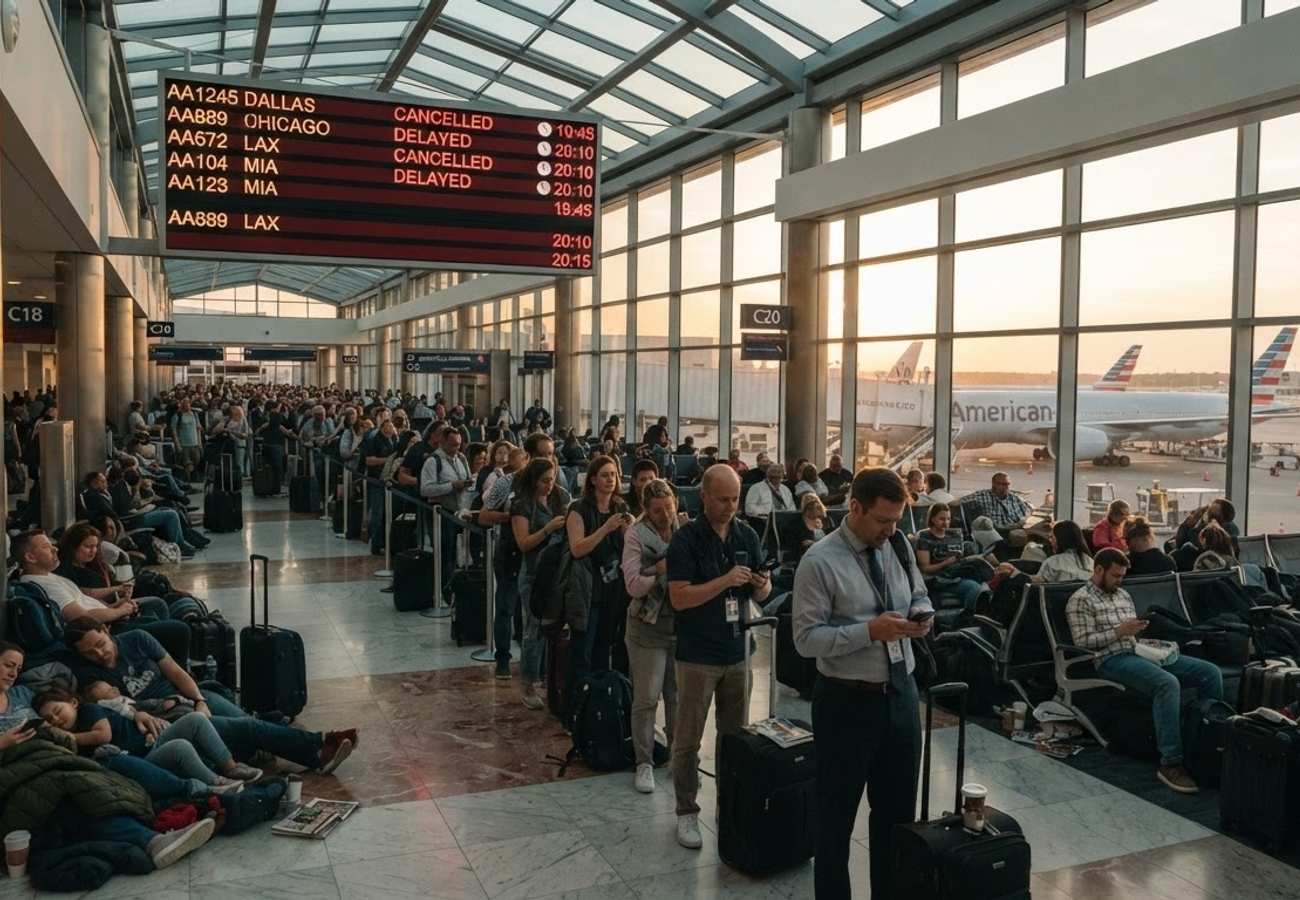
Image generated by AI
Labor Day weekend air travel collapsed on September 6, 2026, as a critical American Airlines technology failure collided with FAA-mandated ground stops across the Northeast. This convergence of systemic IT instability and airspace congestion stranded thousands during one of the year's highest-volume travel windows.
The disruption was not a single isolated event but a compounding failure of infrastructure and technology. While the Federal Aviation Administration (FAA) managed airspace constraints, American Airlines struggled with internal digital collapses, creating a bottleneck that rippled from the East Coast to major hubs in the South and Midwest.
Northeast Corridor Paralyzed by Airspace Constraints
On September 6, 2026, the FAA implemented ground stops at several primary Northeast hubs, including New York-area airports and key connecting gateways. These measures were the direct result of convective weather patterns and extreme airspace congestion, which pushed the region's already strained capacity to a breaking point.
Data from the Air Traffic Control System Command Center reveals that these disruptions were anticipated. FAA planners had previously flagged potential ground stops and delay programs for Newark Liberty and Philadelphia, citing expected thunderstorms and en route constraints.
The New York metropolitan area remains particularly vulnerable due to chronic congestion and existing slot controls. Recent Federal Register notices indicate that slot waivers at John F. Kennedy (JFK) and LaGuardia (LGA) have been extended through late 2026, a move intended to mitigate ongoing staffing shortages and capacity limitations. The Labor Day crisis proves that these structural weaknesses remain a primary risk factor during demand spikes.
American Airlines IT Failure Triggers Nationwide Halt
Simultaneous to the weather-driven delays, American Airlines suffered a severe IT outage that crippled its reservations and departure control systems. This failure forced a carrier-specific FAA ground stop, halting all American flights that were not already in the air.
This incident mirrors a previous systemic collapse on July 28, 2026, where a similar IT failure prompted a nationwide ground stop. The repetition of these events highlights a dangerous reliance on complex digital architectures that lack sufficient redundancy.
The impact was most acute at American's primary hubs:
- Dallas Fort Worth (DFW)
- Charlotte Douglas (CLT)
- Philadelphia (PHL)
At these locations, aircraft remained trapped at gates or on taxiways. Even as local weather improved, flights could not depart because the digital systems required for flight planning and crew management remained offline.
Network Contagion: From Hubs to Regional Airports
The intersection of regional FAA stops and a national airline outage created a "ripple effect" across the entire U.S. aviation network. Because hubs like New York, Philadelphia, Charlotte, and Dallas Fort Worth act as critical nodes, a failure at one point propagates rapidly to secondary destinations.
This pattern is consistent with previous disruptions seen at hubs in Detroit and Houston. When arrival rates are reduced at a major hub, airlines are forced to implement route changes and holding patterns across their entire national schedule.
Regional passengers suffered the most severe consequences. In recovery scenarios, airlines typically prioritize long-haul and international flights to minimize high-cost disruptions. Consequently, short-haul regional flights are often the first to be canceled or delayed indefinitely.
Structural Vulnerabilities in U.S. Aviation
The events of September 6 highlight three systemic vulnerabilities currently facing the U.S. travel industry:
- ATC Staffing: FAA notices for Newark and the New York terminal area cite post-pandemic staffing levels as a continuing challenge, necessitating scheduling relief into 2026 and 2027.
- Digital Fragility: The American Airlines outage underscores the risk of "single points of failure" in critical IT systems that manage check-ins and crew rotations.
- Capacity Saturation: As traffic demand returns to pre-pandemic levels, the margin for error during peak holiday weekends has virtually disappeared.
Operational Impact Summary
| Affected Entity | Primary Cause | Impact Scope | Key Locations |
|---|---|---|---|
| FAA / Northeast Hubs | Convective Weather & Congestion | Regional Ground Stops | JFK, LGA, Newark, Philadelphia |
| American Airlines | IT System Failure | Nationwide Departure Halt | DFW, CLT, PHL, and all US stations |
| Regional Carriers | Network Ripple Effect | High Cancellation Rates | Secondary/Tertiary Airports |
Recovery and Passenger Outlook
Recovery from the Labor Day turmoil is expected to take several days. The process of repositioning aircraft and crews—who may have reached their legal duty limits during the delays—is a slow operational climb.
Passengers flying through affected hubs should monitor flight statuses in real-time. Some carriers have introduced limited change-fee waivers to encourage travelers to rebook and reduce the pressure on congested airports.
While long-term infrastructure and staffing initiatives are moving through regulatory channels, they offer no immediate relief. Until these systemic upgrades are complete, peak travel periods will remain highly susceptible to the convergence of weather, ATC constraints, and technology failures.
The fragility of the modern aviation network is now a predictable variable for the holiday traveler.
Related Travel Guides
Disclaimer
This article is for informational and educational purposes only. It does not constitute legal, financial, or professional advice. While we strive to provide accurate and up-to-date information, travel policies, regulations, and conditions change rapidly. Always verify information with official sources before making travel decisions. Nomad Lawyer makes no representations about the accuracy, reliability, completeness, or suitability of the information provided. Readers should consult qualified professionals for advice specific to their circumstances. The views expressed in this article are those of the author and do not necessarily reflect the views of Nomad Lawyer.