
Global Energy Crisis 2026: Strait of Hormuz Standoff and 3-Hour EU Biometric Border Delays Create Catastrophic Travel Bottlenecks for UK and International Passengers Deflecting Gulf Transit
As the US-Iran conflict triggers a global oil shock, European hubs are drowning under a tidal wave of redirected flights right as the EU's new biometric Entry/Exit System (EES) rolls out, resulting in devastating three-hour border delays.

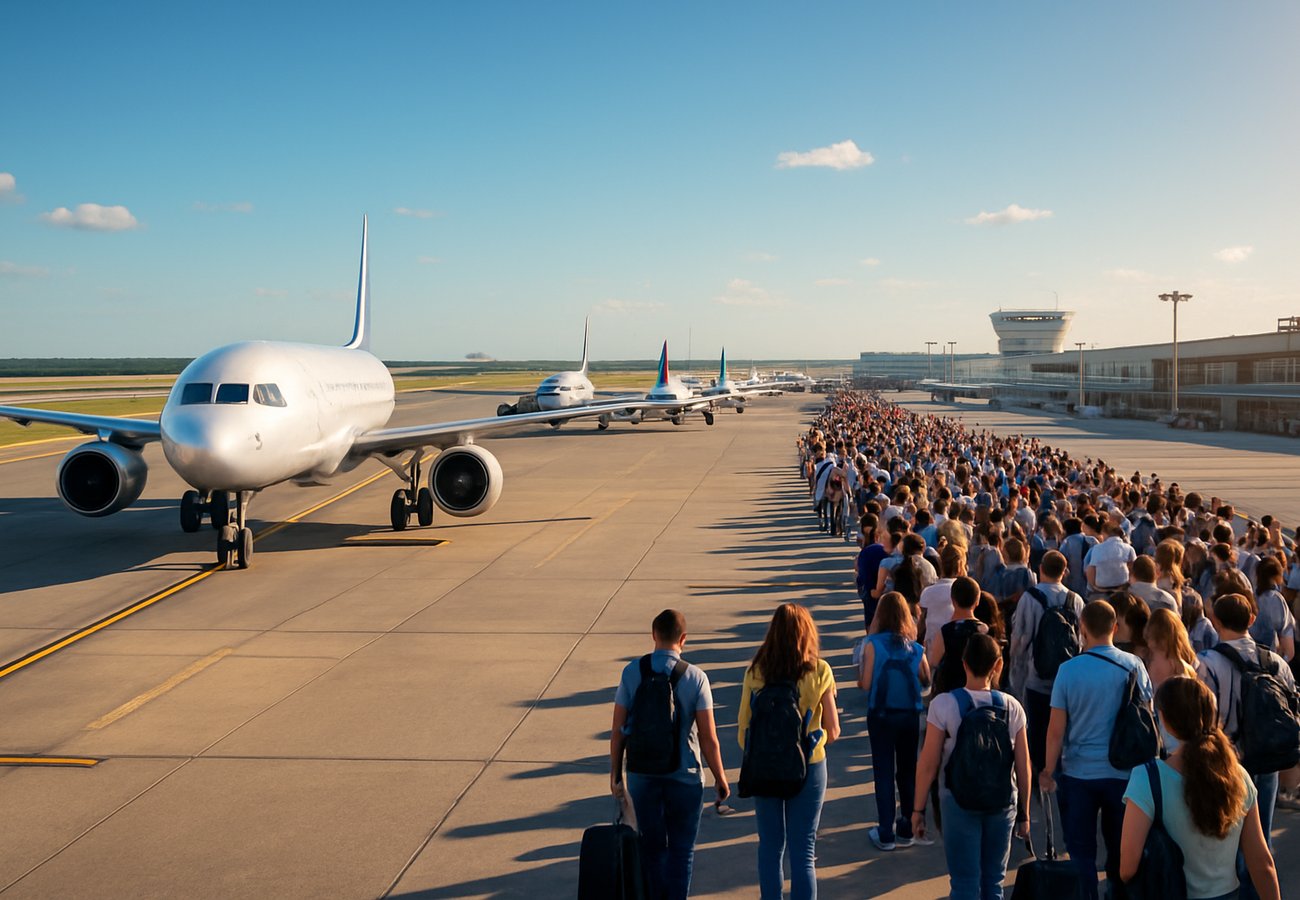
Image generated by AI
Global Energy Crisis 2026: Strait of Hormuz Standoff and 3-Hour EU Biometric Border Delays Create Catastrophic Travel Bottlenecks for UK and International Passengers Deflecting Gulf Transit
The April 10 Rollout of the New Entry/Exit System (EES) Collides with an Unprecedented Influx of Rerouted Flights as the Middle East Conflict Forces Airlines to Avoid Traditional Gulf Mega-Hubs
LONDON, UK — An unprecedented convergence of geopolitical conflict and biometric bureaucracy has pushed European aviation infrastructure to the breaking point. As the world grapples with a systemic global energy crisis fueled by the closure of the Middle East's most critical maritime chokepoints, European hubs in Spain, Italy, and France are functionally buckling under the strain of millions of redirected travelers. On April 10, 2026, the European Union launched its controversial, highly digital Entry/Exit System (EES). However, right as this biometric barrier went live, the escalating military standoff in the Strait of Hormuz forced international carriers to aggressively divert transit flights away from high-risk Gulf airspace and directly into the heart of Europe's congested corridors, triggering staggering border control delays of up to three hours.
EXPANDED OVERVIEW: A System Shock of Historic Proportions
The chaos gripping airports like London Heathrow, Amsterdam Schiphol, and Barcelona El Prat is mathematical in its brutality. With the new system requiring all non-EU citizens—notably millions of UK nationals post-Brexit—to physically supply facial photographs and fingerprint scans upon initial entry to the Schengen Zone, the processing time per passenger has multiplied dramatically.
This localized bottleneck would have been manageable. However, the simultaneous implosion of shipping and airspace availability connecting Asia to the West has amplified the problem. With major international aviation capacity urgently rerouted to avoid the Middle East conflict theater, European airports are suddenly functioning as global emergency transit reservoirs exactly when their internal border efficiency is at its lowest point in modern history. The resulting 180-minute waits mean that travelers are missing connections en masse, inflicting devastating financial strain on airline logistics networks that are already bleeding capital from astronomical fuel costs.
GEOPOLITICAL CONTEXT: The US-Iran Conflict and Forced Diversions
The root cause of this catastrophic capacity overlay lies in the intensifying US-Iran conflict. As military posturing locks down the Strait of Hormuz and severely threatens adjacent territorial airspace, the "Silk Road of the Skies"—traditionally running over the Arabian peninsula—is viewed as increasingly high-risk.
With maritime insurance premiums soaring and airspace declarations narrowing, commercial aviation planners are executing defensive maneuvers. Rather than flying through the warscape, a massive volume of global traffic is hugging the Mediterranean and dropping into European hubs to reposition, refuel, and transfer passengers. This has effectively weaponized the EU's new biometric EES rollout; border guards training on new software are suddenly confronted with an unpredictable tsunami of passenger volume fleeing the Gulf tensions.
GLOBAL ENERGY IMPACT: Skyrocketing Oil Prices Dictating Turnaround Speed
It is critical to analyze the oil prices driving the airlines' reaction to these delays. The global energy shock currently gripping the world means that jet fuel procurement has become cripplingly expensive. In this environment, airline survival requires absolute operational efficiency—planes must dock, unload, and turn around at breakneck speeds to maintain margin viability.
However, the three-hour delays caused by the EES biometric backlog are shattering these highly tuned schedules. Low-cost carriers and leisure titans are finding their jets stranded at the gate while passengers sit trapped in immigration halls. Consequently, major airlines including easyJet, TUI, and Jet2 have triggered emergency advisories, instructing passengers to arrive at least two to three hours prior to departure, an expansion of ground time that fundamentally erodes the profitability of high-frequency aviation models.
SHIPPING & TRADE IMPACT: A Logistical Meltdown Across Land, Sea, and Air
The interconnected nature of global logistics is on full display. The immediate shipping disruption in the Gulf has triggered a frantic scramble for alternative freight transport. As commercial vessels undertake the costly, weeks-long rerouting around the African continent, urgent maritime crews, maritime logistical coordinators, and high-value physical trade negotiators are being rushed into the skies.
This sudden influx of urgent corporate and logistical travel is pouring directly into Europe, where these individuals are subsequently caught in the sweeping dragnet of the new EES mandate. The delays in securing a biometric photo and fingerprint scan are no longer just ruining summer holidays; they are actively delaying essential personnel needed to untangle the snarled global supply chain.
REGIONAL IMPACT (GULF STATES): The Great Passenger Deflection
The crisis profoundly impacts the traditional "super-connectors" based in Saudi Arabia, the UAE, Qatar, Kuwait, Oman, and Bahrain. For a decade, these states absorbed immense portions of the world's transit volume. However, the perceived strategic threats against these hubs amidst the blockade have caused millions of passengers to seek alternate routing structures.
This mass passenger deflection heavily targets Southern Europe. Hubs located in Spain and Italy—the exact locations currently suffering the worst EES processing failures—are being completely overwhelmed. While the new biometric data is securely anchored in the EU system for three years (easing the burden for repeat travelers), the immediate onslaught of first-time entrants diverted from the Gulf has paralyzed the infrastructure.
INDUSTRY / EXPERT ANALYSIS: The "Perfect Storm" of Bottlenecks
"You cannot look at the European airport chaos in a vacuum," dictates a senior geopolitical risk analyst specializing in global logistics at a London think-tank. "European regulators launched the EES on April 10, expecting a standard historical volume of early-spring traffic. What they received was an avalanche of passengers actively dodging a war in the Middle East. You combine a slow, inaugural biometric rollout with a sudden, massive influx of redirected international capacity driven by an oil shock, and you get exactly what we are seeing today: terminal gridlock and a logistical nightmare."
The airlines themselves—specifically Jet2 and easyJet—are attempting to manage the physical flow, demanding travelers head directly to passport control the moment their bags are checked. The time for duty-free shopping has been entirely sacrificed to the altar of biometric compliance and geopolitical rerouting.
WHAT HAPPENS NEXT: A Brutal Summer of Wait Times and Volatility
As the summer high season rapidly approaches, the outlook is grim. The diplomatic efforts required to unblock the Strait of Hormuz will likely stretch well into the fourth quarter of 2026. Therefore, the diverted traffic volume pressing down on Europe is structural, not temporary.
Although airport authorities maintain hope that travelers and border staff will slowly acclimate to the EES machinery (notably minimizing repeat processing times over the three-year data retention window), the sheer volume of UK nationals and global transits guarantees long, hot queues throughout July and August.
CONCLUSION: The Geopolitics of the Passport Control Line
The reality of 2026 travel is that a military blockade in the Middle East explicitly dictates how long a UK citizen waits in an immigration queue in Barcelona. The intersecting forces of a global energy crisis and an uncompromising digital border rollout (EES) have exposed the fragile synchronicity of global travel. Until the Gulf airspace and maritime lanes stabilize, passengers routing through Europe must accept that the three-hour delay represents the new, costly normal of global transit.
KEY TAKEAWAYS
- The Global Collision: The April 10, 2026 rollout of the EU Entry/Exit System (EES) perfectly coincided with massive, unpredictable flight rerouting caused by the US-Iran conflict and the closing of the Strait of Hormuz.
- Three-Hour Delays: The manual collection of facial biometrics and fingerprints has resulted in border control delays stretching up to 180 minutes at major hubs like Heathrow, Schiphol, and Barcelona El Prat.
- Airline Response: Carriers like easyJet, TUI, and Jet2 are aggressively instructing travelers to arrive 3 hours early and proceed immediately to security, as turnaround times are crushed by the delays.
- Data Retention: Once a traveler’s biometric data is captured, it will remain valid in the EU system for three years, a fact intended to offset future delays for frequent travelers.
- The Hub Shift: With travelers actively avoiding historical megahubs in the UAE and Qatar due to Gulf tensions, European airports are absorbing a completely unsustainable volume of deflected global transit.
Disclaimer
This article is for informational and educational purposes only. It does not constitute legal, financial, or professional advice. While we strive to provide accurate and up-to-date information, travel policies, regulations, and conditions change rapidly. Always verify information with official sources before making travel decisions. Nomad Lawyer makes no representations about the accuracy, reliability, completeness, or suitability of the information provided. Readers should consult qualified professionals for advice specific to their circumstances. The views expressed in this article are those of the author and do not necessarily reflect the views of Nomad Lawyer.
Raushan Kumar
Founder & Lead Developer
Full-stack developer with 11+ years of experience and a passionate traveller. Raushan built Nomad Lawyer from the ground up with a vision to create the best travel and law experience on the web.
Learn more about our team →