
Emirates Launches Third Daily Dubai–Cape Town A350 Service in 2026, Expanding South Africa Capacity and Premium Economy Access
Emirates debuts its Airbus A350 on the Dubai-Cape Town route with a third daily flight, restoring Johannesburg capacity and expanding Premium Economy across South Africa.

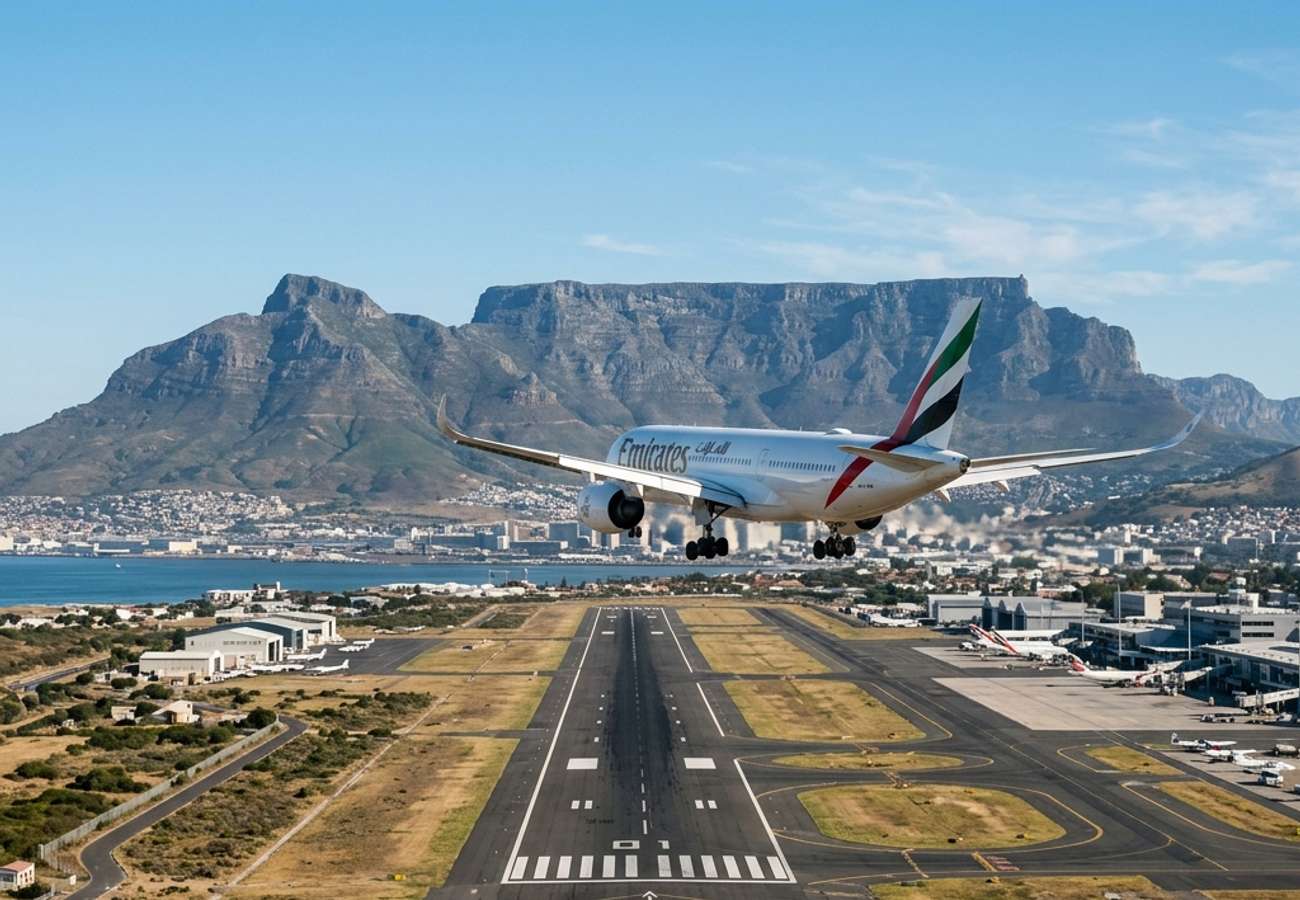
Image generated by AI
Standfirst: Emirates has deployed its Airbus A350 on a third daily Dubai–Cape Town service, marking the aircraft type's South African debut while restoring Johannesburg capacity to 56 weekly flights across three gateways.
Emirates has inaugurated its third daily flight between Dubai and Cape Town, deploying the Airbus A350 on the route for the first time. The service launched on 5 July 2026, giving South Africa's Western Cape a significant capacity uplift and introducing Premium Economy to the corridor.
The new operation runs as flight EK778 from Dubai and EK779 from Cape Town. Emirates confirmed the schedule in January 2026, designing the timetable to optimise connectivity through Dubai to London, Dublin, Mumbai, Brussels, Australasia and Asian markets.
EK778: Departs Dubai 10:25, arrives Cape Town 18:05. EK779: Departs Cape Town 20:00, arrives Dubai 07:25.
The A350 represents the latest addition to Emirates' all-widebody fleet. The aircraft features brighter cabin interiors, larger passenger seats, updated onboard technology and upgraded entertainment systems. Critically for the South African market, it carries Emirates' Premium Economy cabin, which the airline introduced in the country in September 2025.
Market data indicates Premium Economy quickly gained traction among travellers seeking comfort beyond Economy without paying Business Class fares. Emirates now plans to expand the cabin across more than 84 routes by 1 July 2026.
Wesgro Partnership Anchors Tourism Strategy
The Cape Town expansion builds on an April 2026 memorandum of understanding between Emirates and Wesgro, the tourism, trade and investment promotion agency for Cape Town and the Western Cape. The agreement targets inbound tourism growth from the GCC, Far East, India and other source markets identified by both partners.
This partnership gives the added flight a destination-development framework rather than a pure capacity play. The objective is converting seats into measurable visitor growth, hotel demand, restaurant spending, tour bookings and broader tourism value across the Western Cape.
Wesgro's Cape Town Air Access programme has consistently championed improved air links. The results are visible in the 2025 traffic figures.
Cape Town International Airport: 2025 Performance
Cape Town International Airport recorded its strongest year in 2025, according to data cited by Wesgro from Airports Company South Africa.
- 11.1 million two-way passengers (domestic and international combined)
- 3.3 million two-way international passengers, a 7 per cent increase over 2024
- 5,404,706 departing passengers
- 51,497 arriving air traffic movements
- Recognised in the Best Airport ACI-ASQ Awards for Middle East and Africa
The third Emirates daily service strengthens Cape Town's gateway position by adding seat capacity, global reach and schedule depth. Aviation networks typically build momentum around proven demand, and higher frequencies give travellers greater resilience when planning long-haul connections across multiple regions.
Johannesburg Capacity Restored
Emirates' South Africa expansion extends beyond Cape Town. The airline reinstated its fourth daily Johannesburg–Dubai flight on 1 July 2026, increasing total weekly connectivity to Dubai to 56 flights from its three South African gateways.
The Johannesburg operation is further reinforced by a seasonal second A380 service. Emirates confirmed that flights EK761 and EK762 will be operated by a fully retrofitted A380, equipped with Premium Economy and updated cabin interiors. This enhances capacity through O.R. Tambo International Airport, South Africa's largest international aviation hub.
Cargo Dimension Strengthens Trade Flows
The expanded schedule also bolsters Emirates SkyCargo operations. Increased frequencies support belly-hold cargo capacity on the Boeing 777 and A350, alongside the daily Durban service.
Emirates SkyCargo transports South African exports including fresh fruit, vegetables, chilled meat, dairy, seafood and fresh-cut flowers to global markets. For perishable goods, fast and reliable transport is essential. Additional frequencies improve market access for South African producers, particularly when goods require rapid delivery across the Middle East, Asia and Europe.
Network Balance Across Three Gateways
The combined expansion gives South Africa a more balanced Emirates footprint across Cape Town, Johannesburg and Durban. It supports both inbound and outbound demand, linking South African travellers with Dubai and onward destinations while channelling international visitors into multiple regions of the country.
Cape Town remains one of South Africa's strongest destination brands, supported by coastal scenery, food and wine tourism, heritage sites, events, luxury stays and adventure experiences. Johannesburg functions as the primary commercial and transit hub. Durban provides another important coastal and cargo gateway.
The Dubai connection links South Africa with a global transfer hub, enabling travellers from India, the Gulf, Asia, Australasia and Europe to connect through Dubai with broader schedule choice.
| Route | Flight Number | Departure | Arrival | Aircraft |
|---|---|---|---|---|
| Dubai → Cape Town | EK778 | Dubai 10:25 | Cape Town 18:05 | Airbus A350 |
| Cape Town → Dubai | EK779 | Cape Town 20:00 | Dubai 07:25 | Airbus A350 |
| Dubai → Johannesburg | EK761 | Seasonal | Seasonal | Retrofitted A380 |
| Johannesburg → Dubai | EK762 | Seasonal | Seasonal | Retrofitted A380 |
| Johannesburg 4th Daily | — | Restored 1 July 2026 | — | — |
| Metric | 2025 Figure |
|---|---|
| Cape Town total two-way passengers | 11.1 million |
| Cape Town international two-way passengers | 3.3 million |
| International passenger growth vs 2024 | 7 per cent |
| Cape Town departing passengers | 5,404,706 |
| Cape Town arriving air traffic movements | 51,497 |
| Total weekly Emirates flights from South Africa | 56 |
| Premium Economy routes planned by July 2026 | 84+ |
Why This Matters
Our analysis of the flight data indicates Emirates is executing a multi-layered South Africa strategy that goes well beyond simple capacity addition. The simultaneous A350 debut in Cape Town, fourth daily restoration in Johannesburg and seasonal A380 deployment reveal a coordinated network play across three distinct market segments.
The Cape Town A350 deployment targets yield improvement, not just volume. Premium Economy fills the gap between Economy and Business Class, capturing higher-value leisure traffic from the GCC, India, Europe and Australasia. This directly supports the Western Cape's tourism economy, where international visitors spend across hotels, restaurants, wine estates, cultural sites, car rentals and local transport.
The Wesgro partnership signed in April 2026 gives the route expansion a structured destination-development purpose. Industry observers note this is not merely an airline capacity decision but a joint tourism strategy designed to convert additional seats into measurable visitor growth across the province.
The cargo dimension is equally significant. Emirates SkyCargo's belly-hold capacity on the A350 and Boeing 777 supports South African perishable exports, including fresh fruit, vegetables, chilled meat, dairy, seafood and fresh-cut flowers. This dual passenger-cargo model makes the route expansion strategically valuable for both tourism and trade.
Market trends suggest the 7 per cent international passenger growth at Cape Town International in 2025 created the demand signal that justified this investment. The ACI-ASQ award recognition further validates the airport's capacity to absorb additional frequencies.
Industry Outlook
Expect Emirates to monitor Premium Economy load factors on the Cape Town route closely through the 2026 southern hemisphere summer season. If uptake matches the performance seen since the September 2025 South African launch, further cabin retrofits across the Boeing 777 fleet serving Johannesburg and Durban are likely.
The 56 weekly flights from three South African gateways establish a network density that competitors will struggle to match. Watch for potential schedule adjustments to EK778 and EK779 as Emirates refines connection timing through Dubai.
The April 2026 Wesgro memorandum suggests joint marketing campaigns will follow, targeting the GCC, Far East and India. Cape Town's record 11.1 million two-way passengers in 2025 provides a strong baseline, but the real test will be whether the additional capacity translates into sustained international visitor growth through 2027.
Emirates has positioned South Africa as a three-gateway market with Premium Economy, A380 capacity and cargo uplift integrated into a single network strategy.
Related Travel Guides
Disclaimer
This article is for informational and educational purposes only. It does not constitute legal, financial, or professional advice. While we strive to provide accurate and up-to-date information, travel policies, regulations, and conditions change rapidly. Always verify information with official sources before making travel decisions. Nomad Lawyer makes no representations about the accuracy, reliability, completeness, or suitability of the information provided. Readers should consult qualified professionals for advice specific to their circumstances. The views expressed in this article are those of the author and do not necessarily reflect the views of Nomad Lawyer.
Preeti Gunjan
Contributor & Community Manager
A passionate traveller and community builder. Preeti helps grow the Nomad Lawyer community, fostering engagement and bringing the reader experience to life.
Learn more about our team →