
Eastar Jet Expands In-Flight Meals and Onboard Shopping With New Korean Flavours for International Travellers
Eastar Jet introduces five new pre-order meals and 90-day biodegradable packaging on international routes, bringing authentic Korean comfort food to low-cost skies.

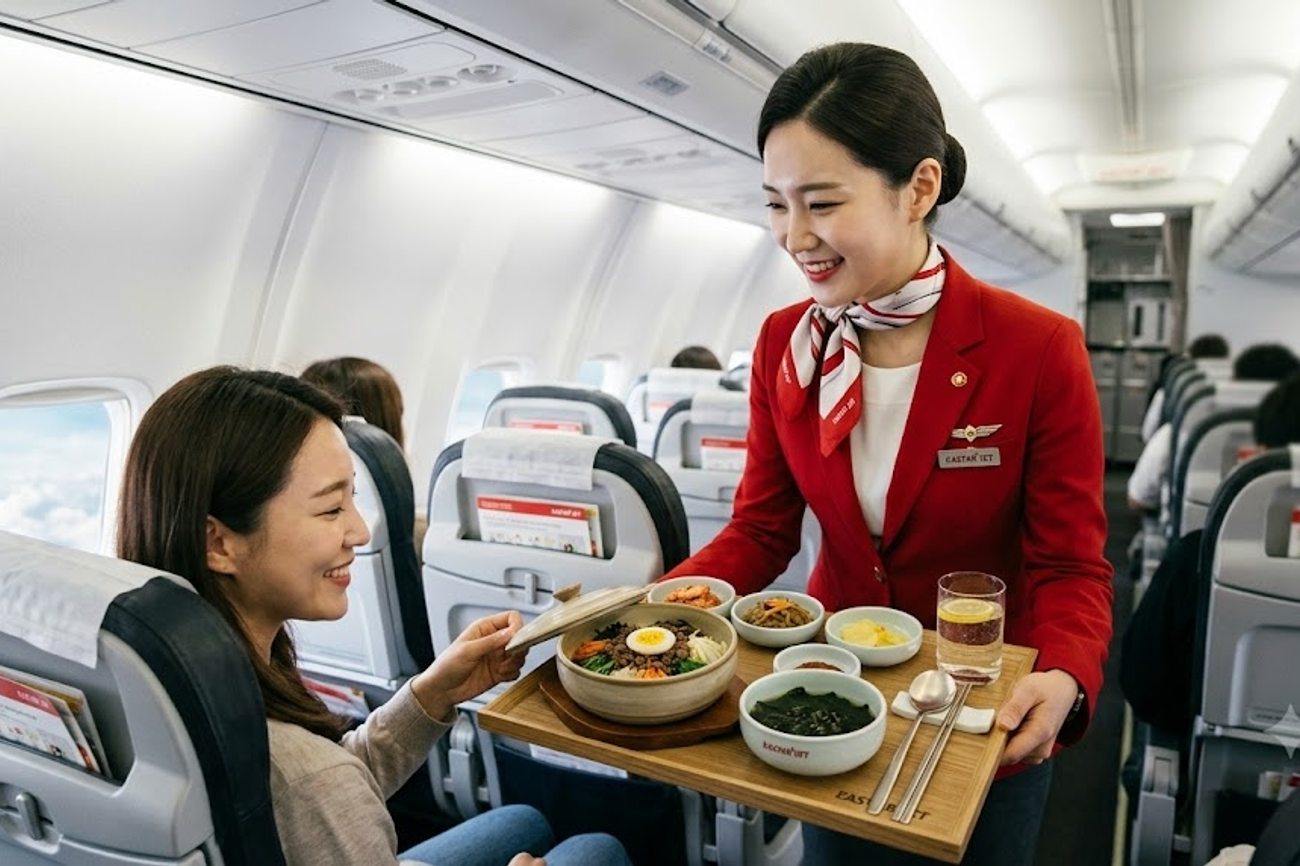
Image generated by AI
While low-cost aviation across East Asia has long reduced in-flight dining to instant foil-packed noodles and lukewarm water, South Korean discount carrier Eastar Jet has introduced steaming bowls of rich black bean jjajang rice served in natural pulp containers that completely biodegrade within ninety days. Announced on 15 September 2026, the carrier's culinary expansion proves that budget travel does not require sacrificing gastronomic pleasure or environmental responsibility. By introducing five distinct pre-order meals—including spicy stir-fried pork rice bowls, crispy fried chicken, fresh chicken breast poke bowls, and savory bulgogi ciabatta sandwiches—alongside expanded Snoopy Peanuts collectibles in its Byeolbyeol Cafe retail lineup, the airline transforms routine flights between Seoul, Tokyo, Taipei, and Jeju into an airborne preview of Korea's dynamic street-market culture.
High-Altitude Street Food: Eastar Jet Elevates Regional In-Flight Dining
The expansion of Eastar Jet's in-flight services highlights an evolving competitive strategy across the Asian budget aviation sector. Low-cost carriers have traditionally competed purely on rock-bottom base airfares, stripping away baggage, seat selection, and complimentary dining. However, as international travelers increasingly seek cultural authenticity and culinary comfort throughout their journeys, carriers are recognizing that onboard food represents a vital brand signature rather than a mere ancillary revenue stream.
The updated menu, unveiled in an official company statement on 15 September 2026, introduces five carefully tailored pre-order dishes designed to accommodate diverse passenger appetites. For travelers seeking hearty traditional flavors, the spicy stir-fried pork rice bowl (jeyuk-deopbap) delivers bold fermented chili warmth balanced by sweet onions and sesame oil. Crispy fried chicken brings Korea's celebrated comfort food tradition to the sky, while the chicken breast poke bowl provides a fresh, nutritious alternative for health-minded voyagers. Rounding out the pre-order roster is the bulgogi ciabatta sandwich, a fusion creation pairing thinly sliced sweet soy-marinated beef with Western artisan bread. Passengers must submit their meal selections at least 72 hours before scheduled flight departure via the airline's website or authorized sales channels, allowing catering kitchens to optimize production and prevent unnecessary food waste.
In addition to advance bookings, Eastar Jet has introduced jjajang rice as an on-demand purchase item available directly during flight on selected international routes. Featuring white rice drenched in savory caramelized black bean sauce, the dish requires no prior reservation. Crucially, the meal is served in an engineered natural pulp container capable of withstanding cabin air pressure and temperature fluctuations while breaking down completely in soil within 90 days. This eco-conscious packaging initiative follows earlier menu expansions that added vegetarian and halal selections, reflecting a broader demographic shift among international voyagers. Complementing the culinary update, the airline broadened its Byeolbyeol Cafe paid retail service, expanding its Peanuts collaboration range to nine unique products with the debut of a collectible 3D aircraft puzzle alongside themed ballpoint pens and key rings.
What Makes Korean Low-Cost Travel and Food Culture Different
Traveling aboard a South Korean discount carrier provides a direct window into the nation's profound relationship with food. In Korean culture, dining is rarely viewed as a functional chore; it is an act of communal care (jeong) that defines daily hospitality. When flying across the peninsula or hopping to nearby regional capitals, mealtime is considered an integral component of the travel experience rather than an optional afterthought.
This culinary pride is particularly evident along domestic trunk routes. Eastar Jet connects the primary Seoul aviation corridor to Jeju International Airport (CJU) over a route that statistically ranks as the single busiest passenger air corridor on Earth, handling over sixteen million travelers each year. Stepping off the aircraft in Jeju transports voyagers into a breathtaking subtropical realm dominated by Mount Hallasan and labyrinthine basalt lava tubes protected by the UNESCO World Heritage Centre.
What sets the Korean travel experience apart is how regional food identity travels with the passenger. The black bean sauce featured in Eastar Jet's jjajang rice traces its origins back to 1905 in the port of Incheon, where Chinese dockworkers adapted traditional bean paste into a sweet, savory comfort staple that eventually became South Korea's unofficial national dish. Whether flying aboard a Boeing 737 or wandering through provincial alleys, travelers find that every meal tells a story of historical adaptation, warmth, and culinary ingenuity celebrated by Visit Korea.
Visitor Insider Tips
Navigating South Korea's budget aviation networks and regional culinary circuits requires practical planning and ground-level savvy.
- Observe the 72-Hour Pre-Order Deadline: If you wish to savor hot specialties like the spicy stir-fried pork bowl or the bulgogi ciabatta, you must complete your order at least 72 hours prior to flight departure on the Eastar Jet website. Onboard supplies of instant jjajang rice are limited on popular international flights to Tokyo Narita or Taipei, and spontaneous purchasing is not guaranteed if cabin demand is high.
- Fly Domestic via Gimpo Rather than Incheon: When booking flights from Seoul to Jeju, Busan, or Yeosu, always select Gimpo International Airport (GMP), managed by the Korea Airports Corporation. Located within the city limits, Gimpo is accessible in just twenty minutes from central Seoul via subway lines 5, 9, and the Airport Railroad, allowing you to bypass the lengthy transit to Incheon.
- Trace Jjajang Heritage in Incheon Chinatown: If the airline's black bean rice sparks your curiosity, ride the Seoul metropolitan subway to Incheon Station and explore the nation's oldest Chinatown. Visit the Jjajangmyeon Museum housed in the historic Gonghwachun restaurant building, then sample thick handmade noodles smothered in pork, zucchini, and black bean sauce at century-old neighborhood family kitchens.
- Decipher Casual Korean Diner Etiquette: When dining at neighborhood street stalls (pojangmacha) or budget eateries (bunsik), service operates on self-reliance. Help yourself to cold water (mul-eun self), metal chopsticks, and sweet pickled radish (danmuji) from the counter station. When you finish eating, clear your own dishes to the designated dish return shelf (toesikgu) with a polite "Jal meogeossseumnida" (thank you for the meal).
- Jeju Night Market Street Food Trails: Upon landing in Jeju, take a short ten-minute taxi ride to Dongmun Traditional Market. Navigate past fishmongers selling fresh silver scabbardfish to reach the bustling evening food stalls. Indulge in grilled Jeju black pork skewers, citrus hallabong juice, and piping-hot buckwheat crêpes (bingtteok) stuffed with radish shreds.
Cultural and Environmental Context
Eastar Jet's introduction of 90-day biodegradable packaging reflects South Korea's aggressive national drive toward environmental sustainability. The country enforces some of the world's strictest municipal waste segregation frameworks (jongnyangje), mandating comprehensive composting of food waste and banning single-use plastic cups in seated hospitality venues. Bringing compostable natural pulp trays into the airline cabin demonstrates how transportation providers can align corporate catering with rigorous consumer environmental expectations.
By adopting packaging that degrades naturally without leaving persistent microplastics, the airline minimizes the immense incinerator footprint traditionally generated by single-use airline plastic trays. This focus on environmental responsibility directly supports vulnerable island ecosystems like Jeju, where rapid tourism expansion poses ongoing challenges for groundwater conservation and coastal marine life.
Sustaining these ecosystems is vital for preserving unique local traditions, including the legendary Haenyeo—Jeju's indigenous women free-divers who harvest sea urchins, conch, and octopus without oxygen apparatus. By choosing regional carriers that invest in biodegradable materials, respecting local waste disposal rules, and supporting family-owned coastal eateries, travelers ensure that Korea's rich culinary traditions continue to thrive in harmony with the natural environment.
FAQ: Flying and Dining with Eastar Jet 2026
How do passengers pre-order meals on Eastar Jet flights?
Travelers can select and pay for their preferred pre-order meals via the official Eastar Jet website or mobile reservation portal up to 72 hours before flight departure.
Is jjajang rice available on every Eastar Jet route?
No. Jjajang rice is offered as an onboard purchase item without advance booking exclusively on selected international routes, served in biodegradable natural pulp packaging.
What new menu items did Eastar Jet introduce in September 2026?
The airline introduced spicy stir-fried pork rice bowls, fried chicken, chicken breast poke bowls, and bulgogi ciabatta sandwiches for pre-order, alongside on-demand jjajang rice.
What products are available in the onboard Byeolbyeol Cafe?
The paid retail service features snacks, beverages, and an exclusive nine-item Peanuts merchandise collection, including a new 3D aircraft puzzle, ballpoint pens, and key rings.
[From thirty thousand feet above the Yellow Sea to the lively night market stalls of Jeju, true discovery begins with the simple joy of sharing a warm, honest meal.]
Related Travel Guides
Disclaimer
This article is for informational and educational purposes only. It does not constitute legal, financial, or professional advice. While we strive to provide accurate and up-to-date information, travel policies, regulations, and conditions change rapidly. Always verify information with official sources before making travel decisions. Nomad Lawyer makes no representations about the accuracy, reliability, completeness, or suitability of the information provided. Readers should consult qualified professionals for advice specific to their circumstances. The views expressed in this article are those of the author and do not necessarily reflect the views of Nomad Lawyer.
Raushan Kumar
Founder & Lead Developer
Full-stack developer with 11+ years of experience and a passionate traveller. Raushan built Nomad Lawyer from the ground up with a vision to create the best travel and law experience on the web.
Learn more about our team →