
Korean Air Starlink WiFi Is Now Set to Unlock Better Global Travel With Free Access in the Sky
Korean Air launches free Starlink satellite internet across all cabins on four wide-body jets, transforming long-haul travel between Seoul, the Americas, and Europe.

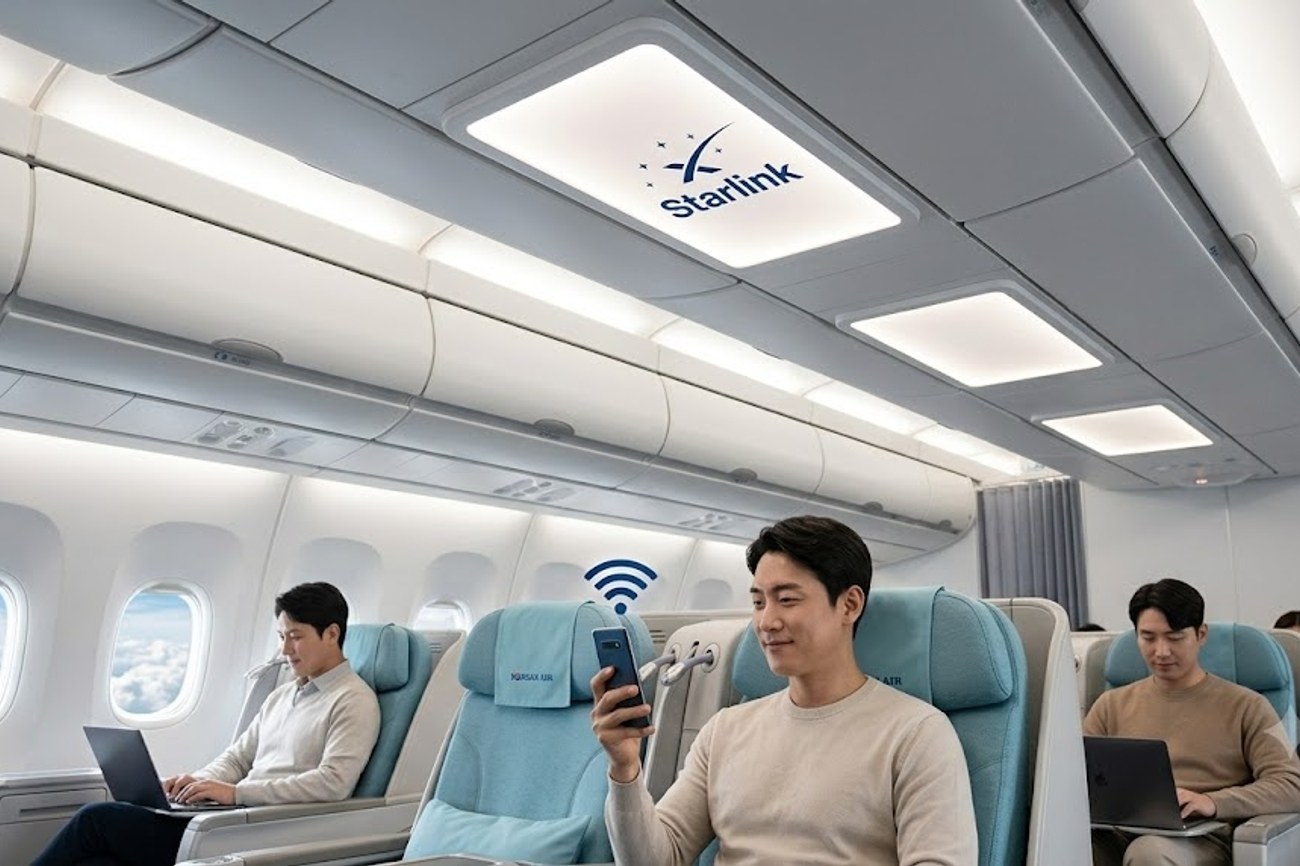
Image generated by AI
While international carriers have spent decades charging upwards of thirty dollars per sector for sluggish satellite connections that struggle to load a single webpage, South Korea's flag carrier has dismantled the inflight paywall entirely—activating free high-speed Starlink satellite internet across every cabin class, from First down to Economy, starting 15 September 2026. Following an official announcement on 11 September, Korean Air deployed the low-Earth-orbit network on an initial fleet of four wide-body aircraft, consisting of three Airbus A350-900s and one Boeing 777-300ER. Operating across major intercontinental corridors linking Seoul Incheon with the Americas, Europe, and Southeast Asia, the move represents a seismic shift in passenger experience. For travelers making the fourteen-hour crossing to East Asia, staying connected in the stratosphere is no longer an exorbitant corporate luxury, but an effortless extension of arriving in the world's most digitally integrated society.
High-Altitude Connectivity: Korean Air Launches Free Starlink Fleet Rollout
The introduction of low-Earth-orbit (LEO) satellite communications marks a decisive technical upgrade over older geostationary systems. Geostationary satellites orbit nearly 36,000 kilometers above the equator, creating latency delays that turn basic browsing and messaging into an exercise in patience. By contrast, the Starlink constellation operates in low-Earth orbit just hundreds of kilometers above the surface, delivering lower latency, higher bandwidth, and reliable connectivity even as aircraft transit high-latitude oceanic corridors.
The verified initial rollout centers on four modified aircraft: three Airbus A350-900s—representing 75 percent of the opening fleet—and one Boeing 777-300ER, making up the remaining 25 percent. These wide-body airframes are assigned to medium- and long-haul international rotations connecting Seoul with gateways across North America, Europe, and Southeast Asia, with occasional appearances on shorter regional sectors between long-haul schedules. Because installations are tied to specific airframe tail numbers rather than fixed route schedules, availability will expand gradually as the carrier works toward its official target of converting most of its operating fleet by the end of 2027. This technological modernization also supports preparations for a broader integrated airline operation planned after December 2026 as Korean Air completes its historic consolidation with Asiana Airlines.
Accessing the system is straightforward. Once aircraft reach cruising altitude, passengers place their smartphones, tablets, or laptops into flight mode, activate Wi-Fi, and join the onboard network portal. Logging in requires only the passenger's surname and seat number as printed on their boarding pass, followed by viewing a brief promotional message—no paid tiers, subscription accounts, or credit card entries required. The connection supports streaming music and video, reading online news, web browsing, instant messaging, cloud work tools, and casual gaming. To protect the collective peace of the cabin, voice calls, video chats, and live social media broadcasting remain strictly prohibited. The technological upgrade applies solely to onboard amenities; visa rules, passport requirements, and customs formalities for entering South Korea remain completely unchanged.
What Makes the Incheon and Seoul Travel Experience Different
Stepping off an aircraft at Seoul Incheon International Airport (ICN) immediately signals that you have arrived in an aviation hub designed with exceptional cultural care. Widely celebrated as one of the world's premier airports, Incheon functions as an active cultural showcase rather than a concrete transit barn. Travelers moving through Terminal 2 encounter daily recreations of historic Joseon-era royal walks, indoor pine-tree gardens filled with classical music, and traditional craft centers where international voyagers can try their hand at crafting Korean mulberry paper (hanji) free of charge.
When you emerge into the capital itself, Seoul presents an extraordinary dialogue between hyper-modern efficiency and deep antiquity. Within minutes of passing high-tech digital media façades in Gwanghwamun, you can enter the serene courtyard of Gyeongbokgung Palace or wander the pine-shaded paths of Changdeokgung Palace Complex, a protected treasure inscribed by the UNESCO World Heritage Centre. Here, the historic Biwon (Secret Garden) preserves centuries-old lotus ponds, tiered stone pavilions, and giant ginkgo trees that burst into gold each autumn.
What truly separates Seoul from other Asian megacities is its human scale. Behind colossal commercial avenues lie intricate neighborhood webs known as golmok (alleyways). In quarters like Ikseon-dong and Bukchon, centuries-old wooden hanok homes with curved ceramic tile roofs have been transformed into artisanal tea rooms, independent perfume laboratories, and quiet galleries. The transition from the high-tech cabin of an A350 to the aromatic warmth of a cedar-beamed teahouse reflects South Korea's unique gift: pioneering the future without abandoning the past.
Visitor Insider Tips
Navigating South Korea like a seasoned local requires adapting to distinct domestic digital platforms and traditional cultural protocols.
- Switch to Domestic Mapping Apps Immediately: Due to strict national security laws governing geospatial data, Google Maps does not provide turn-by-turn walking or driving navigation in South Korea. Before leaving the aircraft Wi-Fi, download Naver Map or KakaoMap. Both apps offer comprehensive English interfaces, real-time subway departure tracking, and doorway-level directions. Always save your hotel address in both English and Korean characters (Hangeul) to show taxi drivers.
- Ride the AREX Non-Stop Express into Seoul: From Incheon Terminal 1 or Terminal 2, bypass highway traffic by boarding the dedicated AREX Airport Railroad Express Train. The non-stop express delivers travelers directly into Seoul Station in precisely 43 minutes from Terminal 1 and 51 minutes from Terminal 2. Purchase a reusable T-money transit card at airport convenience stores for tap-and-go travel across all metropolitan subways, city buses, and local taxis.
- Dine Like a Local in 'Hipjiro' Alleys: Skip crowded tourist barbecue strips and head to Euljiro 3-ga, affectionately nicknamed "Hipjiro." By day, these narrow streets house vintage printing shops and metal fabrication workshops; by dusk, shop owners roll out plastic folding tables into the alleyways. Order crispy garlic chicken, dried pollack (nogari), and ice-cold draft beer, soaking in the energy of Seoul's creative youth and veteran artisans dining side by side.
- Master the Two-Handed Cultural Rule: In South Korea, daily social etiquette revolves around respect. Whenever handing over a credit card, receiving a transit ticket, pouring a drink, or greeting a host, use both hands or support your right wrist gently with your left hand. In traditional restaurants with raised wooden floor seating (ondol), always slip off your footwear at the sunken entry step before walking onto polished wooden floors.
- Prepare Essential Travel Documentation Offline: While Korean Air Starlink connectivity makes mid-flight planning easy, aircraft substitutions can occur at the gate. Always download offline copies of your approved K-ETA (Korea Electronic Travel Authorization), health declaration Q-Code, hotel confirmation, and travel insurance documents before boarding.
Cultural and Environmental Context
South Korea's transportation transformation reflects a broader national strategy that balances rapid digital modernization with ambitious environmental targets. Tourism campaigns curated by Visit Korea emphasize green transit networks that connect international gateways directly to regional eco-tourism hubs. Incheon Airport leads global aviation sustainability by operating extensive solar panel arrays, geothermal heating plants, and zero-emission electric aprons, while high-speed KTX electric bullet trains whisk travelers from Seoul to coastal Busan and historic Gyeongju in just over two hours.
Within Seoul itself, urban renewal has reclaimed industrial scars for community life. The restoration of the Cheonggyecheon stream dismantled an elevated concrete highway to bring a natural, fish-filled waterway right through the heart of the business district, significantly reducing the urban heat island effect. Nearby, the Seoullo 7017 sky garden converted an obsolete 1970s highway overpass into a walkable botanical walkway planted with over 24,000 Korean trees and shrubs.
At the community level, sustainable tourism also means protecting neighborhood peace. In historic residential districts like Bukchon Hanok Village, local municipal authorities have introduced designated visiting hours from 10:00 AM to 5:00 PM, banning late-night tour groups so that elderly multi-generational residents can enjoy evening tranquility. By traveling quietly through historic residential lanes, supporting family-run bunsik diners, and traveling across cities by electric rail, visitors contribute directly to preserving the delicate harmony that makes South Korea extraordinary.
FAQ: Flying to South Korea 2026
Which Korean Air flights feature free Starlink satellite WiFi?
The free service is currently active on four modified wide-body aircraft—three Airbus A350-900s and one Boeing 777-300ER—operating selected long-haul routes connecting Seoul with the Americas, Europe, and Southeast Asia.
Do travelers need to pay a fee or buy a subscription to connect?
No. Starlink WiFi is free for every passenger across all cabin classes. Travelers simply connect to the onboard portal, enter their surname and seat number from their boarding pass, and view a brief announcement.
Are voice or video calls allowed using onboard Starlink WiFi?
No. Voice over IP calls, video calling, and live social media streaming are strictly barred aboard all flights to preserve a restful and quiet cabin environment for fellow passengers.
What entry documents are required for tourists visiting South Korea in 2026?
Visitors must possess a passport valid for at least six months and an approved K-ETA (Korea Electronic Travel Authorization) or valid visa, applied for online at least 72 hours before departure.
[Ten thousand meters above the clouds or wandering the quiet stone alleys of a Joseon palace, South Korea proves that the future is brightest when grounded in timeless grace.]
Related Travel Guides
Disclaimer
This article is for informational and educational purposes only. It does not constitute legal, financial, or professional advice. While we strive to provide accurate and up-to-date information, travel policies, regulations, and conditions change rapidly. Always verify information with official sources before making travel decisions. Nomad Lawyer makes no representations about the accuracy, reliability, completeness, or suitability of the information provided. Readers should consult qualified professionals for advice specific to their circumstances. The views expressed in this article are those of the author and do not necessarily reflect the views of Nomad Lawyer.
Raushan Kumar
Founder & Lead Developer
Full-stack developer with 11+ years of experience and a passionate traveller. Raushan built Nomad Lawyer from the ground up with a vision to create the best travel and law experience on the web.
Learn more about our team →