
China County-Level Hotel Boom: Luxury and Branded Stays Expand to Rural Destinations in 2026
China's hospitality landscape is shifting as luxury and midscale hotel chains penetrate county-level markets, driven by a 22.6% surge in rural tourism and expanded high-speed rail connectivity.

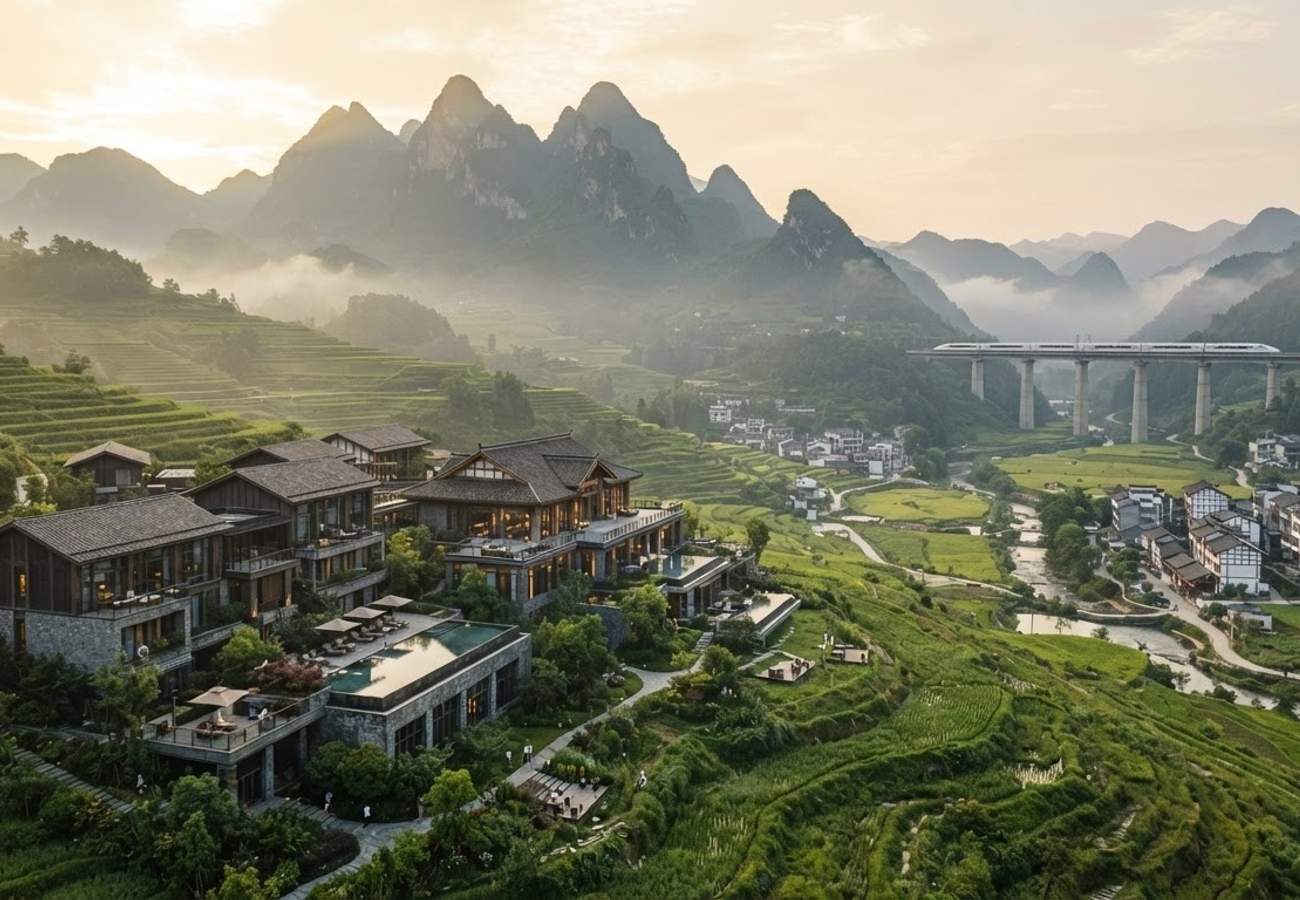
Image generated by AI
The center of gravity for Chinese hospitality is shifting away from Tier-1 metropolises. A massive surge in rural tourism and infrastructure investment is pushing international and domestic hotel brands into previously underserved county-level destinations.
The Rural Hospitality Pivot
For decades, China’s luxury accommodation was concentrated in economic hubs like Beijing, Shanghai, Guangzhou, and Shenzhen. While secondary cities eventually integrated into this network, county-level destinations remained the domain of independent guesthouses and small local properties.
Our analysis of current market data indicates a fundamental change in this hierarchy. Hotel groups no longer view lower-tier cities as peripheral, but as primary growth engines. According to the China Tourism Accommodation Industry Development Report 2025, international groups are aggressively targeting the county market. Notably, 30% of Marriott’s new hotel openings in China during 2024 were located in third-tier cities or lower.
This is not a blanket luxury rollout. Instead, we are seeing a strategic diffusion of branded midscale, upper-midscale, and select premium properties positioned near regional population centers and cultural attractions.
Tourism Growth and Spending Metrics
The expansion is driven by record-breaking domestic demand. In 2025, Chinese residents made 6.52 billion trips, representing a 16.2% increase over 2024. Total tourism spending reached 6.30 trillion yuan.
The data reveals a significant divergence between urban and rural travel patterns:
- Urban Residents: 5.00 billion domestic trips (up 14.3%).
- Rural Residents: 1.53 billion trips (up 22.6%).
- Spending Growth: Rural resident tourism spending rose by 21.4%, vastly outpacing the 7.5% increase seen among urban residents.
This shift indicates that travelers are moving beyond traditional urban landmarks to seek heritage towns, mountain retreats, and rural landscapes. For operators, this means a county with high visitor flow is now a viable market regardless of its business-center status.
Infrastructure as a Catalyst for Overnight Stays
The viability of county-level hotels is inextricably linked to China's transport evolution. By the end of 2025, the national high-speed railway mileage exceeded 50,000 kilometers, with total operating railway mileage reaching approximately 165,000 kilometers.
According to the National Railway Administration, the system carried 46.01 billion passenger trips in 2025, a 6.7% increase. This was supported by a railway fixed-asset investment of 901.5 billion yuan.
Reduced friction between major cities and remote counties has transformed "day-trip" locations into "weekend-stay" destinations. The economic model has shifted from relying on local urban density to leveraging visitor circulation.
Market Penetration and Brand Performance
The transition from independent to branded accommodation is evident in the aggressive expansion of both domestic and international players:
- H World Group: Opened its 10,000th China property in Metok county, Xizang, in 2024. By Q2 2024, 41% of its operating hotels were in third-tier and lower cities.
- Jin Jiang Hotels: Established over 2,800 outlets in cities below the third tier.
- Hilton: Launched Home2 Suites by Hilton in Shitai county, Anhui, in September 2025, signaling the move of select-service international concepts into rural areas.
Overall, China had approximately 8.4 million midscale-and-above hotel rooms by the end of 2025. The competitive nature of this expansion is highlighted by the fact that 1,887 midscale-and-above hotels changed brands during 2025, affecting 184,000 rooms across 275 cities.
Passenger & Traveler Advisory: Navigating Rural China
For the traveler venturing into China's emerging county-level destinations, this shift provides significantly more predictability.
What this means for your stay:
- Standardization: The rise of branded hotels means you can expect consistent room standards, professional front-desk service, and dependable connectivity, even in remote areas.
- Booking Reliability: Using established domestic chains or international brands reduces the risk associated with independent properties that may have limited English-language information or inconsistent booking confirmations.
- Integrated Experiences: Many new county-level properties are adopting "stay-led development," where the hotel serves as the primary attraction, offering regional cuisine and wellness facilities.
Our analysis suggests that travelers should prioritize branded properties in these regions to ensure operational consistency, particularly regarding hygiene and safety standards, which can vary wildly in independent rural guesthouses.
The "county boom" represents a maturation of the Chinese domestic market. By converting day-trippers into overnight guests, these destinations are building longer economic relationships with visitors. With 16,994 A-rated tourist attractions receiving 7.51 billion visits in 2025, the volume of traffic is immense.
However, the high rate of brand switching (1,887 hotels in one year) suggests a volatile environment. Developers are struggling to find the right brand-market fit, and oversupply in certain rural corridors could lead to significant price wars.
The rural frontier is the new battleground for global hospitality giants.
Related Travel Guides
Disclaimer
This article is for informational and educational purposes only. It does not constitute legal, financial, or professional advice. While we strive to provide accurate and up-to-date information, travel policies, regulations, and conditions change rapidly. Always verify information with official sources before making travel decisions. Nomad Lawyer makes no representations about the accuracy, reliability, completeness, or suitability of the information provided. Readers should consult qualified professionals for advice specific to their circumstances. The views expressed in this article are those of the author and do not necessarily reflect the views of Nomad Lawyer.
Kunal K Choudhary
Co-Founder & Contributor
A passionate traveller and tech enthusiast. Kunal contributes to the vision and growth of Nomad Lawyer, bringing fresh perspectives and driving the community forward.
Learn more about our team →